OVERVIEW
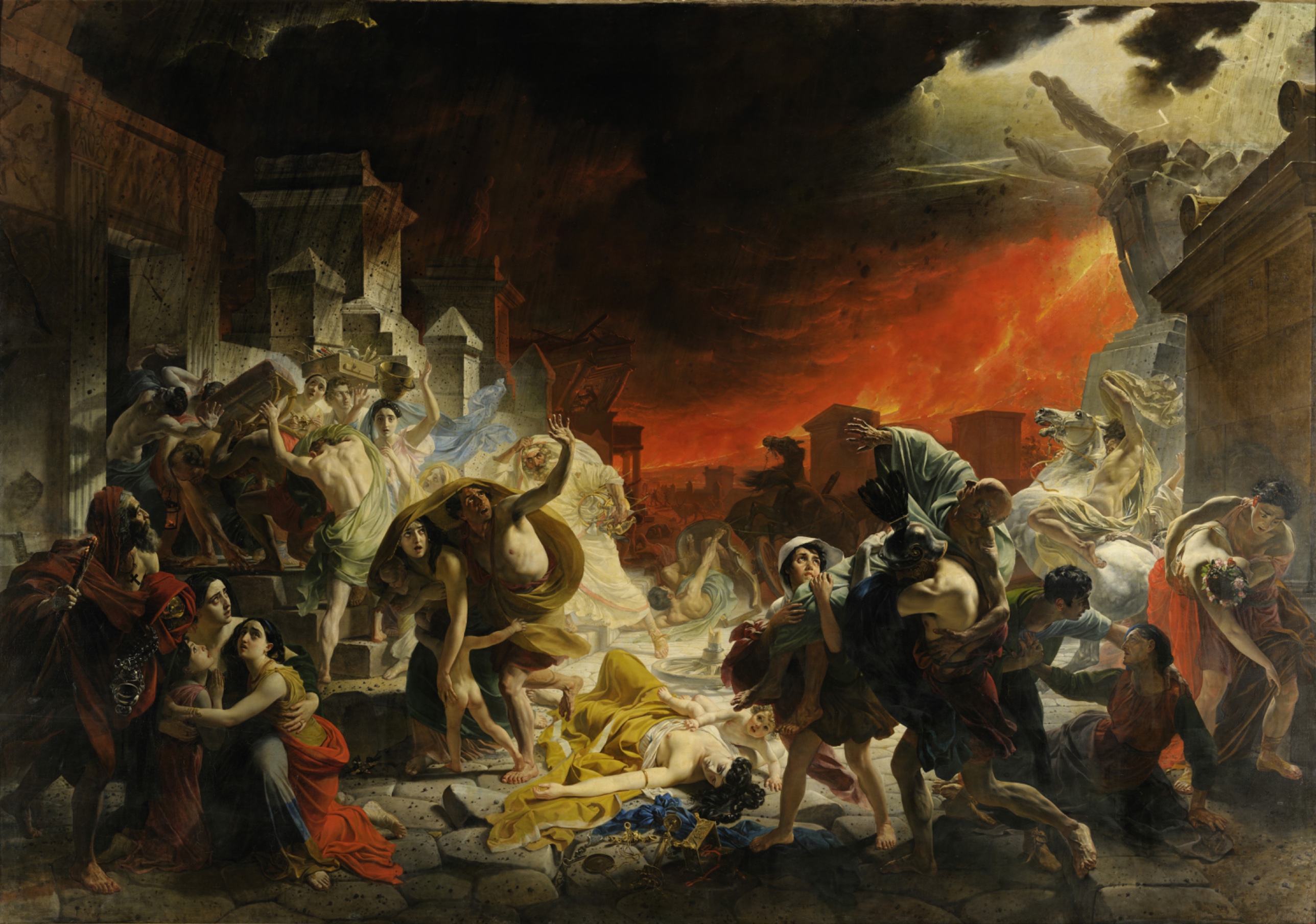
The perceptual and material domains agree with each other almost completely. The eye drops onto the fallen woman's horizontal body, gets pulled upward into smoke, and snaps back down to flesh and gold; the paint handling builds that same hierarchy stroke by stroke, tight and polished where the eye is meant to land, loose and blurred where it is meant to let go. Light Source Logic, Color Temperature, and Value Structure/Massing do the work of organizing attention in the first seconds, and the brushwork (smooth flesh, scumbled smoke) confirms that organization at close range. Material handling stabilizes the perceptual read rather than complicating it.
The cultural and conceptual domains pull against each other more than they align. Culturally, this is a work built to be legible to a European Salon and academic audience: grand multi-figure history painting, classical pose vocabulary, moral subject matter, scaled to compete with the biggest canvases in Paris and Rome. Conceptually, the work wants to argue something about human dignity and family bond persisting under catastrophe, filial piety literalized in the son carrying his father. But the perceptual evidence shows the bodies staying idealized, polished, and composed even in death and collapse. The pale fallen woman's skin is rendered with the same unbroken academic smoothness as a studio nude. That tension, sublime catastrophe argued through bodies that refuse to look catastrophized, is not resolved anywhere in the painting's own material choices.
The live question the work sits inside: whether a disaster argued through classically beautiful, undamaged bodies is making a claim about dignity under destruction, or simply converting destruction into spectacle the academy already knew how to sell.
CULTURAL
Brullov painted this between 1830 and 1833, working in Rome before sending it to St. Petersburg, and it entered the European conversation as a demonstration piece: a Russian artist proving he could build a history painting on the scale and with the ambition of the French and Italian academies. The canvas is enormous, nearly fifteen feet tall and over twenty-one feet wide, built explicitly to stand beside the grand machine paintings of the Salon tradition. One reading of where this lands institutionally is as a national prestige object. It became a centerpiece of what the State Russian Museum now holds up as proof that Russian painting could meet Western European academic painting on its own terms, multi-figure composition, classical anatomy, moral narrative, all deployed at Salon scale.
The audience it is built to reach is legible on its face: academy juries, court patrons, and Salon critics trained to read figure grouping, pose quotation, and narrative hierarchy as the markers of serious ambition. Pompeii as subject matter sits inside a live European fascination with the excavated city, archaeology and catastrophe both newly fashionable. The painting is not departing from the cultural conditions around it. It is meeting them directly, almost aggressively, positioning itself inside the existing taste for Romantic disaster subjects (Gericault's raft, later Delacroix's massacres) while keeping the figure drawing conservative and legible in a way those painters were already pushing past.
A possible reading some critics have taken is that the painting reads as backward-looking even at the moment of its making, an academic synthesis rather than a genuine Romantic departure, borrowing the sublime subject of catastrophe without letting the figures themselves destabilize. If that reading holds, the painting's cultural position is secure and institutional rather than contested: valued for technical ambition and scale, not for formal risk.
CONCEPTUAL
Hypothesis (insufficient visual evidence): the painting argues that natural catastrophe is a divine judgment visited on Pompeii specifically for its vice. The visual record shows no attribute that confirms this beyond a general crowd-in-peril subject, so this reading cannot be anchored to observation.
A better-anchored reading draws on two observable features: the son carrying his father on his back, and the family and rescue clusters repeated across the crowd (mother-and-child, flight pairs at right). Together these support a reading that the painting argues for human bonds, parental care, filial duty, maternal protection, persisting as the one stable value when architecture, geology, and empire all fail. This is the oldest argument available to history painting: virtue tested and confirmed by disaster, descending from the Aeneas-carrying-Anchises tradition Brullov is visibly quoting in the father-on-back figure.
The painting's problem, visible in its own handling, is that the bodies making this argument never actually look endangered. Sharp, continuous contours and smooth, blended flesh paint give every foreground figure a classical calm that collapsing cities don't produce. If the argument is that human dignity survives catastrophe, the execution agrees almost too literally: dignity here means never losing academic polish, even collapsing, even dead. The conceptual position, that virtue is unbroken by disaster, is supported by a formal choice (unbroken, idealized contour) that was already in place before the disaster subject was chosen. The painting may be less an argument about catastrophe than a demonstration of academic figure drawing using catastrophe as pretext. Both readings are available in the same canvas, and nothing in the handling tells the viewer which one Brullov intended to win.
PERCEPTUAL
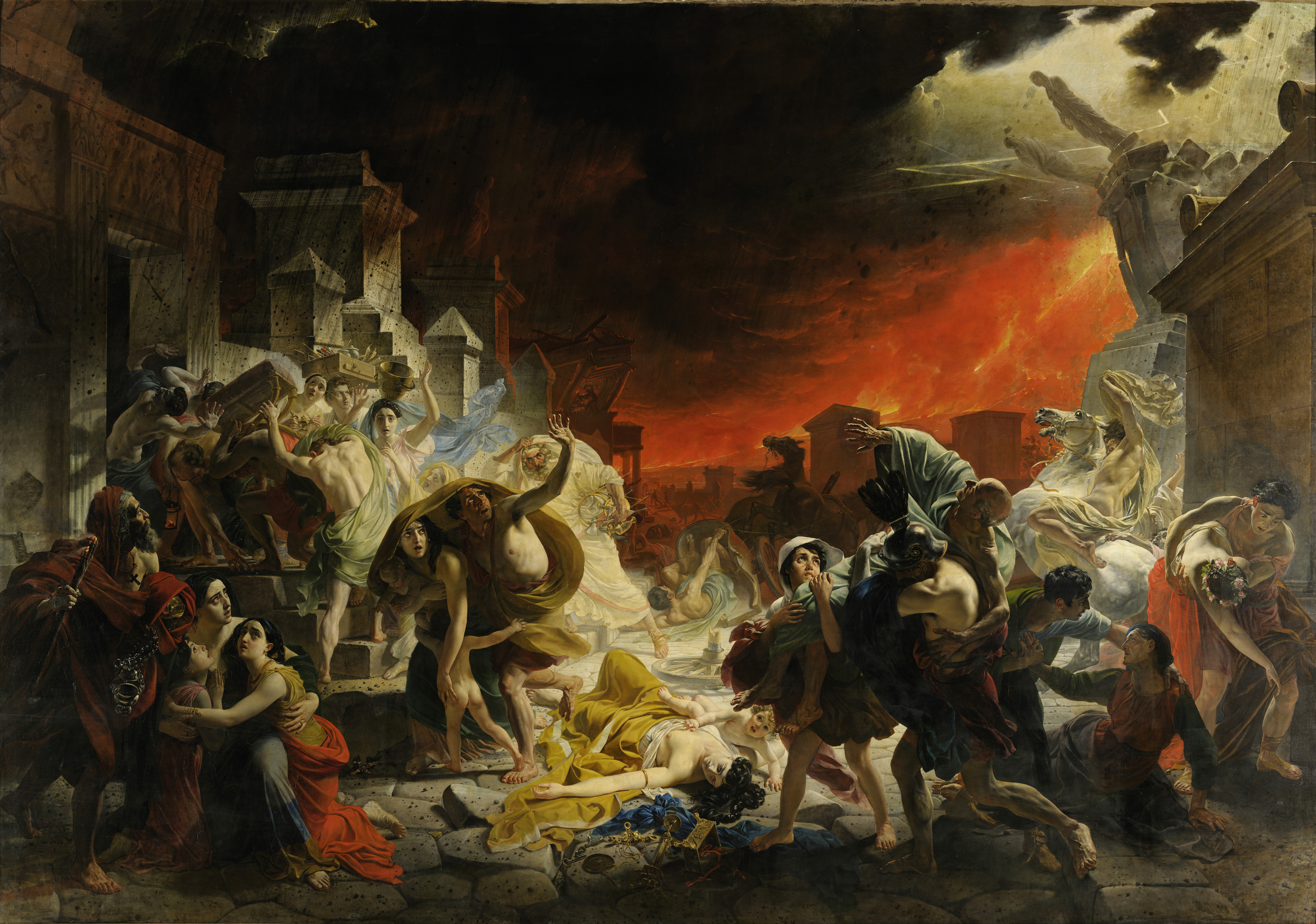
Standing in front of this canvas, the eye drops first to the pale, horizontal body of the woman in the yellow robe, the one still thing in a field of falling stone and running bodies. From there it gets dragged backward and up into black smoke pressing down against red fire, then yanked forward again by a white horse rearing against that darkness. The experience is less like looking at a scene than being caught between one quiet body and a sky that seems to be falling toward you.
WHAT HITS YOU FIRST
- Light Source Logic [A]: strength 3
- The fallen woman's skin reads brighter than anything around her because two competing lights, warm fire-glow from the right background and a paler cold light from the left sky, both claim her body as their target.
- Overlap/Occlusion [A]: strength 3
- Interlocking limbs, the child draped over the dead mother, the father slung across his son's shoulders, stack the crowd into one legible mass before any single figure gets read individually.
- Postural Affect [A]: strength 3
- The horizontal collapse of the yellow-robed woman against the straining uprightness of the horse and the carrying son reads as death against continued effort before a single face is examined.
- Visual Pop-out / Pre-attentive Features [A]: strength 3
- The white horse rearing against dark smoke, and the hard glints off gold vessels and jewelry near the fallen woman, jump out instantly against the matte earth tones surrounding them.
- Color Temperature [B]: strength 3
- Orange-red fire pushes forward optically while black smoke recedes, splitting the canvas into an advancing lower register and a retreating upper one almost immediately.
- Complexity and Visual Density [B]: strength 3
- Bodies, drapery, architecture, and falling stone pack the lower two-thirds of the canvas with no resting gap, and that density is itself the first thing felt.
- Directional Force/Implied Movement [B]: strength 3
- The horse's rearing diagonal, the father-on-back pose, and the collapsing statues point along conflicting diagonals that cross near center, generating visible push before any vector is traced.
- Value Structure/Massing [B]: strength 3
- A dark upper mass of smoke presses down on a lit lower mass of flesh and stone, and that two-part split is legible from across a room.
WHAT HOLDS YOU THERE
- Agency Attribution [A]: strength 2
- The son carrying his father reads as rescue in progress, though which figures are saving whom versus merely clustered together stays unresolved on a longer look.
- Biological Motion Detection [A]: strength 2
- The horse's bent legs and arched neck register as a living creature mid-strain, distinct from the static stone figures toppling beside it.
- Common Fate [A]: strength 2
- Figures fleeing toward the lower right and statues falling above them read as one event moving together, despite occupying different depths.
- Face Detection [A]: strength 2
- Faces scattered through the crowd pull the eye into a search pattern once the main horizontal and vertical structure has been read.
- Figure-Ground Relationships [A]: strength 2
- The sharply lit foreground cluster reads as figure against the smoke-dissolved architecture as ground, though that boundary blurs at the crowd's edges.
- Gaze Direction / Social Attention [A]: strength 2
- Some figures look outward at the viewer and others look up at the sky, splitting attention between the event's witnesses and the event itself.
- Grouping [A]: strength 2
- Bodies cluster into discrete family and rescue units, mother-and-child, father-and-son, rather than reading as one undifferentiated mob.
- Linear Perspective [A]: strength 2
- Steps, columns, and tombs on the left recede along converging lines, the only clean spatial recession in a canvas otherwise built from stacked overlap.
- Simultaneous Contrast [A]: strength 2
- Small cool blue-green veils and cloth read sharper and colder than they would in isolation, surrounded as they are by ochre and terracotta.
- Anchoring and Reference Points [B]: strength 2
- The fallen woman's horizontal body is the fixed reference point against which every diagonal and vertical in the crowd gets measured.
- Color Weight and Advancement [B]: strength 2
- The orange-red fire zone carries more visual weight than its size alone predicts, pulling the eye back toward the middle distance repeatedly.
- Cropping/Framing [B]: strength 2
- Figures at the right edge appear mid-exit, implying the catastrophe and the crowd both continue past the canvas edge.
- Embodied Simulation [B]: strength 2
- The strain in the son's bent knees carrying his father produces a felt sense of muscular effort in the viewer's own body.
- Scale Relationships [B]: strength 2
- Life-sized foreground bodies shrink to silhouette scale in the smoke-filled middle distance, measuring the crowd's depth in bodies rather than architecture.
- Unity vs Variety Tension [B]: strength 2
- A single palette of ochre and terracotta unifies wildly different poses and incidents into one readable event.
- Visual Tension [B]: strength 2
- The rearing horse's diagonal stays visually unresolved, hooves not yet settled, holding the eye in suspension.
- Visual Weight/Balance [B]: strength 2
- The dense crowd and falling masonry on the right are balanced against the open diagonal recession of architecture on the left.
- Color Harmony Systems [C]: strength 2
- The earth-tone dominant scheme with cool accent notes reads as a deliberately restricted harmony rather than a naturalistic record of mixed light.
- Empathic Resonance [C]: strength 2
- The child reaching across its dead mother is the point where the picture most directly asks for an emotional rather than formal response.
- Implied Time/Narrative Sequence [C]: strength 2
- Toppling statues, an already-dead mother, and a still-fleeing crowd place the viewer at a single frozen instant containing both the collapse and its aftermath.
WHAT SURFACES ON A LONGER LOOK
- Elevation in Picture Plane [A]: strength 1
- Figures placed higher in the frame, the toppling statues and the horse's raised head, read as more endangered than the grounded foreground bodies.
- Binocular vs Monocular Depth Cues [A]: strength 1
- Occlusion and diminishing scale do the depth work; once the smoke erases the architecture there is little left to confirm distance, and readings of how deep the space actually goes disagree.
- Embodied Perspective / Eye-Level Effects [B]: strength 1
- The viewer's eye-level sits roughly with the standing and fleeing figures, placing the viewer inside the crowd rather than above it.
- Interval Relationships [B]: strength 1
- Gaps between figure clusters stay nearly uniform and narrow, reinforcing a crowd with no room left to move.
- Pattern Completion/Closure [B]: strength 1
- Bodies partially hidden behind others get filled in as complete figures even where limbs disappear behind drapery.
- Peak Shift / Supernormal Stimuli [B]: strength 1
- The horse's arched neck and wide eye exaggerate equine fear past what a calm animal reference would show.
- Rhythm and Repetition [B]: strength 1
- Repeated diagonal poses, falling, carrying, fleeing, set up a visual beat across the crowd that one figure alone wouldn't produce.
- Symmetry/Asymmetry [B]: strength 1
- The composition weights heavily toward the right-hand crowd and horse, countered only by the architectural recession on the left.
- Simultaneity vs Sequence [C]: strength 1
- The frozen instant implies several stages of the disaster, falling stone, fleeing bodies, the already dead, compressed into one simultaneous view.
Beyond what the principles name, the eye is doing something closer to triage. It keeps returning to the fallen woman because she is the only figure not asking it to do anything, everyone else is mid-action, mid-gaze, mid-fall. That stillness is what lets the eye rest long enough to notice the jewelry, the child's hand, the gold bowl, before the smoke and the horse pull it back out into the crowd's noise. The painting is asking the viewer to hold two incompatible jobs at once: read one body slowly, and scan a crowd quickly. It does not resolve that conflict. It alternates the viewer between them.
MATERIAL AND FORMAL
Up close, the flesh and drapery are worked to a porcelain smoothness, no visible brush mark, the paint licked flat. The smoke and fire passages are handled completely differently: visibly dragged, scumbled, built with a drier, looser touch. From across the room the canvas is wall-sized, taller than a door and wider than two cars end to end, and the scale forces a physical confrontation with bodies rendered close to life size.
WHAT HOLDS YOU THERE
- Atmospheric Perspective [A]: strength 2
- Brushwork loosens and edges blur into smoke exactly where the architecture recedes, the paint handling performing the distance rather than just describing it.
- Color Opponent Channels [A]: strength 2
- The small cool blue-green cloth passages are mixed as distinct pigment notes rather than optical blends, holding their chill against the surrounding warm paint instead of muddying into it.
- Edge Detection [A]: strength 2
- Muscle contours and drapery folds on foreground figures carry a hard, continuous line, while the smoke's edges never resolve into a line at all.
- Specularity/Surface Reflection [A]: strength 2
- The gold bowl and jewelry near the fallen woman carry tight, bright highlights laid on with a loaded brush, standing out against an otherwise matte paint film.
- Contour Quality [B]: strength 2
- The firmness of the foreground contours against the dissolved contours of the distant crowd is a handling decision, not only a subject one.
- Detail Density Gradient [B]: strength 2
- Jewelry, hair, and fabric texture render at high resolution in front, falling off to flat silhouette within a few feet of pictured space.
- Local vs Atmospheric Color [B]: strength 2
- The yellow robe keeps its local hue under both fire and sky light, while the distant crowd loses local color entirely into the smoke's gray-brown cast.
- Saturation [B]: strength 2
- The fire's orange-red is the most saturated passage on the canvas, and that saturation is what keeps a nominally distant background from reading as fully receded.
- Texture [B]: strength 2
- Flesh and drapery are built with smooth, blended paint while the smoke and fire areas show visible, drier brush drag, a legible material contrast at close range.
WHAT SURFACES ON A LONGER LOOK
- Closure/Negative Space [A]: strength 1
- The dark smoke mass left unresolved at the canvas's top edge reads as solid volume rather than empty sky, because nothing in it offers a boundary to complete.
- Focal Blur/Depth of Field [B]: strength 1
- Distant architecture and crowd go soft in a way that mimics optical blur, though the mechanism is paint handling rather than an actual depth-of-field effect.
- Transparency/Opacity [B]: strength 1
- Smoke is built with thinner, more translucent paint than the opaque, built-up flesh passages, a material distinction that reads as atmosphere set against substance.
What the hand did here is maintain two separate painting disciplines on one canvas: an academic, studio-trained finish for the bodies, and a looser, almost sketch-like handling for the uncontrollable elements, smoke, fire, falling dust. That split is consistent across the whole canvas, which argues it was a deliberate hierarchy rather than an inconsistency in finishing time. The surface is honest about this hierarchy at close range, where the difference in brush drag is obvious, but from across the room it reads as a single smooth illusion, the loose passages still cohering into solid-looking smoke. The material choice supports the perceptual effect of catastrophe pressing down on composed human order, but it also means the figures are never physically painted as if they were themselves disordered by the disaster they are living through.
NOISE: CONSOLIDATED
PERCEPTUAL: The two light sources, warm fire-glow and cool sky-light, compete for the job of explaining why the foreground figures are lit, and the Pass 1 record itself is split on which one actually dominates. That ambiguity means no single scan path through the lighting logic is fully stable; the eye is working from an input that contradicts itself about where the brightest light is actually coming from.
MATERIAL: The academic smoothness of the flesh passages fights against the subject matter's claim to raw catastrophe. A surface that never roughens, even on bodies supposedly caught in falling ash and fire, works against a reading of documentary urgency, even as it supports the composition's clean hierarchy of attention.
CULTURAL