OVERVIEW
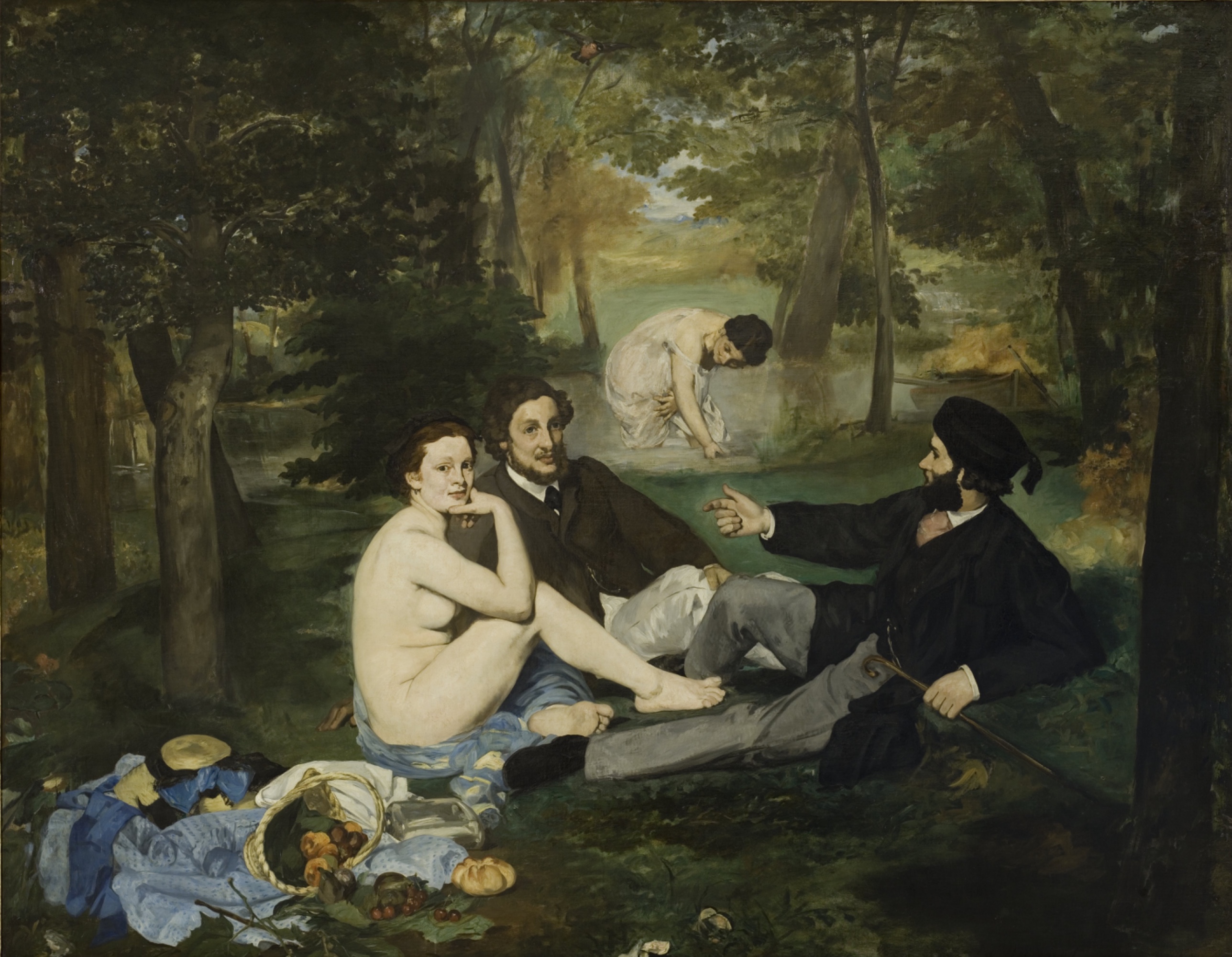
The perceptual and material findings agree with each other almost entirely. The eye snaps to the nude body because of value contrast; the paint confirms it, laid flat and bright with almost no internal modeling. Edge quality does the same double duty: sharp against the coat, soft into the foliage, and that's true both as an optical event and as a brushwork event. The picture is unusually honest about how it produces its own first impression.
The cultural and conceptual domains pull against that stability. The perceptual read says: this composition works, it organizes attention efficiently, the eye knows where to go and what to do once it gets there. The cultural and conceptual reads say: this composition was built to violate the terms under which paintings like it were supposed to succeed. A nude that looks back is not a formal event, it's a social one, and it breaks the contract of the pastoral-nude genre it borrows its structure from. So the same gaze that the perceptual system praises as a clean anchor point is, in the cultural register, an act of insubordination.
There is also friction inside the perceptual/material pairing itself, smaller but real. The picture asks the eye to read depth through overlap and occlusion, and does that job well in the foreground. Then the background bather breaks the depth logic the foreground just established, at a scale that reads as spatially inconsistent. The material handling doesn't fix this. It confirms it: the background is looser, less resolved, painted with less conviction, as if the artist stopped solving that problem once the foreground body was settled.
The live question the work sits inside: whether a painting can use the machinery of harmonious looking, sharp edges, occlusion, a still life rendered with care, to deliver a subject built to refuse harmony, and whether those two things ever fully reconcile inside the same canvas.
CULTURAL
This work enters the conversation around the Salon nude and immediately declines its terms. The nineteenth-century Salon nude asks for mythological alibi: goddesses, nymphs, allegory, something to keep the naked body at a narrative distance from the room it hangs in. This painting gives none of that. The woman's direct gaze out of the canvas, noted across the Pass 1 record even where the model families disagree on its exact reading, removes the alibi. She isn't caught. She's looking back. One reading of where this lands institutionally: it belongs to the history of the Salon des Refusés, 1863, the exhibition built specifically to house work the official Salon rejected, and it becomes a founding document of an alternative institutional path, the one that eventually produces Impressionism and the independent exhibition as a legitimate venue.
The clothed men beside a nude woman, a composition drawing on Renaissance precedent, particularly Giorgione and Titian, signals fluency with the tradition it's rejecting. It isn't a naive break. It quotes the old structure and repopulates it with contemporary Parisian dress. That specific move, the frock coats against the nude flesh, would be legible to an audience trained in academic painting as a citation with the wrong furniture in it. To a general public in 1863, without that training, the coats might simply read as scandalous, undignified, or crude, which was in fact the received reaction on record for this painting historically.
The still life at lower left, rendered with tighter, more careful brushwork than the surrounding foliage, might also read as a claim of seriousness aimed specifically at the academic community: a demonstration that this artist can paint with Salon-level control when he chooses to, so the looseness elsewhere in the canvas is a decision, not an incapacity. Whether that reads as respect for the tradition or provocation against it is not settled by the image alone.
CONCEPTUAL
The work is in dialogue with the pastoral nude tradition and with the emerging argument, becoming central to French painting in this decade, that a picture's subject need not justify its own making. The nude's stare, combined with the modern dress on the men and the abrupt unmodulated light across her body (all stable Pass 1 observations), reads as an argument that the female nude can be presented as a contemporary fact rather than a mythological pretext. That's a position about what painting is allowed to depict and how.
A second argument sits underneath the first, about painting's own procedures. The value structure organizes the canvas into flat masses rather than graduated tone; the hard contour where flesh meets coat refuses the soft transitional edges that academic modeling requires; the background bather is scaled in a way that breaks strict spatial logic. Taken together, these choices can be read as an argument that internal consistency, of light, of scale, of perspective, is not the price a painting has to pay for coherence. The still life proves the artist can produce academic finish. The rest of the canvas proves he's choosing not to, everywhere except where it suits him.
The historical precedent that matters most here is Marcantonio Raimondi's engraving after Raphael, source of the group's pose, and Titian's Pastoral Concert, source of the clothed-men-nude-woman structure. Reading this work without that lineage in mind makes the composition look like a compositional accident. Reading it with that lineage in mind makes clear the argument is built on precise citation, not improvisation.
PERCEPTUAL
Standing in front of this canvas, the eye goes straight to the pale body in the clearing before it registers anything else in the scene. The dark coats and woodland around her don't compete for attention; they sink. Only after the body is settled does the eye start doing the work of sorting who these people are and what they're doing together.
WHAT HITS YOU FIRST
- Face Detection [A]: strength 3
- The pointing man's face, and the nude's face turned toward the viewer, both pull the eye toward them ahead of anything else with a face-like structure in the canvas.
- Figure-Ground Relationships [A]: strength 3
- The nude reads as a solid, separate form popped forward of the woodland behind her, with almost no value bridge connecting figure to ground.
- Gaze Direction / Social Attention [A]: strength 3
- The nude's straight-out stare breaks from every other figure's averted gaze, making her the one point in the canvas that returns attention rather than absorbing it.
- Light Source Logic [A]: strength 3
- The flat, frontal wash across the nude's torso, with minimal shadow modeling, is the first thing that registers as physically strange once the eye lingers.
- Overlap/Occlusion [A]: strength 3
- Crossed legs, overlapping arms, and bodies stacked against each other establish who is in front of whom before any perspective cue does.
- Visual Pop-out / Pre-attentive Features [A]: strength 3
- The nude's pale skin against dark greens and blacks functions as an immediate, involuntary target for the eye, no scanning required.
- Scale Relationships [B]: strength 3
- The compressed or oversized background bather registers, almost immediately, as a size that doesn't match her supposed distance from the group.
- Value Structure/Massing [B]: strength 3
- The canvas organizes into two big value zones, dark clothing and woodland against pale flesh and linen, with almost nothing in between.
WHAT HOLDS YOU THERE
- Agency Attribution [A]: strength 2
- The extended arm and pointing finger of the man on the right reads as mid-sentence, holding the eye on the exchange between the two men.
- Atmospheric Perspective [A]: strength 2
- The trees keep their saturation and contrast into the depth of the canvas, so distance doesn't dim them the way the eye expects.
- Color Opponent Channels [A]: strength 2
- The warm flesh tone against the cool dark green ground sharpens the nude's presence past what value contrast alone would produce.
- Edge Detection [A]: strength 2
- The hard line where pale skin meets the dark coat keeps snapping the eye back to that single boundary each time it drifts.
- Elevation in Picture Plane [A]: strength 2
- The bather's higher placement in the canvas keeps her read as farther away even while her scale argues against it.
- Grouping [A]: strength 2
- The three foreground figures cluster into one visual unit through proximity and overlap, separate from the isolated bather.
- Postural Affect [A]: strength 2
- The nude's relaxed, open pose against the men's upright, engaged posture reads as a difference in what each figure is doing there.
- Anchoring and Reference Points [B]: strength 2
- The nude's body functions as the fixed point the eye keeps returning to after checking the still life or the background.
- Color Temperature [B]: strength 2
- The warm skin and warm fruit accents sit against a cool, dark woodland, keeping the warm elements forward in the visual field.
- Color Weight and Advancement [B]: strength 2
- The saturated orange and red of the spilled fruit carries enough visual weight to compete briefly with the nude for attention.
- Contour Quality [B]: strength 2
- The alternation between the nude's hard outline and the dissolving edges of the leaves sets up a rhythm the eye tracks across the canvas.
- Detail Density Gradient [B]: strength 2
- The tightly rendered still life pulls the eye down into the lower left corner after the initial scan of the figures.
- Saturation [B]: strength 2
- The blue cloth and red fruit register as small, isolated bursts of saturation in an otherwise muted field.
- Texture [B]: strength 2
- The one glint of specular highlight on the glass or metal vessel in the still life catches the eye as the single hard reflective note in a matte painting.
- Visual Tension [B]: strength 2
- The nude's calm stare against the men's absorbed conversation creates a small unresolved friction every time the eye moves between them.
- Visual Weight/Balance [B]: strength 2
- The pale nude on one side and the dark clustered men on the other balance the canvas without symmetry, through value alone.
WHAT SURFACES ON A LONGER LOOK
- Biological Motion Detection [A]: strength 1
- The bather's wading posture in the distance eventually reads as a body in motion, though it takes longer to parse than the seated figures.
- Linear Perspective [A]: strength 1
- There's barely any converging line to find, and once you look for it, its absence becomes noticeable.
- Simultaneous Contrast [A]: strength 1
- The nude's skin looks warmer and brighter than it would in isolation, an effect that becomes explicit only once you compare it mentally to the dark ground around it.
- Specularity/Surface Reflection [A]: strength 1
- The single glinting vessel in the still life stands out more the longer you look, precisely because nothing else in the canvas reflects light that way.
- Complexity and Visual Density [B]: strength 1
- The lower-left still life turns out to be more crowded with small objects than the initial glance suggested.
- Cropping/Framing [B]: strength 1
- The canopy gap holding the small bird becomes noticeable only after the eye has exhausted the ground-level incident.
- Directional Force/Implied Movement [B]: strength 1
- The pointing arm's direction eventually reads as a vector pushing the eye toward the central man's face.
- Embodied Perspective / Eye-Level Effects [B]: strength 1
- The viewer's implied eye level, roughly level with the seated group, becomes apparent only after settling into the scene.
- Embodied Simulation [B]: strength 1
- The reclining postures of the men start to suggest a felt sense of ease in the body, a slower read than the initial figure recognition.
- Focal Blur/Depth of Field [B]: strength 1
- The soft, undifferentiated background foliage starts to read as a depth-of-field effect only once compared directly to the sharp foreground.
- Local vs. Atmospheric Color [B]: strength 1
- The distant trees keeping local color rather than fading into blue-gray becomes a noticeable oddity on return visits to the same passage.
- Optical vs. Physical Color Mixing [B]: strength 1
- Passages of foliage color that could read as either mixed pigment or optical blending only resolve as a question on close, repeated looking.
- Peak Shift / Supernormal Stimuli [B]: strength 1
- The nude's brightness is pushed past what ordinary skin tone contrast would produce, an exaggeration that only registers as exaggeration on reflection.
- Rhythm and Repetition [B]: strength 1
- The repeated dark-light-dark alternation across the canvas, coat, flesh, coat, becomes apparent as a pattern only after several passes.
- Symmetry/Asymmetry [B]: strength 1
- The composition's near-balance without true symmetry becomes clear only once you try to draw a center line through it.
- Transparency/Opacity [B]: strength 1
- The water around the bather reads ambiguously between transparent and opaque, a detail that surfaces only on close inspection.
- Unity vs. Variety Tension [B]: strength 1
- The tension between the tight still life and the loose canopy becomes a conscious observation only after noticing the detail density gradient itself.
- Color Harmony Systems [C]: strength 1
- The muted green-brown-flesh palette starts to read as a considered scheme only after the initial shock of the nude's brightness settles.
- Economy of Means [C]: strength 1
- The sparseness of incident outside the main figure group becomes apparent only once the eye has finished cataloguing the group itself.
- Empathic Resonance [C]: strength 1
- A felt sense of the nude's ease or exposure surfaces slowly, well after the initial optical shock of her brightness.
- Implied Time/Narrative Sequence [C]: strength 1
- The suggestion of a meal in progress, interrupted or paused, only comes into focus once the still life and the men's gestures are read together.
What the picture is really doing, underneath the principle list, is running two separate errands through the same eye movement. One errand is optical: get you to the brightest shape fastest, hold you on its hard edge, let the soft woodland fall away. The other is social: once you're there, make you deal with the fact that the shape is looking at you. Those two errands don't conflict, they're sequential, which is why the painting feels immediate and then feels uncomfortable a half-second later, rather than both at once. The still life is doing a third job entirely, unrelated to the figures: it's the one passage in the canvas rewarding close, patient looking, and it sits far enough from the emotional center of the picture that most viewers reach it last.
MATERIAL AND FORMAL
Up close, the canvas alternates between passages built with real care, tight, controlled brushwork in the fruit, the bread, the folds of blue cloth, and passages that look almost abandoned, the canopy laid in with loose, unresolved strokes that don't describe individual leaves. From across the room those differences collapse into a single confident image; the looseness reads as woodland shadow rather than unfinished paint. The paint itself sits mostly matte across the canvas, flat and dry-looking, except for one small glint of reflected light on a glass or metal vessel in the still life, the only place the surface behaves like a mirror rather than a skin.
WHAT HITS YOU FIRST
- Value Structure/Massing [B]: strength 3
- The paint is laid in broad, largely undifferentiated masses, dark coat, dark ground, pale body, with almost no worked transition between them.
WHAT HOLDS YOU THERE
- Edge Detection [A]: strength 2
- The border between painted flesh and painted coat is a single hard line, evidently drawn with intention rather than blended wet-into-wet.
- Detail Density Gradient [B]: strength 2
- The still life's brushwork is noticeably tighter and more resolved than the canopy's, a visible difference in how much time and control went into each passage.
- Contour Quality [B]: strength 2
- The nude's outline is drawn firm and continuous while the foliage's edges are broken and approximate, a deliberate difference in handling rather than an inconsistency of skill.
- Texture [B]: strength 2
- The matte paint surface across most of the canvas makes the one specular highlight on the still life's vessel stand out as a distinct material event.
WHAT SURFACES ON A LONGER LOOK
- Specularity/Surface Reflection [A]: strength 1
- That single glinting highlight, on close inspection, is a thicker or differently handled patch of paint, the only place the surface itself seems built to catch light.
- Focal Blur/Depth of Field [B]: strength 1
- The soft canopy brushwork, examined closely, isn't blurred so much as simplified, fewer strokes standing in for foliage detail rather than detail smeared out.
- Transparency/Opacity [B]: strength 1
- The water around the bather is painted with a thinness that suggests transparency without ever fully resolving what's beneath the surface.
- Optical vs. Physical Color Mixing [B]: strength 1
- Some green passages in the foliage look mixed on the palette rather than built from separate touches of color, a flatter, more uniform green than the layered color elsewhere.
The oil is applied on canvas with a working method that treats different zones of the same picture by different rules: finish where finish serves the still life's credibility, and speed where speed serves the woodland's atmosphere. That's a controlled inconsistency, not carelessness, since the hand clearly can produce the tighter mode when it wants to. The physical surface supports the picture's larger move: showing restraint and control in one corner earns the license to be loose everywhere else. Up close, the canvas reads as a demonstration of choice. From a few steps back, all of that dissolves into a single coherent scene, and the labor behind the choice disappears, which is exactly what the picture needs from a viewer at Salon-viewing distance.
NOISE: CONSOLIDATED
PERCEPTUAL: The clearest interference is the background bather's scale against the foreground occlusion logic. The eye builds a working sense of depth through overlapping bodies in the foreground, then hits a figure in the middle distance that's rendered too large, or too small, depending on which reading you trust, to fit that depth model. The result is a small perceptual stutter every time the eye travels from the group to the water. A second, quieter interference is the light source: the nude's flat frontal illumination doesn't match a woodland canopy's expected dappled light, so the body reads as lit by a different rule than its setting.
MATERIAL: The material choices aren't fighting the work's logic so much as encoding it. The one place a tension shows up is the surface-finish question itself, most passages read matte, but there's a recorded observation of sheen or raised texture on flesh and coats under certain lighting conditions, which doesn't fully agree with the matte consensus. If that sheen is real and not a lighting artifact of reproduction, it complicates the claim that this is a uniformly dry, flat surface throughout.
CULTURAL: What blocks a fully clear cultural read is the ambiguity of address. The nude's stare could be read as an argument for female subjectivity and directness, or it could be read, and was read by much of its first audience, as vulgar exhibitionism dressed up in a classical pose. The painting doesn't resolve which reading it wants; it hands the viewer both a respectable pictorial lineage and a scandalous contemporary cast, and leaves the friction between them unclosed.
CONCEPTUAL: The strongest place the work works against its own argument is the still life. If the larger claim is that internal consistency doesn't need to be paid for coherence, the meticulous, conventionally finished still life undercuts that a little, since it shows the artist can and does deliver the very academic polish the rest of the canvas withholds. That makes the looseness elsewhere look like a choice rather than a position, which weakens the argument's claim to being a genuine alternative rather than a selectively applied one.
The scale break in the background bather and the selective finish in the still life both look like decisions serving other domains, spatial provocation in one case, credibility banking in the other, while the surface-finish disagreement looks like the one genuinely accidental inconsistency across all four.