OVERVIEW
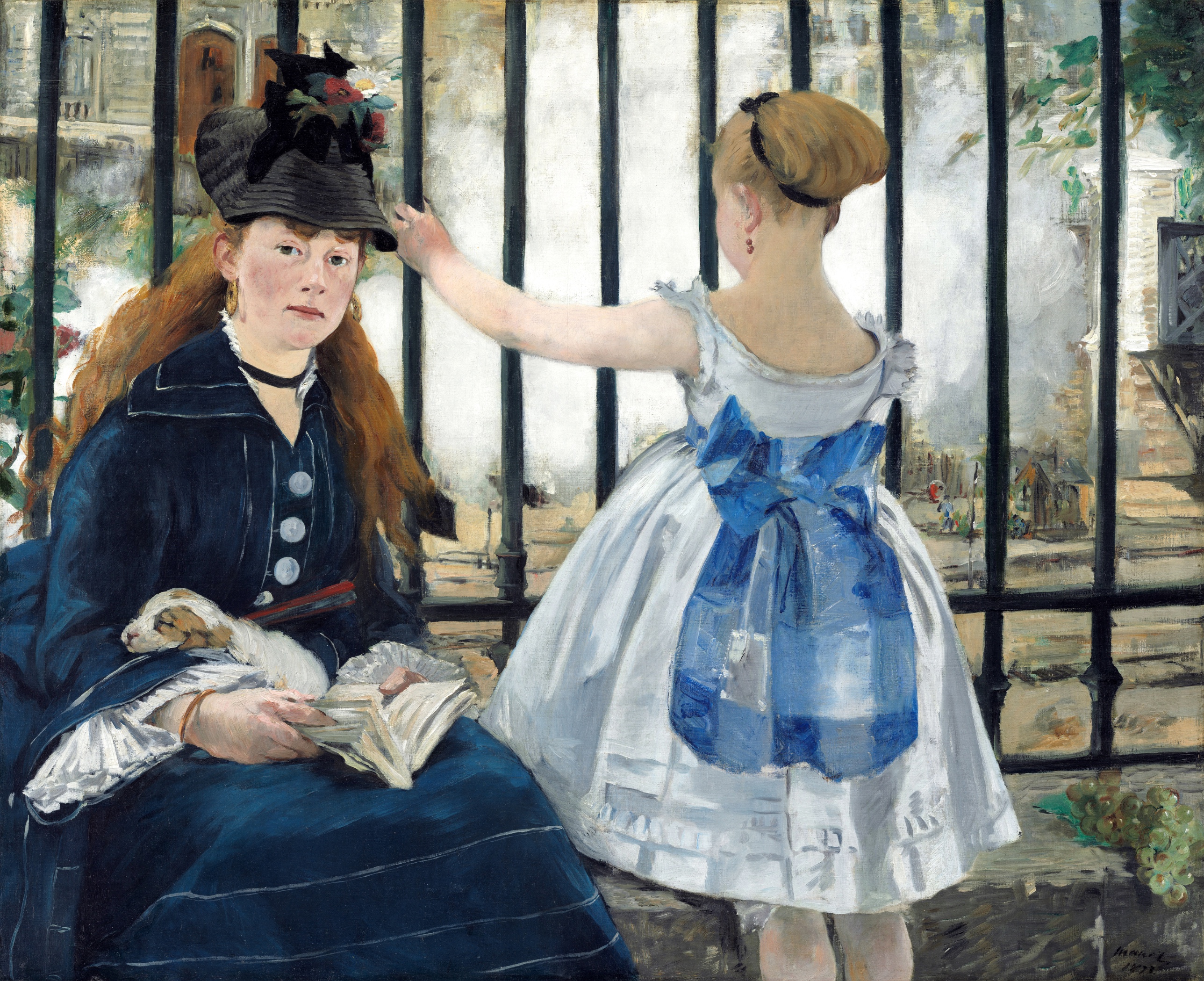
The perceptual and material domains agree with each other almost completely. The eye lands on the face, gets stopped by the bars, and reads two value masses divided by a haze. The brushwork confirms all of it: the face is smoother than the dress, the dress is a flat dark mass, the background is loose enough to look like weather instead of buildings. Nothing in the paint contradicts what the eye does first.
The cultural and conceptual domains pull against that stability. A painting this optically coherent, this legible in its massing and its intervals, is also a painting that refuses to tell you what is happening. A girl with her back turned, gripping a bar, watching something the viewer cannot see. A woman who meets your eye but offers no story. The formal clarity and the narrative opacity are doing opposite jobs. One organizes your looking. The other denies you a payoff for having looked.
The bars are the hinge. Perceptually they are an interval system, a rhythm, a depth cue. Culturally and conceptually they can be read as something closer to an argument, a literal barrier between the viewer and the machinery of modern life. The painting doesn't resolve which one they are. It uses the same iron to organize the eye and to block the story.
The unresolved question the work sits inside: is the railing a compositional device that happens to carry symbolic weight, or a symbolic refusal that happens to organize the composition. The painting gives no ground for choosing.
CULTURAL
This work enters the conversation of the 1870s Paris Salon system at the exact moment that system is starting to lose its grip on what counts as serious painting. Manet submits it to the Salon of 1874, the same year the Impressionists mount their first independent show without him. He does not join them. He keeps trying to be accepted by the institution that keeps refusing him on his own terms. One reading of where this work sits institutionally is that it is a negotiation: modern subject matter, modern brushwork, but still oil, still canvas, still large enough and still ambitious enough for the Salon wall.
The setting itself, the Gare Saint-Lazare rail yard, signals urban modernity, and the choice of a governess or mother with a child rather than a heroic or mythological subject signals the same allegiance Manet keeps making across his career: everyday Parisian life is worth the scale and seriousness usually reserved for history painting. That's a departure from Salon convention even while the painting court's the Salon jury.
The community most likely to recognize and value this work is the same one that valued Manet generally: critics and collectors invested in the argument that modern life is a legitimate subject for ambitious painting, plus later a modernist art history invested in Manet as the hinge between Realism and Impressionism. The girl facing away, denying the viewer her face, would have been read by contemporary Salon audiences as a formal insult, a withholding of the thing a painting is supposed to give. Hypothesis (insufficient visual evidence): that withholding was intended as a specific critique of Salon expectations regarding narrative closure. The visual evidence supports the withholding; it doesn't establish intent to critique.
CONCEPTUAL
The painting is in dialogue with the problem of how to paint modern Paris without falling into either academic narrative machinery or picturesque genre sentiment. The seated woman's level, undramatic gaze and the grapes and book handled as still-life notes rather than symbolic props both suggest a resistance to storytelling. The standing girl turned away, gripping the bar, watching an event the canvas won't show, reinforces that resistance: the painting places a witness inside the frame and then blocks the viewer from seeing what she sees.
That's consistent with a reading in which the argument being made is about withheld information as a legitimate subject. Realist and early Impressionist painting had already begun replacing anecdote with sensation, and this canvas pushes that further: the "event" of the railway, the steam, the train, is reduced to a haze of paint, while what stays sharp is a face that offers no narrative payoff and a girl's back that offers none either. The historical precedent that matters most here is Manet's own earlier practice of frontal, confrontational gazes (Olympia, Le Déjeuner) repurposed toward blankness rather than provocation. Where Olympia's gaze accuses, this woman's gaze simply observes, flatly, and the painting stakes its position on the argument that flatness of affect can carry as much weight as flatness of paint handling.
The bars are the site where the argument sharpens. They are the most resolved, hardest-edged forms in the picture, painted with none of the looseness given to the dog or the background. Hypothesis (insufficient visual evidence): that Manet intends the bars as a deliberate statement about class or gendered confinement to the domestic sphere. The formal evidence, hard edges, dark value, division of the whole canvas into gated intervals, supports a reading of the bars as a barrier. It does not, on its own, establish the social content of that barrier.
PERCEPTUAL
Standing in front of this canvas, the eye goes straight to the pale, steady face on the left before it registers anything else in the picture. Then it gets caught on the black bars running across the middle distance, which seem to sit closer to the viewer than everything else. Only after that does the rest of the scene, the white dress, the haze, the small dog, start to sort itself out.
WHAT HITS YOU FIRST
- Atmospheric Perspective [A]: strength 3
- The rail yard behind the bars dissolves into pale vapor, and the tiny background figures lose contrast and edge almost entirely, pushing that whole zone far back.
- Face Detection [A]: strength 3
- The seated woman's pale, level face reads as a face before anything else in the canvas resolves, pulling the eye there first regardless of where the composition places it.
- Figure-Ground Relationships [A]: strength 3
- The two figures sit forward of a haze that refuses to cohere into readable architecture, locking a clean front-to-back separation.
- Overlap/Occlusion [A]: strength 3
- The iron bars pass in front of both figures, the dog crosses the woman's lap, and the arm crosses the railing, stacking multiple overlap cues that all agree on the same depth order.
- Contour Quality [B]: strength 3
- The bars have the hardest, most continuous edges in the painting, against which every other contour, dress, hair, haze, reads as softer by comparison.
- Rhythm and Repetition [B]: strength 3
- The evenly spaced verticals of the railing set up a beat that the eye tracks across the whole width of the canvas.
- Value Structure/Massing [B]: strength 3
- The composition splits cleanly into the woman's near-black mass, the girl's white dress, and the pale haze behind, three value zones doing the heavy compositional lifting.
WHAT HOLDS YOU THERE
- Agency Attribution [A]: strength 2
- The girl's raised hand gripping the bar reads as a body caught mid-action, reaching or steadying, which keeps attention on her longer than her hidden face would otherwise earn.
- Color Opponent Channels [A]: strength 2
- The woman's copper hair sits directly against her navy dress, and that warm-cool clash keeps the head anchored as a color event, not just a shape.
- Edge Detection [A]: strength 2
- The crisp line between the white dress and the surrounding tones gives the eye a second hard boundary to rest on after the bars.
- Gaze Direction / Social Attention [A]: strength 2
- The seated woman's direct, level gaze meets the viewer's, while the standing girl's turned head points attention outward, off-canvas, splitting where the viewer is asked to look.
- Light Source Logic [A]: strength 2
- Illumination reads as diffuse rather than raked from one clear direction, which keeps the two figures visually equalized instead of one being singled out by a spotlight effect.
- Postural Affect [A]: strength 2
- The girl's turned back and gripping hand carry more visible tension than the seated woman's relaxed, book-in-lap posture, giving the two figures different emotional temperatures.
- Visual Pop-out / Pre-attentive Features [A]: strength 2
- The blue sash on the girl's back is the single most saturated note in the picture and pulls the eye even though her face is withheld.
- Anchoring and Reference Points [B]: strength 2
- The seated woman's face functions as the fixed point the eye returns to after scanning the rest of the canvas.
- Color Temperature [B]: strength 2
- The warm hair and small red accents sit against a dominant field of cool navy and pale grey, giving the warm notes outsized visual pull.
- Color Weight and Advancement [B]: strength 2
- The dark navy dress reads as heavier and closer than the pale dress and haze, reinforcing the near/far split already set by occlusion.
- Cropping/Framing [B]: strength 2
- The tight framing crops the scene close on both figures, leaving no room to see what the girl is looking at, which keeps the eye searching the edges of the canvas for information it doesn't get.
- Detail Density Gradient [B]: strength 2
- Resolution drops steadily from the faces to the dog to the background haze, giving the eye a built-in order for how long to linger where.
- Interval Relationships [B]: strength 2
- The even gaps between the bars set a measured rhythm that contrasts with the more irregular spacing of the figures and objects in front of them.
- Local vs. Atmospheric Color [B]: strength 2
- Readings disagree on how sharply the local color of the figures separates from the atmospheric color of the background, some seeing a hard color break at the bars, others a softer bleed.
- Pattern vs. Figure [B]: strength 2
- The repeating bars register first as a pattern and only secondarily as a barrier object, competing with the figures for status as the "subject."
- Saturation [B]: strength 2
- The blue sash and small red accents are far more saturated than anything around them, which makes them read before the more muted flesh tones.
- Scale Relationships [B]: strength 2
- The background figures and locomotive are rendered at a sharply reduced scale, doing double duty as a distance cue and a comment on how small the "event" behind the bars actually is.
- Texture [B]: strength 2
- The dog's loosely painted fur, the woman's hair, and the smooth face each carry a different apparent texture despite being adjacent in the picture.
- Visual Weight/Balance [B]: strength 2
- The dark mass on the left and the white dress on the right counterbalance each other across the canvas, keeping the composition from tipping to either side.
- Color Harmony Systems [C]: strength 2
- The overall palette of navy, cream, and copper reads as a controlled, cool-dominant harmony interrupted by isolated warm notes.
- Economy of Means [C]: strength 2
- Readings disagree on whether the loose, quick handling of secondary elements like the dog counts as deliberate restraint or simple lack of finish.
WHAT SURFACES ON A LONGER LOOK
- Grouping [A]: strength 1.5
- The two figures, despite being separated by the picture's own division of dark and light mass, get pulled back together as a single "pair" once the eye registers their shared enclosure behind the bars.
- Directional Force/Implied Movement [B]: strength 1.5
- The girl's raised arm and turned body imply motion toward the unseen event beyond the bars, a pull the static seated woman does not share.
- Optical vs. Physical Color Mixing [B]: strength 1.5
- The hazy background reads as mixed color at a distance even though the brushwork up close remains distinct and unblended.
- Unity vs. Variety Tension [B]: strength 1.5
- The picture holds together as one scene despite sharply different handling across face, dress, dog, and background, a tension that only becomes visible once you look past the first read.
- Biological Motion Detection [A]: strength 1
- The girl's posture, weight shifted, arm extended, reads as a body caught in motion rather than posed.
- Closure/Negative Space [A]: strength 1
- The gaps between the bars function as negative space the eye fills in as continuous background rather than as separate slivers.
- Elevation in Picture Plane [A]: strength 1
- The seated woman placed slightly lower and the girl slightly higher in the frame gives a small vertical separation that reads as spatial rather than symbolic on first look.
- Simultaneous Contrast [A]: strength 1
- The navy dress makes the adjacent pale skin look even paler by contrast.
- Specularity/Surface Reflection [A]: strength 1
- Small bright accents on buttons or earrings suggest reflective surfaces without committing to a consistent highlight logic across the picture.
- Canonical Views [B]: strength 1
- The seated woman's near-frontal pose is a familiar portrait view, which makes the girl's turned back read as an even sharper departure by contrast.
- Complexity and Visual Density [B]: strength 1
- The picture is sparse relative to a typical genre scene, with few competing objects beyond the two figures, the dog, and the bars.
- Embodied Perspective / Eye-Level Effects [B]: strength 1
- The viewpoint sits close to the seated woman's eye level, which levels the encounter with her gaze.
- Embodied Simulation [B]: strength 1
- The girl's gripping hand invites a felt sense of tension in the viewer's own hand.
- Emergence [B]: strength 1
- The rail-yard scene behind the bars only cheres into "a place" after a few seconds of scanning the haze.
- Focal Blur/Depth of Field [B]: strength 1
- The soft background against sharp foreground figures approximates a shallow depth of field even though the medium is paint, not lens optics.
- Pattern Completion/Closure [B]: strength 1
- The interrupted forms behind the bars get completed by the viewer into recognizable train-yard architecture despite minimal information.
- Symmetry/Asymmetry [B]: strength 1
- The two figures are asymmetrically placed and asymmetrically weighted, dark mass against light mass, avoiding any static mirroring.
- Transparency/Opacity [B]: strength 1
- Readings disagree on whether the steam is meant to read as transparent vapor or as an opaque scrim closing off the background.
- Visual Tension [B]: strength 1
- The unresolved question of what the girl is looking at keeps a low level of tension active even after the composition has been fully scanned.
- Empathic Resonance [C]: strength 1
- The girl's gripping hand and turned body invite a mild projected empathy even without a visible face.
- Implied Time/Narrative Sequence [C]: strength 1
- The raised arm and directed gaze imply a "next moment" the canvas withholds.
- Linear Perspective [A]: strength 0.5
- Faint architectural lines in the haze gesture toward converging perspective without establishing it clearly.
The seated woman's face and the vertical bars split the viewer's attention almost immediately, and the picture never fully reconciles that split. Once the eye has registered both, it keeps oscillating: back to the steady gaze on the left, out through the bars toward whatever the girl is watching, then down to the dog and book as low-stakes resting points. Visual weight sits heaviest on the left, in the dark dress, but color intensity sits heaviest on the right, in the blue sash, so the canvas asks the eye to hold two different kinds of pull at once. Nothing forces a resolution. The bars keep the two demands, look at the face, look at the withheld event, physically separated, and the eye just keeps crossing back and forth between them.
MATERIAL AND FORMAL
Up close the paint sits in visibly separate strokes: thin and controlled on the faces, thicker and more dragged in the hair and dress, quick and almost scribbled on the dog. From across the room those differences flatten into a single coherent scene, faces reading as faces, fur reading as fur, without the brushwork announcing itself as texture. The canvas itself is a modest, table-sized rectangle, wider than it is tall, built for a domestic wall as much as a Salon one.
WHAT HITS YOU FIRST
- Contour Quality [B]: strength 3
- The iron bars are laid down with the flattest, most unbroken paint edges in the picture, a deliberate contrast to every organic contour around them.
- Value Structure/Massing [B]: strength 3
- The near-black dress is painted as a single flat mass with almost no internal shadow modeling, built more by area than by tonal gradation.
WHAT HOLDS YOU THERE
- Color Weight and Advancement [B]: strength 2
- The heavy, opaque application of the navy dress physically sits higher on the canvas surface than the thinner paint of the background, reinforcing its visual advance.
- Detail Density Gradient [B]: strength 2
- Paint handling itself carries the depth cue: tight, smooth strokes on the faces loosen into blunt marks on the dog and dissolve into scumbled haze behind the bars.
- Texture [B]: strength 2
- The dog's fur is built from short, dry, unblended strokes distinct from the wet, smoothed handling of the skin just inches away on the same canvas.
- Economy of Means [C]: strength 2
- Readings disagree on whether the reduced finish on secondary elements is a considered economy or simply less resolved paint handling; the brushwork alone doesn't settle it.
WHAT SURFACES ON A LONGER LOOK
- Optical vs. Physical Color Mixing [B]: strength 1.5
- The hazy background is built from separate dabs of grey, cream, and pale blue that only fuse into "steam" at viewing distance.
- Focal Blur/Depth of Field [B]: strength 1
- The looseness of the background paint mimics an out-of-focus zone despite being static oil on canvas, not an optical blur.
- Transparency/Opacity [B]: strength 1
- Readings disagree on whether the steam passages are built with thin, layered glazes suggesting transparency or with opaque scumbling that just reads as pale color.
The physical size of the canvas, under four feet across, keeps the encounter close and domestic even though the subject is industrial. The bars, the single most resolved passage in the painting, sit at the same distance from the picture plane as a viewer standing at arm's length would expect a real railing to sit, which gives the flattest paint handling in the picture the most physically convincing presence. The surface is honest about its own hierarchy: where Manet wants your eye to stop, the paint gets tighter; where he wants it to slide past, the paint gets looser and drier. That hierarchy matches the perceptual read almost exactly, which is unusual, most paintings hide at least one seam between what the hand did and what the eye does. Here the seams line up.
NOISE: CONSOLIDATED
PERCEPTUAL: The two demands on attention, the woman's face and the girl's blocked event, don't resolve into a single hierarchy. The Pass 1 record shows disagreement on light direction (upper left versus diffuse versus upper right) and on whether specular highlights exist at all, which means even the basic lighting logic of the scene doesn't lock into one stable read across viewers.
MATERIAL: The dog is the clearest material inconsistency: painted with looser, less resolved strokes than everything around it, which threatens the otherwise consistent logic where resolution tracks narrative importance. The grapes and the book are inconsistently registered across viewers, present in some readings and absent in others, meaning the material record itself isn't settled on what small objects are even there.
CULTURAL: The painting's refusal to show what the girl is watching would have been legible to a Salon audience as a formal problem, a picture that doesn't deliver its subject, before it could be read as a modern position. That gap between formal illegibility and modernist intent is not resolved by anything visible in the canvas itself.
CONCEPTUAL: The argument that withheld narrative is the subject depends on reading the bars as a considered barrier rather than a convenient rail-yard prop, and the visual evidence supports the barrier reading without confirming the intent behind it.
The material inconsistency around the dog and the perceptual disagreement over lighting look accidental, artifacts of quick, unresolved passages rather than considered strategy; the cultural and conceptual noise around withheld narrative looks more like a deliberate refusal the painting commits to and never walks back.