OVERVIEW
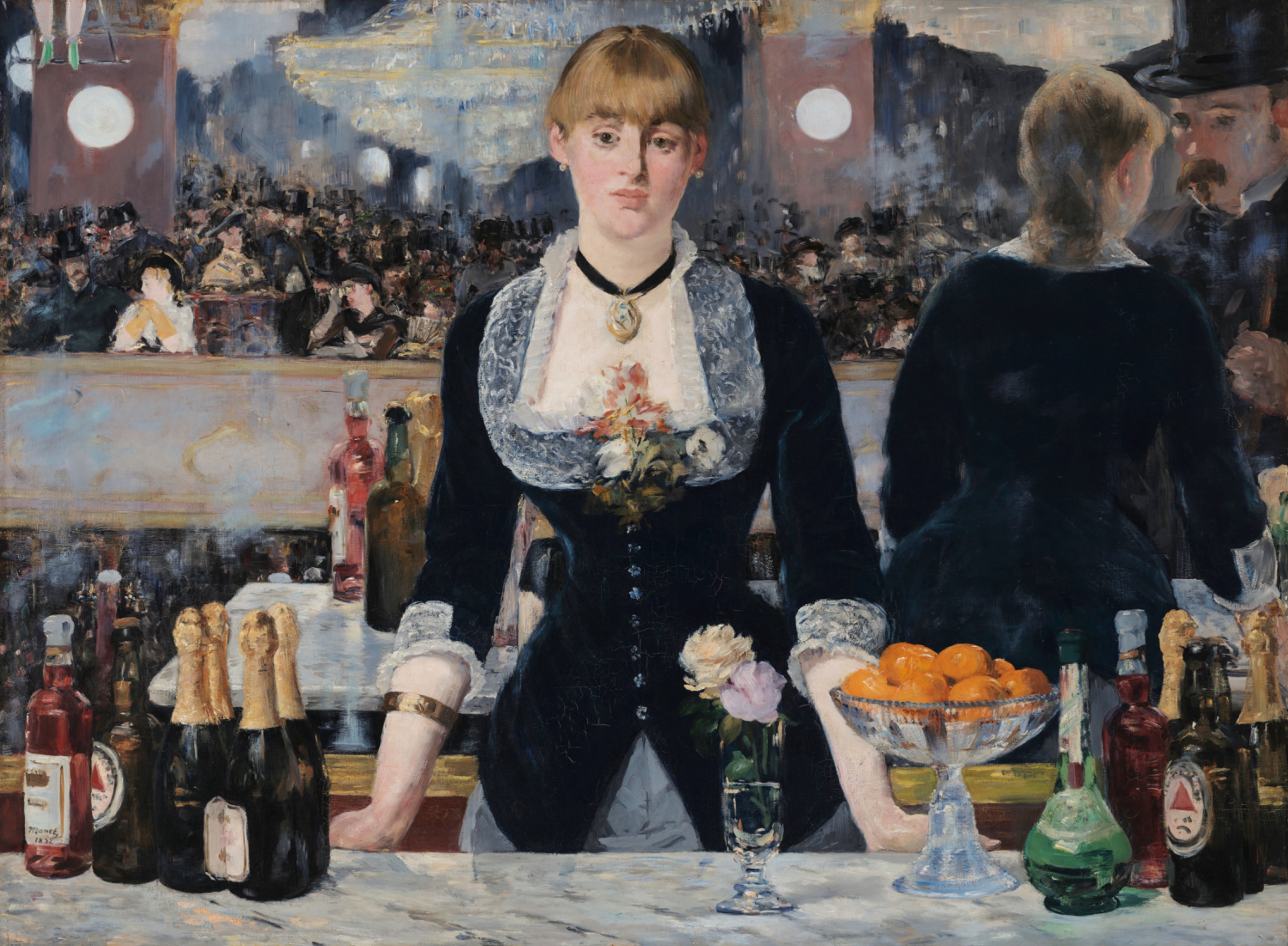
The perceptual read and the material read agree with each other almost completely. The eye lands on the face, drops to the black bodice, then to the counter, and the paint handling confirms that route at every stop: sharp contour where attention is supposed to hold, dissolved edges where it isn't. Detail Density Gradient and Contour Quality are doing the same job from two different domains. That's rare, and it means the painting's attentional logic is not an accident of subject matter. It's built into the brush.
The trouble starts at the mirror. Perceptually, Overlap/Occlusion and Scale Relationships tell the eye there's a spatial problem back there, a man positioned where the viewer should be standing, a reflection that doesn't track. Materially, that same passage is handled with the loosest, least resolved paint in the picture, so the "problem" reads first as sketchiness, not as argument. The eye finds the anomaly before the hand's evidence explains it. Cultural and conceptual readings then have to decide whether that mismatch is Manet's deliberate rupture of the mirror-as-truth convention, or Manet working fast and leaving it unresolved. The formal record can't settle that. It just shows the discrepancy is really there.
Culturally, the work asks to be read inside the modern-life painting project, Baudelaire's flâneur, the Folies-Bergère as a site of commercial spectacle. Conceptually, the blank gaze and the impossible reflection support a reading about looking itself, who gets to look at whom, and whether the barmaid is subject or merchandise. That conceptual weight rests almost entirely on two things: Gaze Direction and the mirror anomaly. Everything else in the perceptual record, the oranges, the lamps, the bottle rhythm, is compositional scaffolding, not argument. The painting's intellectual reputation and its actual visual center of gravity aren't quite the same size.
The unresolved question the work sits inside: is the mirror's spatial impossibility a statement about the barmaid's alienation from her own reflection, or is it the residue of a working method that never fully reconciled a studio-posed model with an invented background?
CULTURAL
This work enters the conversation around modern Parisian spectacle, the world Baudelaire asked painters to record: cafés, boulevards, performers, the commerce of leisure. A reading available here is that Manet is answering that call directly, staking the barmaid and her counter of bottles and fruit as a subject as worthy of serious oil paint as a mythological scene. The dense, resolved still life at the bottom of the canvas argues for that seriousness in paint-handling terms; it gets the same attention a history painter would give to drapery or armor.
The setting itself, a real, named nightclub, signals a departure from Salon subject matter even as the work was shown in the Salon. That double gesture, prestige venue plus disreputable subject, is one reading of why the picture unsettled its first audiences. The Folies-Bergère was a place where barmaids doubled, by common knowledge of the period, as sex workers available beyond the counter. If a viewer carries that context in, the woman's braced posture and unfocused gaze reads less like passivity and more like professional detachment, a body on display managing its own visibility. That reading depends on outside knowledge the canvas itself doesn't supply; the painting gives the posture and the gaze, not the biography.
Institutionally, the picture now sits in the Courtauld, a collection built around exactly this transition point between Impressionism and what comes after it. A visitor there has likely been primed to look for the mirror problem before arriving, since it's the painting's most discussed feature in exactly this kind of survey collection. That's one way the work's current cultural position outruns what a cold viewing supports: the reputation for the "impossible mirror" precedes the encounter, so the perceptual surprise Pass 1 records, an anomaly the eye catches before it's named, is largely gone for anyone who already knows to look for it.
The work also sits comfortably inside a later critical conversation, associated with writers like T.J. Clark and John Berger, about the female body as spectacle and the structure of the gaze. One reading is that the painting anticipates that critique. Another is that later criticism found in the canvas a problem it was already primed to look for. Both readings are available; neither is settled by the image alone.
CONCEPTUAL
The picture is in dialogue with the mirror-as-truth-telling device that runs from Van Eyck through Velázquez's Las Meninas, a convention where a reflection either confirms or complicates who is really being looked at. Manet's mirror doesn't confirm anything. The reflected man in the top hat sits where the viewer's own reflection should logically fall, and the reflected woman's back doesn't track cleanly to the front-facing figure at the counter. That's the anchor for a real interpretive claim: the painting is not offering the mirror as evidence of a coherent, single vantage point. It's offering it as a second, unreconciled account of the same scene.
The gaze anchors the other half of the argument. Her eyes aim off to the side rather than meeting the viewer (anthropic and openai, majority), which sits against the mirror's suggestion that someone, the top-hatted man, is engaging with her directly. Read together, those two observations support a position: the painting stages two different relationships to the same woman at once, a frontal presentation aimed at whoever stands at the counter, and a transaction happening just behind her that the viewer only sees secondhand, through glass. That's an argument about looking having more than one register at once, public presentation and private exchange occupying the same body in the same instant.
This sits against Realism's promise of a single truthful vantage point, the premise Courbet and early Manet had both traded on. Here the vantage point fractures instead of resolving. Hypothesis (insufficient visual evidence): that the fracture is a specific statement about commodification of the barmaid's body, since that claim needs biographical and economic context about the venue that the image itself doesn't supply, only her stance and gaze.
The loose, unresolved brushwork on the crowd and mirror, against the tight, dense still life on the counter, tracks a real position in period debate over finish: what deserves full resolution and what doesn't. Manet gives full resolution to inanimate objects, bottles, fruit, glass, and lets the human crowd behind the glass go soft. One reading: attention, not hierarchy of importance, decides what gets finished. The objects a viewer would actually reach for get the clearest paint; the crowd a viewer would only glance past gets the loosest.
PERCEPTUAL
Standing in front of this, the face arrives first, pale and still against all that black. Then the eye drops to the counter and gets caught by the fruit and glass, which look more finished, more touchable, than anything else in the room. Behind her the whole scene goes soft and crowded and hard to parse, and something about that gap, sharp glass in front, blurred party behind, keeps pulling the eye back and forth without settling.
WHAT HITS YOU FIRST
- Face Detection [A]: strength 3
- The pale symmetrical face against the black bodice and blurred crowd is the first shape the eye organizes, before anything else in the canvas resolves.
- Figure-Ground Relationships [A]: strength 3
- The barmaid's solid dark mass separates cleanly from the loose, unresolved crowd behind her, so she reads as figure against a ground that never fully settles into people or place.
- Gaze Direction / Social Attention [A]: strength 3
- Her eyes aim off to the side rather than meeting the viewer, and that unmet gaze becomes a second point of fixation right after the face itself.
- Overlap/Occlusion [A]: strength 3
- Her body blocks the counter behind her, the bottles overlap each other along the marble, and the reflected man in the top hat sits partly behind her reflected shoulder, stacking three depth cues into one reading.
- Detail Density Gradient [B]: strength 3
- The oranges, glass, and lace resolve at close range while the crowd stays a field of dabs, so the eye is told exactly where to stop and look hard.
- Value Structure/Massing [B]: strength 3
- The black bodice is the single largest, darkest shape on the canvas, and everything else sits lighter than it, so it anchors the whole picture like a keystone.
WHAT HOLDS YOU THERE
- Atmospheric Perspective [A]: strength 2
- The crowd's blurred color dabs recede the way distant shapes do, even though the "distance" is actually a mirror pushed flat against the picture plane.
- Color Opponent Channels [A]: strength 2
- The orange fruit against the blue-gray marble and black dress works a warm-cool push the eye registers before it identifies the objects.
- Grouping [A]: strength 2
- The bottles cluster by shape and color at each end of the counter, reading as two loose sets rather than a random row.
- Light Source Logic [A]: strength 2
- The hard specular hits on the bottles and crystal bowl all point to one bright source, which the eye accepts even as the mirror behind contradicts where that light should come from.
- Postural Affect [A]: strength 2
- Her stiff, straight-armed stance with flattened hands on the counter reads as braced or fatigued before any story attaches to it.
- Visual Pop-out / Pre-attentive Features [A]: strength 2
- The orange fruit and the pink flowers at her chest fire as color pop-outs against the dark bodice and grey marble almost instantly.
- Anchoring and Reference Points [B]: strength 2
- The face, the black mass, and the counter edge give the eye three fixed points to return to after each excursion into the blurred crowd.
- Color Weight and Advancement [B]: strength 2
- The black dress pulls forward optically even though it's the coolest, darkest value, simply through its size and edge sharpness.
- Complexity and Visual Density [B]: strength 2
- The crowded reflection and the exact still life sit at opposite densities in the same canvas, forcing two different viewing speeds.
- Cropping/Framing [B]: strength 2
- The green shoes cut off at the upper left read as a performer sliced by the frame edge, breaking the sense that everything in view is fully accounted for.
- Embodied Perspective / Eye-Level Effects [B]: strength 2
- The counter sits at a height that puts the viewer standing directly across from her, as if ordering a drink.
- Emergence [B]: strength 2
- The crowd only becomes a "crowd" once the eye stops trying to resolve individuals and lets the dabs cohere at a distance.
- Pattern Completion/Closure [B]: strength 2
- The lace collar is built from broken comma strokes the eye closes into continuous trim without any continuous line actually being there.
- Rhythm and Repetition [B]: strength 2
- The bottles along the counter repeat in a loose beat of color, red, green, gold, echoed again at the far end.
- Scale Relationships [B]: strength 2
- The reflected figures behind her read as too small or too displaced for the distance the mirror implies, a mismatch the eye notices without measuring it.
- Symmetry/Asymmetry [B]: strength 2
- Her frontal, near-centered pose promises symmetry that the off-kilter reflection behind her then refuses.
- Unity vs Variety Tension [B]: strength 2
- The tight still life and the loose crowd sit in the same frame without reconciling their handling, and the eye holds both readings without merging them.
- Visual Tension [B]: strength 2
- The mismatch between her static pose and the man in the top hat positioned where a viewer would stand keeps the eye moving between her face and that reflected exchange.
- Visual Weight/Balance [B]: strength 2
- The dark bodice on the left-center and the brighter bottle cluster on the right hold the composition roughly level even though nothing in it sits symmetrically.
- Empathic Resonance [C]: strength 2
- The flattened hands and unfocused gaze read as detachment or exhaustion, a bodily read that arrives before any narrative reasoning.
WHAT SURFACES ON A LONGER LOOK
- Agency Attribution [A]: strength 1
- The reflected man in the top hat, angled toward her, reads as an actor in an exchange even though his face isn't visible.
- Elevation in Picture Plane [A]: strength 1
- The two globe lamps sit high in the picture, marking depth mostly by position rather than by size or clarity.
- Linear Perspective [A]: strength 1
- The counter's edge offers the only real converging line in the painting, and it's short enough that it barely asserts itself.
- Simultaneous Contrast [A]: strength 1
- The pale skin looks even paler set against the black bodice than it would against a mid-value ground.
- Canonical Views [B]: strength 1
- The frontal barmaid-behind-counter pose is the expected view for this kind of scene, which is partly why the mirror's disruption stands out.
- Directional Force/Implied Movement [B]: strength 1
- The trapeze performer's legs at the upper corner imply motion happening outside the frame, though nothing in the main scene moves.
- Embodied Simulation [B]: strength 1
- The braced arms and splayed hands invite a slight muscular echo in the viewer, a felt stiffness.
- Interval Relationships [B]: strength 1
- The spacing between the bottles is uneven enough to avoid a mechanical row, keeping the counter from reading as a diagram.
- Pattern vs Figure [B]: strength 1
- The dabbed crowd behind her flirts with becoming decorative pattern before the isolated top-hat figure snaps it back into "scene."
- Color Harmony Systems [C]: strength 1
- Black, white, and orange recur enough to feel like a chosen palette rather than an accident of the subject.
- Implied Time/Narrative Sequence [C]: strength 1
- The positioning of the man in the top hat suggests a moment just before or after an exchange with her, without showing either.
- Simultaneity vs Sequence [C]: strength 1
- The mirror shows what should be a single moment as two spatial states at once, her front and her reflected interaction.
The face and the black mass do the heaviest work; almost everything else in the composition exists to be interrupted by them and then to send the eye back out toward the mirror. That back-and-forth never really resolves. The still life offers a place to rest, hard edges, bright highlights, real weight. The mirror offers a place to get lost. The picture keeps handing attention between a body that won't look at you and a background that won't hold still, and it never picks one over the other.
MATERIAL AND FORMAL
Up close the counter, the bottles, and the fruit bowl are built from thick, confident, separate strokes that stay legible as brushwork even while reading as glass and rind. Step back and those same strokes fuse into hard, wet-looking objects. The crowd behind her does the opposite: up close it's a field of loose, scrubbed color with no resolved shapes, and it never fully resolves even from across the room. The dress is a flat, worked black with fine surface cracking visible in the dark passages, a sign of the paint's age more than its original intention.
WHAT HITS YOU FIRST
- Contour Quality [B]: strength 3
- The edge of her face and collar is drawn firm and continuous while the crowd's edges dissolve into unbounded dabs, so contour marks what the painter wants held versus let go.
- Specularity/Surface Reflection [A]: strength 3
- The hard white highlights on the bottle glass and crystal bowl are built from loaded, opaque strokes of pure white laid over darker underpaint, a physical record of where the brush pressed hardest.
WHAT HOLDS YOU THERE
- Edge Detection [A]: strength 2
- Foreground objects, the bowl, the bottles, keep a hard edge against the marble, while the mirror world softens every boundary, so edge sharpness itself does the spatial sorting.
- Color Temperature [B]: strength 2
- Warm gold foil and orange fruit sit against cool grey marble and blue-black glass, a temperature split built with the paint itself, not just the drawing.
- Optical vs Physical Color Mixing [B]: strength 2
- The lace trim is a scatter of separate light and dark touches that only fuse into "white lace" at viewing distance, an optical mix rather than a blended one.
- Saturation [B]: strength 2
- The oranges carry the only fully saturated color in the picture, surrounded by desaturated blacks, greys, and muted crowd tones.
- Texture [B]: strength 2
- The still life is built with denser, more worked paint than the background, so the surface itself is thicker where the eye is meant to stop.
- Transparency/Opacity [B]: strength 2
- The champagne bottles alternate an implied glassy transparency with opaque bands of reflected light, achieved by leaving some passages thin and loading others.
- Focal Blur/Depth of Field [B]: strength 2
- The crowd is handled with a soft, unresolved touch that reads like blur, though it sits on the same flat mirror plane as the sharply painted foreground, so the "blur" is a paint choice, not an optical fact.
- Economy of Means [C]: strength 2
- A handful of comma-strokes stands in for lace, and a few blobs stand in for a hundred faces in the crowd, doing a lot with very little worked surface.
WHAT SURFACES ON A LONGER LOOK
- Local vs Atmospheric Color [B]: strength 1
- The reflected crowd is given a slightly cooler, greyer local color than the foreground objects, borrowing atmospheric color logic for a scene that isn't actually at a distance.
The hand is doing two different jobs on one canvas and not disguising the seam between them. Where an object needs to be believed, glass, marble, fruit skin, the paint is dense and edge-true. Where a crowd needs to feel present but not itemized, the paint goes thin and gestural, sometimes down to a single loaded dab standing in for a whole face. That's an honest surface: nothing here pretends to a uniform level of finish across the picture, and the canvas doesn't hide that some passages got far more time than others. Up close, the illusion breaks down fastest exactly where the eye is asked to linger, the lace, the highlights; from across the room those same passages are what convince first.
NOISE: CONSOLIDATED
PERCEPTUAL: The clearest interference is the fight between Gaze Direction and the mirror's implied social exchange. The eye is told two contradictory things at once, that she is not engaging anyone, and that someone behind her is positioned to be engaging her directly. There's no way to resolve both readings simultaneously, so attention keeps oscillating rather than settling, which is itself the noise: a viewer can't finish looking at this painting the way they can finish looking at a portrait with a single, stable gaze.
MATERIAL: The still life's density and the crowd's looseness sit at war with the picture's claim to be a single coherent scene. If the mirror is meant to be read as physically continuous with the room, the wildly different levels of finish between what's in front of the glass and what's reflected in it undercut that continuity. The paint handling reads less like one moment observed and more like two separate painting sessions stitched together.
CULTURAL: The painting's reputation as a puzzle about spectatorship now arrives ahead of the viewing experience for most audiences who encounter it in a museum or textbook context, so the perceptual surprise the mirror anomaly was likely built to produce is largely gone before anyone stands in front of the actual canvas. That flattens a first-hand cultural encounter into confirmation of something already known.
CONCEPTUAL: The argument depends on reading the mirror's spatial break as intentional commentary on vision and commerce, but the same passage is also the least resolved paint in the picture. The conceptual weight and the physical evidence pull against each other: a viewer can't fully tell whether the impossibility is a claim about looking or a compositional shortcut that was never reconciled.
The gaze/mirror contradiction is very likely doing real work for the conceptual reading, unresolved tension as the whole point, while the uneven finish between still life and crowd more likely reflects working method than intention, and the cultural front-loading of the "impossible mirror" story is an accident of the painting's own success as a talking point.