OVERVIEW
The four domains split along a single line: what the surface is doing to the body versus what the face is doing to the viewer.
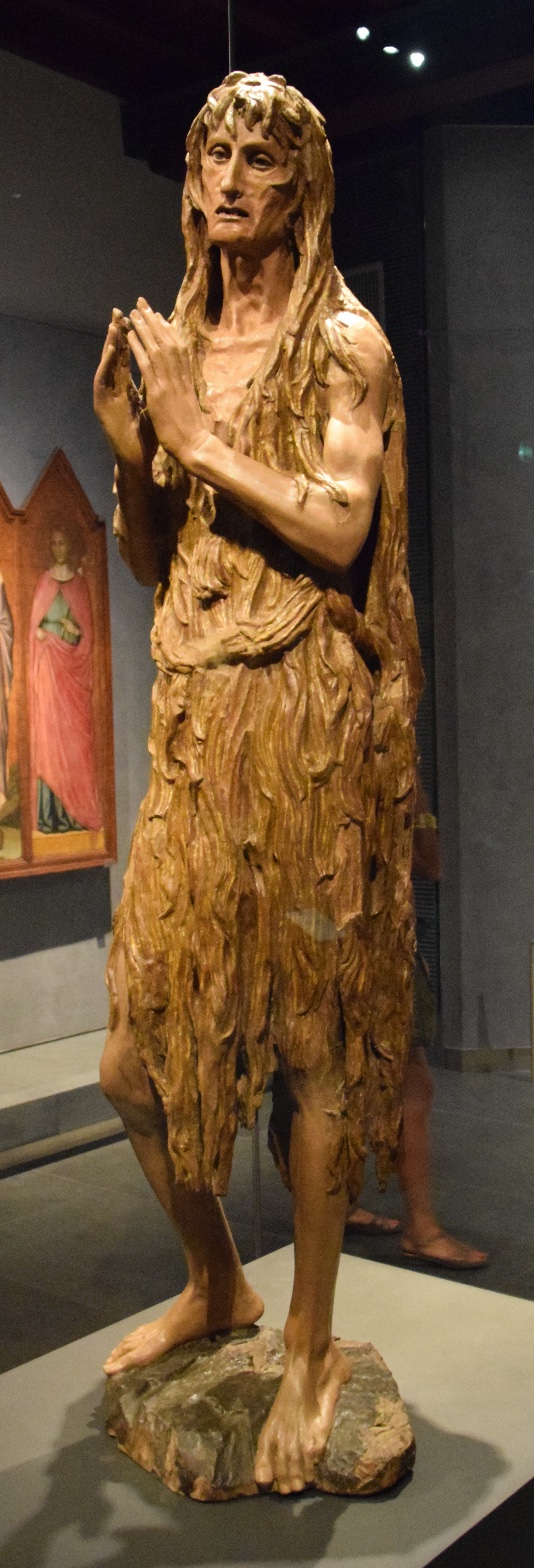
Perceptual and material findings agree closely. The eye goes to the face first because of Face Detection, then reads the vertical ridges across the torso as Texture and Rhythm and Repetition. The wood carving confirms this directly: the gouges are real tool marks, not painted illusion. Perceptual and material domains reinforce each other cleanly here.
Cultural and conceptual domains introduce the friction. A 1440s Florentine devotional carving asking for a bronze or metal reading (per the contradicted medium observations) sits oddly against Donatello's known late style of rough, unfinished wood surfaces. If a viewer arrives expecting bronze finish and gets splintered wood, the Peak Shift the sculpture is aiming for (exaggerated emaciation past naturalism) reads differently depending on which material the viewer thinks they're looking at. The conceptual argument, that suffering has hollowed this body into bark and fiber, depends on the viewer knowing it's wood. Cultural readings of the object as museum-bronze would flatten that argument.
The Detail Density Gradient is the sharpest internal tension. Fine, resolved carving at the face and gaunt anatomy sits against a torso that reads almost geological, unresolved, more like erosion than anatomy. That gradient is not a flaw in one domain, it is the perceptual mechanism that carries the conceptual argument about bodily dissolution. Here perceptual thinness in the middle of the body is the conceptual point.
The unresolved tension: does the wood asking to be misread as metal work for or against the argument that this is a body eaten away by penitence, not cast into permanence.
PERCEPTUAL
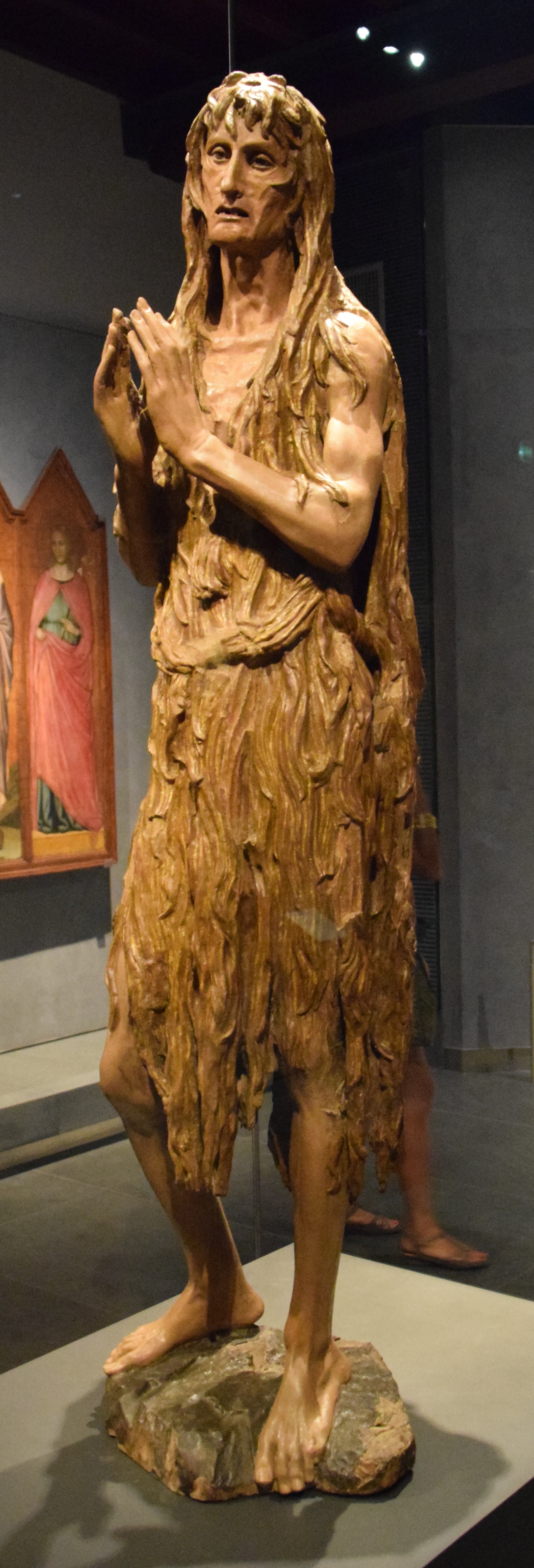
The eye lands on the face first. Hollow eye sockets, a gaunt cheekbone line, and a parted mouth trigger Face Detection before any other part of the sculpture registers. This is not a gentle draw. The skull-like quality of the face functions as Visual Pop-out: dark cavities against the surrounding wood catch attention pre-attentively, ahead of any read of the body as a whole.
From the face, the eye drops to the hands. Clasped and interlaced at chest height, the hands create a second anchor point directly below the face, connected by an implied vertical line. This is Anchoring and Reference Points at work: face and hands form two poles, and the gaze moves between them rather than settling.
The torso resists that easy travel. Deep vertical ridges running the length of the body read as Rhythm and Repetition, but the pattern is dense enough to register as Texture rather than distinct anatomical form. The eye slows here. Complexity and Visual Density is high across the hair mass and torso, low across the arms and lower legs, which are smoother and more sharply edged. That contrast in resolution, sharp face and limbs against blurred, striated core, produces the Detail Density Gradient: attention keeps bouncing off the torso and returning to the crisper zones.
Color reinforces the isolation. The warm brown/umber figure sits against a cool gray architectural background. This is Color Temperature and Color Weight and Advancement working together: the warm figure optically advances, the cool walls recede, and Figure-Ground Relationships lock the sculpture as the sole subject regardless of the deep architectural space behind it (receding tiles, vitrines, a staircase, all built through Linear Perspective).
Specular highlights on the ridge peaks, knuckles, forehead, and knees create small bright points across an otherwise matte, dark mass. These are Specularity/Surface Reflection effects from overhead gallery lighting. They do useful work: they pick out the raised topology of the carving and let the eye trace form without needing continuous edges.
The overall visual request is split. The face asks for prolonged, close attention. The torso asks to be read fast, as pattern, not form. Those two requests do not fully resolve into one continuous viewing rhythm. The eye keeps re-entering at the face.
MATERIAL AND FORMAL
This is a wood carving, roughly six feet tall, human-scaled against the surrounding museum architecture. The vertical gouges across the torso, hair, and garment are consistent with direct removal of material: a carver's tool working down a length of wood, leaving parallel channels rather than modeled musculature. Where the observations describe "bark" or "torn fiber," they are describing the actual behavior of gouged wood grain, not a metaphor applied after the fact.
The arms and lower legs carry crisper edges and smoother surfaces than the torso. That difference is a real material fact: less aggressive tool work in those zones, more finishing. The hand that carved this piece slowed down at the extremities and worked faster, rougher, deeper through the central mass.
The surface color, warm brown against cool gallery gray, is consistent with aged, unpainted or thinly pigmented wood rather than a metal patina, though the observation record itself is split on this: some readings lean bronze or cast metal. If the material is in fact wood, as the medium field states, then the "metal" readings are optical, produced by lighting and surface sheen rather than by the object's actual construction. That gap between what the material is and what it can look like under gallery light is itself a material fact worth naming: the specular highlights across the ridges can mimic cast metal's reflectivity even on a wood ground.
The rough, uneven base the figure stands on continues the same handling logic as the body: irregular, unsmoothed, in contrast to the machined gray plinth beneath it. The carver's roughness is set deliberately against the museum's engineered flatness. Up close, this asks the viewer to register tool marks as anatomy. At a distance, those same marks flatten into a single dark textured mass, and the body reads as a silhouette before it reads as carved wood at all.
CULTURAL
Donatello made this in Florence around 1440, deep into a period when devotional sculpture typically presented saints as composed, idealized, physically dignified figures. A carved wood Magdalene reduced to a skull-faced, emaciated body departs from that convention. One reading: the work enters a specifically penitential and ascetic strand of fifteenth-century piety, the same current that valorized hermits, desert fathers, and bodily mortification as spiritual achievement. Read that way, the extreme gauntness isn't a failure of idealization, it's the subject matter itself: years of fasting made visible in wood.
The institution housing it, the Museo dell'Opera del Duomo, signals that this object is read today as cathedral-adjacent patrimony, part of Florence's civic-religious sculptural canon alongside Ghiberti and other Duomo-associated masters. That museum placement, glass vitrines, tiled floor, staircase, converts a devotional object into a viewing object. A visitor today encounters it as sculpture-in-a-museum before encountering it as an object of veneration. That shift in context is not something the carving itself controls.
Whether this figure's illegibility as flesh, the skull-like face, the bark-like body, was legible in 1440 as an accepted representation of extreme asceticism, or whether it pushed past what patrons expected from devotional imagery, is a real historical question. One position: it extends an existing tradition of penitential imagery toward its logical extreme. Another position: it marks a departure from the softer, more Gothic-influenced Magdalene imagery common earlier in the century. Both readings require knowledge outside the image itself and should be held as positions, not settled fact.
CONCEPTUAL
The work appears to argue that extended penitence physically erodes the body toward something closer to raw material than to flesh. The Detail Density Gradient carries this argument directly: a still-legible human face sits atop a torso that has degraded into texture, into something closer to wood grain or bark than anatomy. That gradient reads as the conceptual center of the piece: the body dissolving from the inside out while the face, the seat of identity and suffering, stays sharp.
This puts the work in dialogue with a broader Christian tradition of imagery where physical ruin signals spiritual intensity rather than failure, the wasted body as evidence of years spent in the wilderness. Read this way, Donatello is not failing to finish the anatomy. He's using Economy of Means in reverse: withholding resolved form from the body precisely where a classical sculptor would apply the most modeling.
The clasped hands at chest height, held between the two anchor points of face and hands, function as Postural Affect: a held, contracted posture rather than an open, presentational one. Combined with the parted mouth and hollow eyes, the gesture supports a reading of interior suffering rather than external address to a viewer, though the contradicted gaze-direction evidence (up-and-past versus down-and-away) means the work is not decisively meeting or refusing the viewer's eye. That ambiguity itself may be part of the argument: a figure no longer oriented outward at all, whose attention has turned entirely inward.
The historical precedent that matters most here is the tradition of Magdalene-as-penitent-hermit rather than Magdalene-as-mourner-at-the-cross. This carving takes the hermit tradition to a physical extreme that later Renaissance sculpture, more invested in idealized anatomy, generally avoided. Hypothesis (insufficient visual evidence): that Donatello intended the wood's material qualities, the way carved grain evokes matted hair or desert-worn skin, as a specific conceptual device linking material and subject. The observations support the resemblance; they don't establish the artist's intent.
NOISE: CONSOLIDATED
PERCEPTUAL: The clean read is interfered with by the Detail Density Gradient itself. Face and hands are Anchoring and Reference Points inviting slow, close viewing; the torso's dense Texture invites a fast, pattern-level read. The eye cannot maintain one consistent viewing speed across the whole figure.
MATERIAL: The specular highlights across the ridges create a reflectivity that can visually mimic cast metal even though the medium is wood. This is not the carving fighting itself, it's gallery lighting producing an optical effect that contradicts the physical fact of the material, which is why the observation record itself splits on bronze versus wood.
CULTURAL: The museum setting (vitrines, tiled floor, staircase, placard) converts a devotional object into a viewing object. A visitor reading it as sculpture-in-a-gallery may miss the penitential-devotional context that gives the extreme gauntness its original meaning. That's a real gap between the audience the object was built for and the audience it now reaches.
CONCEPTUAL: The work's argument (bodily dissolution through penitence) depends on the viewer registering the material as wood eroded by tool and time. If the viewer reads the surface as bronze, the argument shifts from "flesh worn away by fasting" to "the eternal, cast image of a saint," which is closer to the opposite claim.
The material/gallery-lighting noise and the medium ambiguity are likely accidental, a product of photographic and lighting conditions rather than the carving's design. The Detail Density Gradient noise in the perceptual domain is more likely intentional, since it directly serves the conceptual argument about a body dissolving from the torso outward while the face remains legible.