OVERVIEW
The perceptual and material domains agree with each other almost completely. The eye moves along the floorboards, the paint moves the same way, the wood grain and the brushwork share one direction. That agreement is the stable core of this painting.
The cultural and conceptual domains introduce the friction. A history painting's scale applied to three laborers scraping a floor is a legible provocation in 1875 Paris, but the painting doesn't editorialize about that provocation anywhere in its surface. The formal rigor (perspective, value control, the calm signature) works against any reading of the subject as raw or unmediated labor. The eye is asked to admire construction. The subject asks to be read as class document. Those two demands don't fully reconcile, and the painting doesn't seem to be trying to reconcile them.
The unresolved question the work sits inside: is this a painting about looking at structure, or a painting about who gets looked at, and does Caillebotte's own class position (a wealthy amateur painting workers in his family's house) settle that question or just make it visible.
PERCEPTUAL
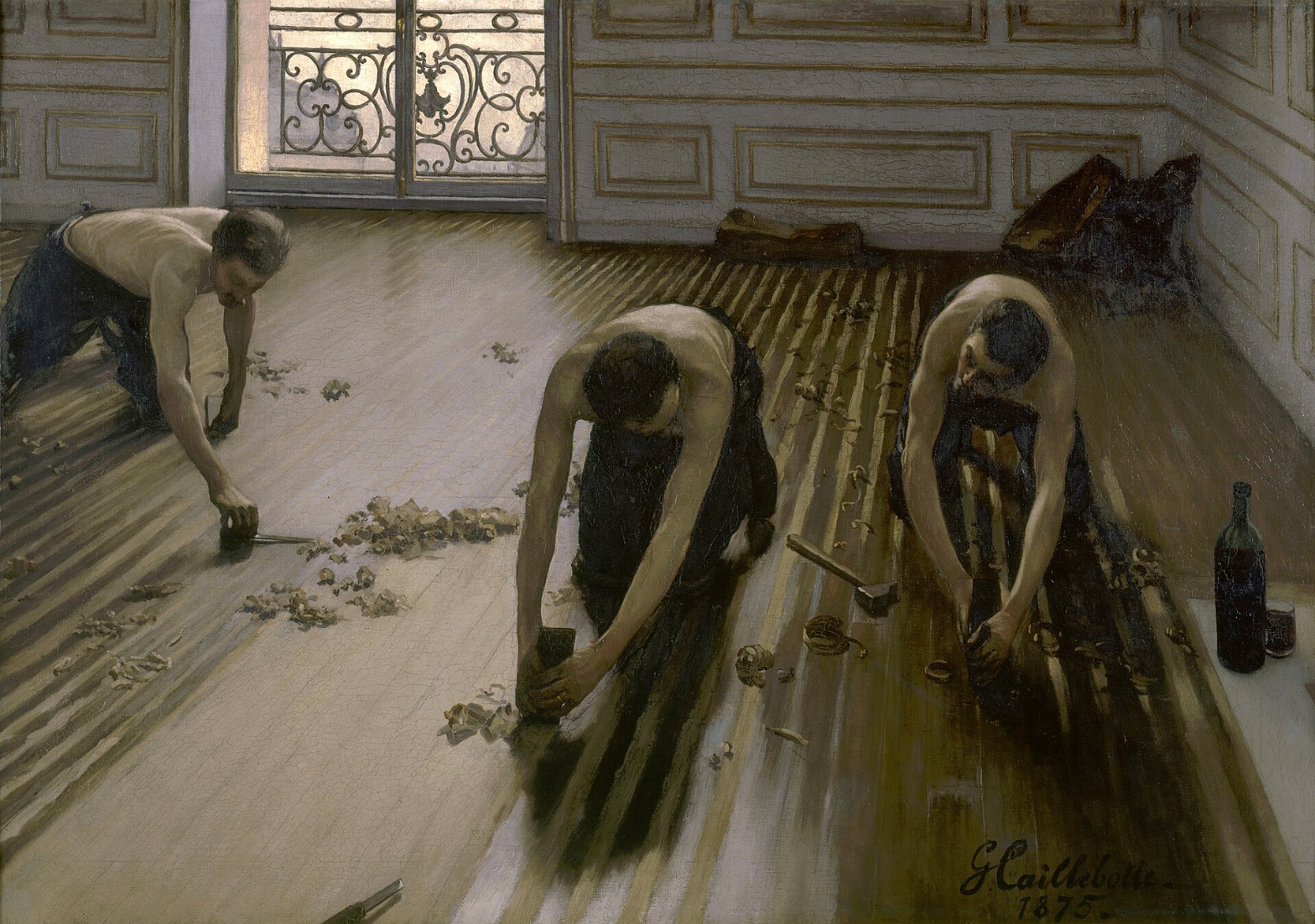
The eye lands on the window grille first. It's the brightest, sharpest passage in the painting, and the floorboards' Linear Perspective drives straight at it, so Directional Force and Anchoring and Reference Points both put the eye there within the first second. From that point the floorboards pull the eye back down and forward, board by board, in a long diagonal sweep. This is Rhythm and Repetition doing double duty: the boards repeat, and the three men repeat at intervals along the same diagonal, so the Interval Relationships between figures echo the interval between planks.
The three bent bodies stop the eye's slide toward the window. Their Postural Affect (curved spines, dropped heads, extended arms) reads as strain before any face is legible. No face is legible. Biological Motion Detection fires off posture alone, and Agency Attribution follows automatically: these are working bodies, not decorative ones. The dark trousers and skin against the pale floor give a clean Figure-Ground read, so the men separate from the ground instantly even where their edges dissolve into shadow.
The wine bottle and glass in the lower right is a small Visual Pop-out. It's a dark, hard-edged shape sitting alone against pale floor, and it catches the eye on its way out of the frame, briefly, before the signature does the same job again. The signature is the last stop, a controlled full stop after a painting built entirely on diagonal motion.
The conflict: the perspective system wants the eye to run straight back to the window in one gesture. The repeated figures want the eye to stop three times along that same run. The painting asks for both continuous motion and staged pause, and it gets the eye to do both by putting the stopping points directly on the moving line rather than off to the side.
MATERIAL AND FORMAL
Oil on canvas, roughly the size of a small door standing on its side. That scale matters here: it's the size usually reserved for history painting, and the subject is three men on a floor. The canvas is large enough that a viewer standing close sees individual brush loads separate from each other; standing back, they resolve into board and shadow.
The handling changes by zone, and the change is visible, not smoothed over. The floorboards and the ironwork are laid down with straight, controlled strokes, following the wood grain and the perspective lines exactly. The wood shavings are built with thicker, curled, impasto touches, physically raised off the canvas in a way the floor is not. Run a hand near the surface (not on it) and the shavings would catch light differently than the flat boards around them, an Edge Detection difference of paint thickness matching a difference of depicted material. That's the surface being honest about construction: flat things painted flat, curled things painted with a curl of paint.
Skin and shadow are where the surface loosens. Edges soften where a knee meets the dark floor or where a shoulder drops into shade, and this is Focal Blur/Depth of Field handled by hand rather than optics, since a fixed-lens eye in 1875 wasn't the model, controlled attention was. Faint craquelure runs across the paint film at this point in the work's life, a network of surface cracks that has nothing to do with the image and everything to do with the physical age of the drying oil.
Up close the painting is a set of decisions about stroke direction and paint load. At a distance those decisions add up to a floor, a window, three men, a bottle. Nothing here contradicts the subject. The controlled, almost architectural handling of the floor supports a reading of the room as a stable, rule-governed space, and the looser handling of the bodies keeps them from becoming just another board in that system.
CULTURAL
One reading: this painting enters the Salon-scale history-painting tradition and swaps out its usual cast. Bare-chested men bent in labor, seen at close range, filling a canvas this size, is a gesture usually reserved for mythological or religious bodies. Caillebotte's own submission of this work to the 1875 Salon, where it was reportedly rejected before appearing with the Impressionists, suggests the scale-subject mismatch was legible to contemporaries as too plain, too material, not elevated enough in subject to justify its size. Whether that account of reception is accurate for this specific painting is a claim about institutional history, not about the image itself.
A second reading: the restrained, warm, closely observed palette and the tight perspective control align the painting with a Realist project descending from Courbet, work that insists ordinary labor deserves the same visual seriousness as a battle scene or a saint. The floor scrapers' bodies get the same commitment to structure that a academic nude would receive.
A third reading, harder to settle from the image alone: Caillebotte's position as a wealthy man painting laborers in what may be his own apartment building raises a question about whose labor is being aestheticized and for whom. The painting doesn't resolve this. It shows the men working, gives them no faces to individuate them, and gives enormous formal care to the floor they're stripping. Whether that formal care dignifies the labor or absorbs it into decoration is a live disagreement, not something the canvas settles.
The wine bottle in the corner might read, in one possible interpretation, as a small note of ordinary domestic life amid the labor, a detail an Impressionist-adjacent audience would recognize as a marker of unposed, observed reality rather than staged allegory. That reading rests on the object's Visual Pop-out status and its placement near the signature, an anchoring position usually reserved for a maker's personal touch.
CONCEPTUAL
Hypothesis (insufficient visual evidence): the painting argues that industrial-era Paris renovation labor deserves the pictorial weight of history painting. This reading is supported by scale and by the compositional seriousness given to Postural Affect and Directional Force, but the claim about renovation-era Paris specifically requires knowledge outside the image.
What the image can support more directly: the painting treats structural analysis (perspective, floorboard geometry, light logic from the window) and bodily labor as equivalent subjects, worth the same degree of attention. The floorboards get the same rigor as the men's spines. Nothing in the paint privileges the men over the room, which is itself an argument. A painting that wanted the men to dominate would use Scale Relationships or Color Weight and Advancement to push them forward against the room. Instead the room and the men share the same Value Structure, the same warm restrained palette, the same level of finish. That equivalence reads as an argument for a kind of Realism where the maker's attention is evenly distributed, no hierarchy of subject over setting.
The absence of faces matters conceptually. Without Face Detection cues, the men can't become individuated portraits; they stay figures defined by Biological Motion Detection and Postural Affect alone. That choice, read as intent, positions the painting closer to a study of labor as form than a document of specific people. Whether that is a limitation or the actual argument (labor rendered as structural motif, parallel to the floorboards themselves) is a position the painting takes without commenting on it.
The historical precedent that matters most for this argument is Courbet's Stone Breakers, a painting with the same subject register and a similarly plain formal seriousness. Caillebotte's version replaces Courbet's rougher, more overtly political handling with a tighter, more geometrically governed space. That shift, if read as deliberate, moves the argument from social protest toward optical and structural analysis: labor as an occasion for studying light, line, and interval, not primarily as a call to political attention.
NOISE: CONSOLIDATED
PERCEPTUAL: The perspective system pulls the eye continuously toward the window while the repeated figures demand three separate stops along that same path. Continuous motion and staged pause compete on the same diagonal line. The eye resolves it by treating the men as way-stations rather than obstacles, but the two demands are genuinely in tension, not merely additive.
MATERIAL: No real fight here. The zones of tight, controlled handling (floor, ironwork) and loose handling (skin, shadow) match what those materials are depicting. The craquelure is age, not intention, and doesn't interfere with the formal logic; it sits outside the argument entirely.
CULTURAL: The painting's scale and formal seriousness point toward history painting's audience, but its subject and plain domestic details (the wine bottle, the bare floor) point toward Realist and proto-Impressionist audiences with different values. A Salon jury reading it as under-elevated and an Impressionist circle reading it as still too academically controlled are both plausible receptions, and the painting doesn't clearly commit to either audience's taste.
CONCEPTUAL: The argument for even-handed attention to labor and structure is undercut by the facelessness of the men. Treating labor as form risks flattening the very people the subject seems to elevate. The painting doesn't resolve whether this facelessness is respect for form or erasure of the individual.
The eye's staged pauses on the figures and the conceptual choice to withhold faces work together: both keep the men present as bodies-in-structure rather than portraits. The Salon-versus-Realist ambiguity and the craquelure are the accidental noise, one a matter of unsettled reception history, the other simple physical aging with no bearing on the picture's argument.