OVERVIEW
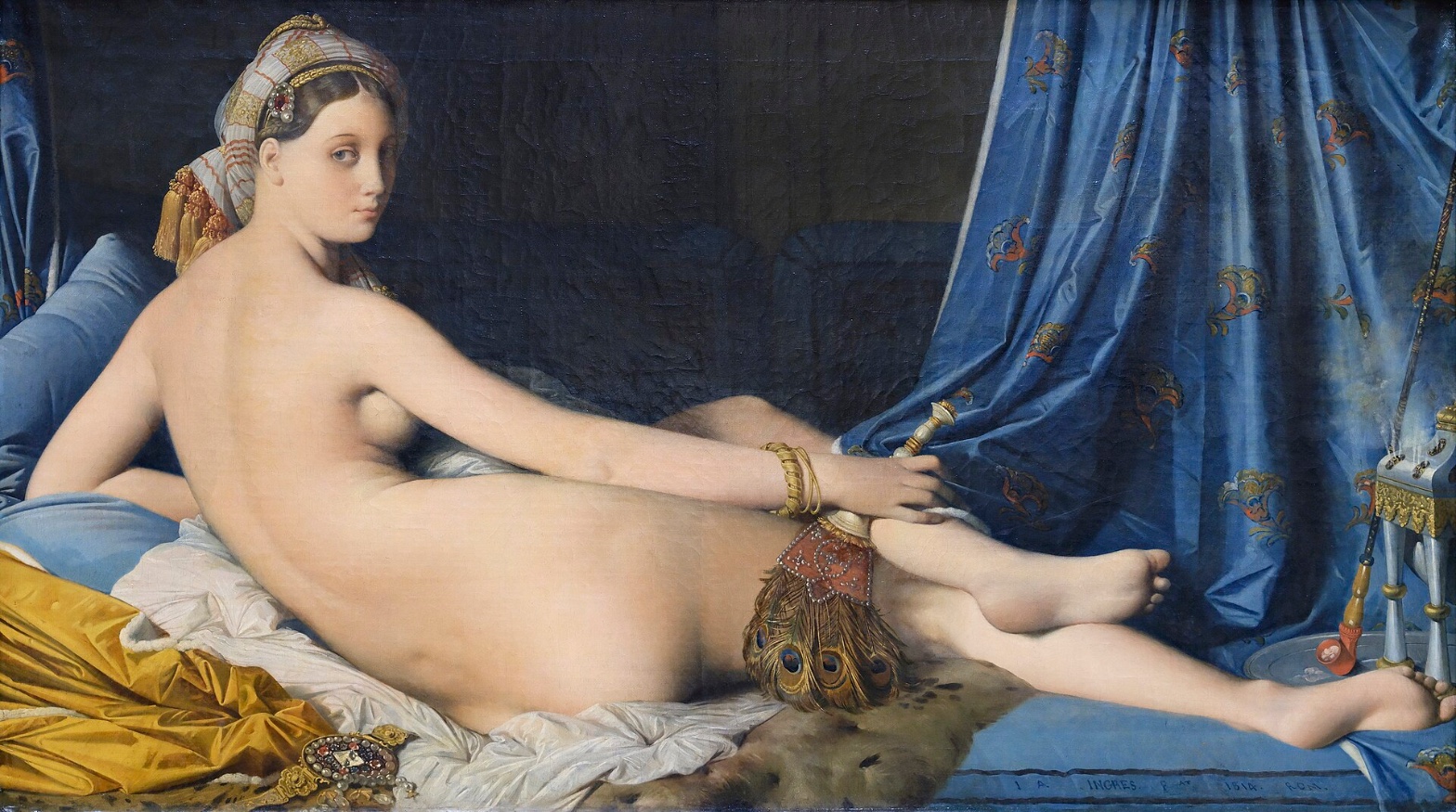
The eye and the anatomy disagree. Perceptual attention moves smoothly, back to front, dark to light, sharp edge to soft edge. The body it's moving across doesn't hold together as a single physical structure. That's the core tension in this work, and it shows up differently in each domain.
Material handling supports the eye's smooth path: the flesh is rendered with almost no visible brushwork, so nothing interrupts the light mass as it reads. But that same smoothness is what lets the elongation slide past on first viewing. The paint doesn't announce the distortion. It absorbs it.
Culturally, the work sits inside a fully legible genre, the reclining odalisque, the Orientalist harem interior, a tradition Ingres's audience at the 1814 Salon would have recognized instantly through the props alone: peacock fan, blue brocade, incense vessel, turban. The anatomical liberty is the disruption inside that legible frame. Critics at the time read the spine as a mistake. A later reading treats it as the argument.
Conceptually, this is where the domains actually converge instead of fighting: the perceptual smoothness, the material erasure of the hand, and the anatomical impossibility all point at the same idea, that this figure is built for a sustained gaze, not for anatomical truth. Peak Shift and Scale Relationships are doing real work here, not just describing an error.
The unresolved tension: does the painting's fluency (the eye's ease, the paint's polish) neutralize the deformation it's built on, or is that fluency the mechanism that makes the deformation acceptable to look at.
PERCEPTUAL
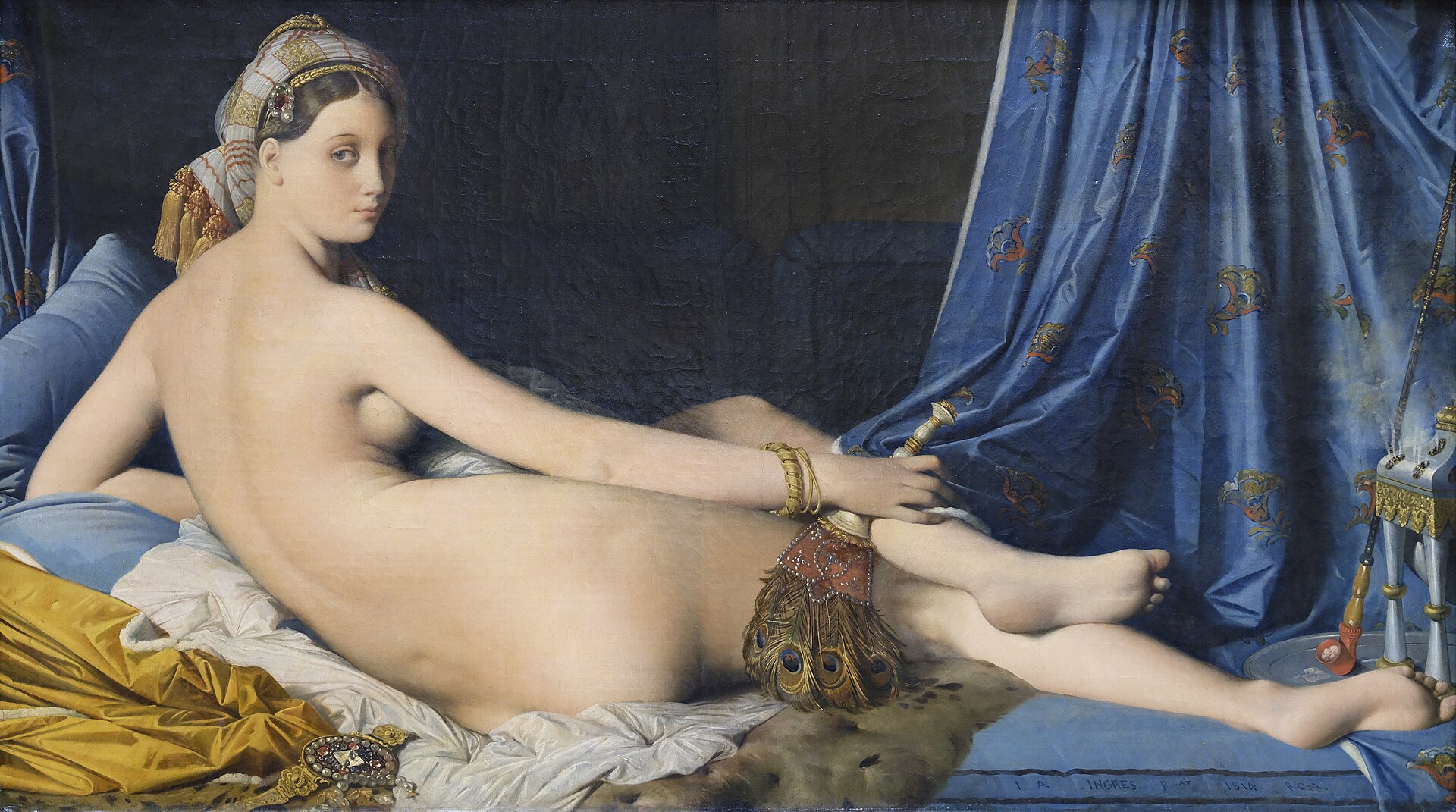
The eye lands on the pale back first. It's the largest continuous light shape in the frame, set hard against a near-black background, and that value jump is the strongest pre-attentive signal in the composition, a clean case of Figure-Ground Relationships and Visual Pop-out. From there the eye has two competing paths. One follows the spine's long curve rightward toward the turned head, pulled by Gaze Direction, since the face looks back at the viewer and Face Detection recruits attention fast. The other gets pulled sideways by the saturated blue curtain and its gold brocade, which compete for weight through Color Weight and Advancement and Saturation.
Edges do specific work here. Where the back meets the dark wall, the contour is hard and exact, a clean line that stops the eye and holds the silhouette. Where flesh meets the white bedding or falls into shadow, the edge softens and dissolves, so the body seems to breathe out into its surroundings at the bottom while staying crisp at the top. That's an edge-quality split, not a lighting inconsistency, and it directs the eye to keep circling the upper body rather than exiting downward.
The peacock fan and the jewelry act as texture interruptions. Both are rendered with tight, specific detail, fine barbs on the feathers, hard specular points on the bracelets, against the otherwise matte, undifferentiated skin. That contrast (Detail Density Gradient) gives the eye small stopping points along its circuit, so attention doesn't fully settle on the body, it keeps making short trips out to the objects and back.
The proportions ask something harder to name cleanly. The back reads as continuously long, and nothing in the image gives a hard perspective check on that length, no floor grid, no architectural line, just overlap and drapery. Overlap/Occlusion carries the depth cues almost entirely (no linear perspective is present), which means the eye has no external ruler to catch the elongation against. The distortion doesn't stop the eye. It just doesn't correct itself either.
MATERIAL AND FORMAL
Oil on canvas, thirty-five inches by sixty-four inches, close to the footprint of a door laid on its side. The paint handling splits sharply by subject. Flesh is built with soft, blended transitions, brushwork suppressed almost to nothing, so the body reads as continuous light rather than as marks. The curtain, the fan, the jewelry get the opposite treatment: distinct, worked passages, individual feather barbs, tight specular hits on metal and gems, visible pattern-work in the brocade.
That split is a formal decision, not an inconsistency. The smooth flesh asks to be seen from a distance, as shape and light mass. The textured objects ask for close inspection. The canvas is doing two different kinds of looking at once, and the size of the work, big enough to hold a life-scale figure, supports both: far enough back, the body reads as pure Value Structure/Massing; close in, the objects reward Edge Detection and surface attention.
The smoothness of the flesh is also what makes the anatomical stretching hard to catch. There's no seam, no visible correction, no place where the paint shows the hand adjusting a joint or a rib. The surface is confident and finished everywhere, which means the elongation isn't a visible edit. It's built into the initial drawing and carried through without the paint ever flagging it. The material is honest about its own construction (blended oil, deliberate contrast in touch across zones) but it is not honest about the body's structure. Those are two separate claims and they don't align.
CULTURAL
This sits inside the reclining nude tradition running through Titian and Giorgione, restaged as an Orientalist harem scene, a genre the 1814 Salon audience would read immediately from the props: peacock fan, hookah-adjacent vessel, brocade curtain, turban. One reading is that Ingres is using an exoticized setting to license a nude that a mythological or classical setting no longer could, sidestepping the moral scrutiny attached to a French female body by relocating her to an imagined Ottoman interior.
The anatomical elongation is the specific point where the work stops being legible to its own moment. Contemporary Salon critics read the extra vertebrae and stretched back as bad drawing, a failure of academic correctness Ingres was otherwise trained to deliver. A later reading, developed well after the fact, treats that same distortion as intentional, as evidence that the painting prioritizes a continuous decorative line over anatomical truth. Both readings depend on the same visual fact, the elongated spine, read through different institutional expectations. This is a case where illegibility to one audience becomes legibility to another: the Salon wanted correct anatomy, later modernist and formalist criticism wanted evidence of pictorial invention over mimetic obligation.
The painting's current position in the Louvre, as a canonical reference point for Ingres and for the odalisque genre generally, is itself a later cultural fact, not something visible in the image. What is visible is a work built entirely out of recognizable genre signals, aimed at a Salon audience that had a fixed vocabulary for reading them.
CONCEPTUAL
The argument, if the elongation is read as deliberate rather than accidental, is that pictorial coherence can override anatomical fact. Ingres trained inside a tradition built on correct drawing as the precondition for painting. This canvas keeps every surface convention of that tradition, hard contour, smooth modeling, precise value structure, while breaking its core rule. That's a specific kind of argument: fidelity to line and surface rhythm matters more than fidelity to the body underneath it.
Hypothesis (insufficient visual evidence): the turned head and returned gaze function as a deliberate strategy to hold the viewer's attention on the face long enough that the spine's length goes unchecked. This would require knowing Ingres's working intent, which the image alone can't confirm; what's observable is only that the gaze pulls attention and the elongation runs along the same visual path.
Where the material and perceptual domains agree, smooth paint handling plus a lack of external depth cues, the conceptual claim gets real support: the picture is built to be taken in as a continuous decorative line first, an anatomical structure second. That puts it in dialogue with a tradition (extending forward to Matisse's odalisques and backward to Mannerist elongation in painters like Parmigianino) where the body becomes a vehicle for line and pattern rather than a record of observed structure. The perceptual thinness, the fact that nothing in the composition forces a viewer to measure the spine against a fixed reference, isn't a failure of the argument. It's the condition that lets the argument work at all.
NOISE: CONSOLIDATED
PERCEPTUAL: The two things competing for the eye, the pale body via Figure-Ground contrast and the saturated blue curtain via Color Weight and Advancement, split attention rather than sequencing it cleanly. There's also no external depth reference (no linear perspective, only Overlap/Occlusion) to check the body's proportions against, so the eye can't confirm or deny the distortion it's moving across.
MATERIAL: The suppression of brushwork in the flesh works against a viewer trying to visually audit the anatomy. Smooth paint reads as confident and correct even where the underlying structure is not. The material choice that makes the body beautiful is the same choice that hides its inconsistency.
CULTURAL: The Orientalist framing was fully legible to its intended Salon audience, but the moral and now the postcolonial reading of that framing were not available to that audience and complicate legibility for a contemporary one. A viewer today reads the harem setting as a historical construct requiring context most casual viewers won't bring.
CONCEPTUAL: If the elongation is the argument (line over anatomy) the work never signals that clearly. Nothing in the image separates "artist's deliberate distortion" from "period Salon audiences were right, this is an error." The painting doesn't argue for its own liberty; it just takes it.
Some of this noise is doing double duty. The smooth paint that hides the anatomical liberty (material) is the same mechanism that lets the perceptual path run uninterrupted and lets the conceptual argument (line over structure) hold together; the cultural ambiguity around intent versus error is likely accidental, a gap in the historical record rather than a built-in device.