OVERVIEW
The perceptual and material domains agree with each other almost completely. The eye's path (top figures, down through the central chamber, out through dense pilasters, resting at the base) tracks exactly where the bronze is worked hardest and softest. Value structure and tool marks reinforce the same hierarchy the eye already builds on its own.
The cultural and conceptual domains pull against that stability. Culturally, the work sits inside an institutional apparatus (a doorway that never became a doorway, a commission that outlived its building) that complicates any clean reading of "monument" or "portal." Conceptually, the work argues for chaos and multiplicity inside a rigid frame, and that argument depends on the very symmetry/asymmetry tension the perceptual pass documents. So here the domains reinforce rather than conflict: the eye's experience of order-versus-disorder is the conceptual argument, not just a formal byproduct of it.
The real friction is internal to the perceptual record itself, carried into the other domains as unresolved noise: observers disagree on where density peaks, how rigid the symmetry really is, and where the eye actually stops. That disagreement is not resolved by material study (which confirms hand-tooling everywhere, undifferentiated) or by cultural/conceptual framing (which explains why density and rest might be deliberately withheld, not settled).
The live question the work sits inside: does the base offer real visual rest, or is that rest an illusion produced by exhaustion rather than resolution.
PERCEPTUAL
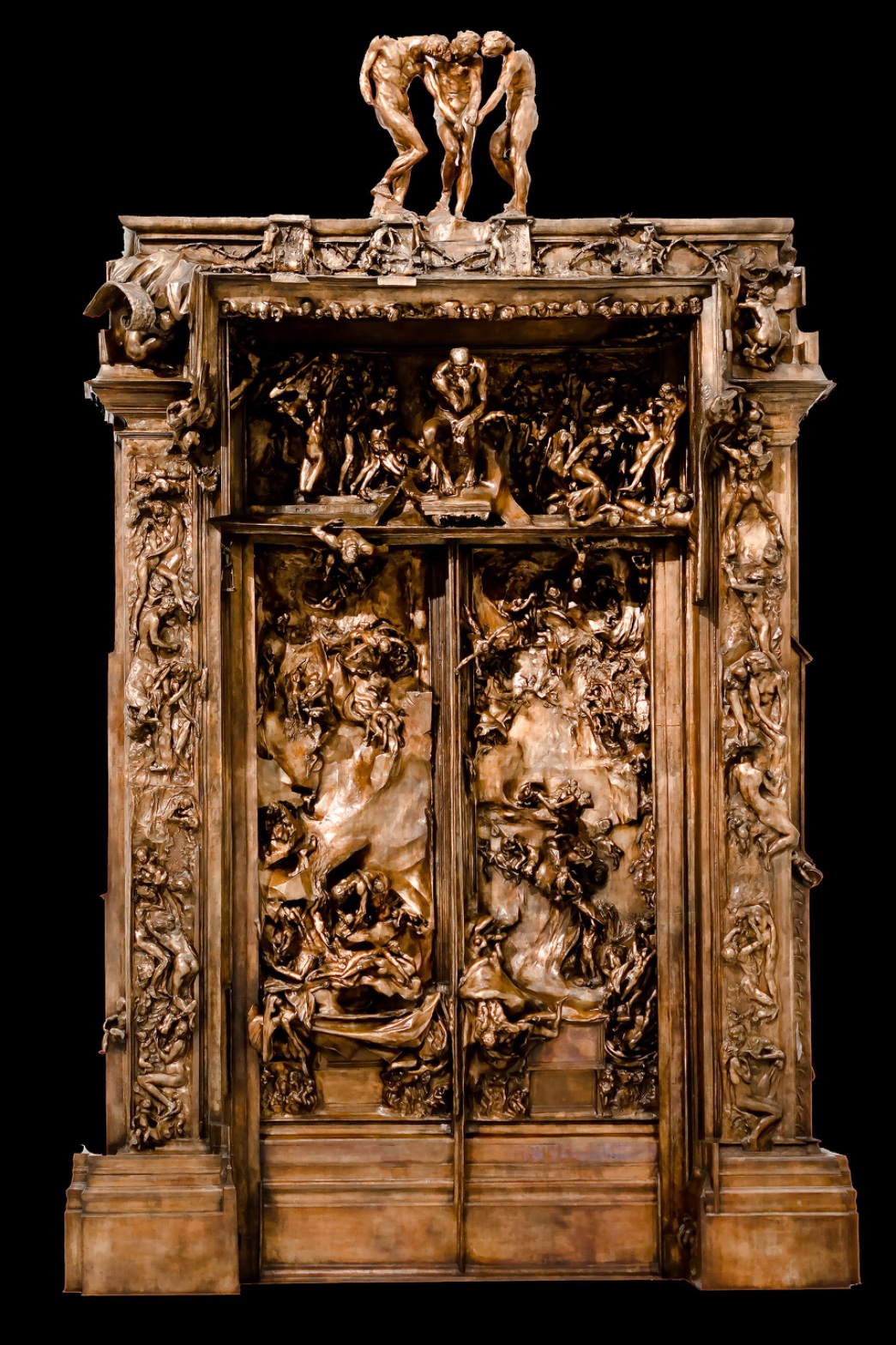
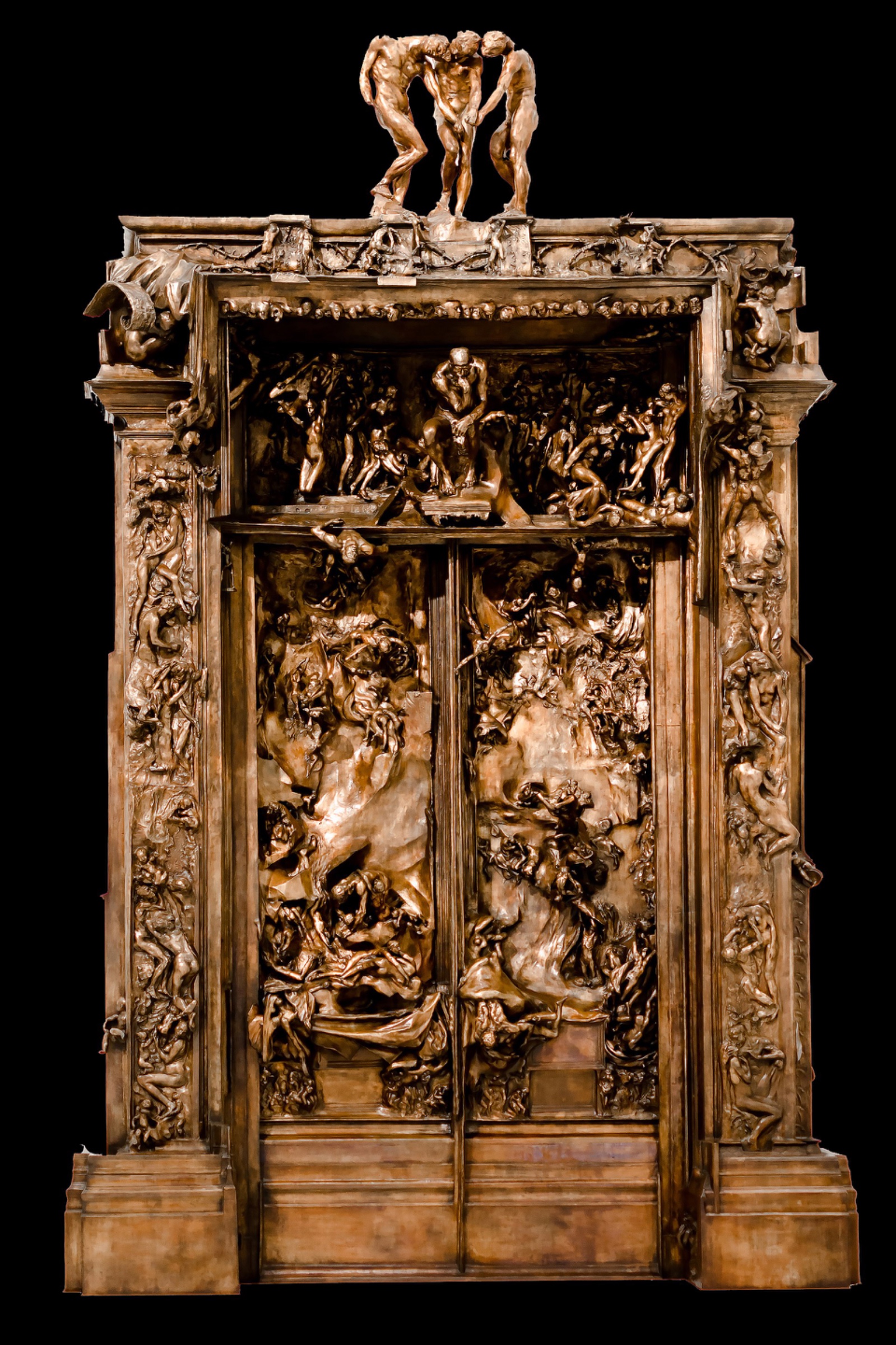
The eye lands first on the three nude figures at the top. They sit against pure black, so Figure-Ground Relationships do the initial work: warm bronze mass against flat void gives instant Visual Pop-out. Nothing else in the composition has that kind of isolated silhouette.
From there the three figures lean their heads toward a shared point. That inward lean reads as Agency Attribution and Directional Force/Implied Movement together. The heads converging create a funnel. The eye follows that funnel down into the recessed central chamber, where a seated figure catches more light than its neighbors. That figure functions as a second Anchoring point, a place to land after the fall from the top.
Below that, density takes over. Overlap/Occlusion is constant: torsos cross limbs, limbs cross other limbs, and Edge Detection starts to fail. Contours that were crisp at the top dissolve into merged, ambiguous masses in the door panels and pilasters. This is where Complexity and Visual Density peaks, and where the eye slows down, because it has to work to separate one body from another.
The two vertical pilasters compound this. Small figures stack in continuous Rhythm and Repetition, climbing the columns, and the smaller Scale Relationships here (versus the larger top and central figures) push those bands slightly into the background even though they're carved just as deep. Meanwhile, smoother passages within the door panels act as a release valve, plain enough for the eye to rest for a beat before diving back into the crowd.
The base is the one place agreement is strong: it's plainer, less crowded, and the eye slows to a stop there. Whether that stop is genuine rest or just visual fatigue after so much occlusion is a live question the perceptual record doesn't settle. The architecture around all of it, pilasters, lintel, base, stays bilaterally symmetrical, so the frame gives a stable container for content that never behaves symmetrically inside it. That tension, rigid outer frame against writhing interior, is what keeps the eye moving instead of settling early.
MATERIAL AND FORMAL
This is bronze, cast from a plaster model, worked by hand before casting and finished after. The surface everywhere carries tool marks: gouges, soft transitions between planes, the kind of texture that comes from modeling in clay or plaster and pushing material around rather than from a mechanically smoothed final pass. Up close, the hand is visible in every recess. Nowhere does the surface pretend to be seamless or industrial.
The palette stays inside one family: bronze, ochre, umber, copper, gold. There's no hue-based way to separate one figure from the next. Instead depth comes entirely from Value Structure/Massing and Specularity/Surface Reflection. Raised surfaces, shoulders, knees, heads, catch the brightest highlights. Recesses between bodies go almost black. That's the only depth cue doing real work here, since color offers nothing extra.
The physical choices support what the eye already does. The dense, hand-gouged crowding in the door panels and pilasters isn't cleaned up or simplified; it's built to resist quick reading, matching the perceptual difficulty of separating overlapping bodies there. The top three figures and the central seated figure, by contrast, get more resolved, legible modeling; the hand spent more separating time on the parts meant to anchor the eye first.
Up close the material asks for tactile attention: every gouge is a decision, not an accident of casting. At a distance, all of that detail collapses into value masses, and the piece reads as light and dark shapes rather than individual figures. The material is honest about both distances. It doesn't fake a smooth read from far away, and it doesn't fake a mechanical read up close.
CULTURAL
One reading: this work sits in the tradition of the monumental portal, church tympanums, triumphal arches, doors meant to be walked through and meant to announce what waits on the other side. It never became a functioning door. It stayed a freestanding sculptural object, first as plaster, later as multiple bronze casts distributed to museums. That history puts it in conversation with the museum-as-cathedral, an object built for threshold ritual now displayed for contemplation instead of passage.
A second reading: it enters the field of individual figures extracted and sold separately, The Thinker and The Kiss both began as details within this larger composition. That practice, cannibalizing a large unified work into standalone marketable pieces, positions the object inside a market logic that values fragments over the whole. That's arguably in tension with the physical unity the piece displays: one continuous field of Complexity and Visual Density, not a set of discrete vignettes designed for extraction.
For an audience trained on Christian portal sculpture (Bourges, the Baptistery doors), the reference is legible: hierarchy of figures, top-to-bottom narrative descent, architectural frame around figural chaos. For an audience trained on later modernist sculpture, valuing reduction and Economy of Means, the density and literary program (Dante-derived subject matter) can read as excess rather than sophistication. The work doesn't resolve which audience it's for. It was built across nearly four decades, revised continuously, and arguably belongs equally to both audiences without fully satisfying either one.
CONCEPTUAL
Hypothesis (insufficient visual evidence): this work argues that damnation has no single organizing narrative, only accumulation.
That hypothesis is worth naming even without full anchoring, because the perceptual record supports adjacent, better-anchored claims. The architectural frame stays symmetrical and rigid while the figural content stays chaotic and asymmetrical. That tension is documented directly: bilateral symmetry in pilasters/lintel/base, disorder in the bodies within. Read conceptually, that's an argument about order imposed on top of chaos rather than order emerging from it, the frame doesn't tame the content, it just contains it.
The work is in dialogue with a Romantic-into-modern tradition that treats the fragment and the unfinished as more truthful than the polished whole. Visible tool marks, edges that dissolve into ambiguity in the dense panels, a surface that never resolves into smooth finish: these support a position that finish is dishonest, that the labor of making should stay visible as evidence of struggle with the subject matter. That's a plausible reading, not a settled one; it depends on knowing Rodin's stated resistance to academic finish.
The precedent that matters is Dante's Inferno as literary source and the Baptistery Doors (Ghiberti) as sculptural precedent. Both give this work a lineage of using a doorway as a compressed narrative field, many scenes forced into one frame, sequence collapsing into Simultaneity vs. Sequence. Where the perceptual record shows top-to-bottom eye movement without a stable, agreed final resting point, the conceptual position this suggests is that the narrative of damnation has no ending, only an exhausted stopping point. That reading is anchored by two things: the base's documented plainness and the persistent disagreement over whether the eye actually settles there or just gives up.
NOISE: CONSOLIDATED
PERCEPTUAL: The clean top-to-bottom read is interrupted by disagreement over where density peaks. If pilasters carry the densest crowding, the eye's path bends sideways as much as downward. If the central chamber or door panels carry it instead, the vertical funnel from the top figures stays intact longer. Both can't be true of the same first-seconds experience.
MATERIAL: No real fighting here. The hand-worked surface, the value-driven depth cues, and the monochrome palette all support the same reading consistently across the observed record. This domain is stable.
CULTURAL: The work's history as a source for extracted, individually famous fragments works against its identity as a unified field. An audience encountering The Thinker or The Kiss first may never read the Gates as one continuous argument at all, only as a quarry.
CONCEPTUAL: The claim that chaos-within-order is deliberate philosophical argument rather than compositional accident is only as strong as the symmetry evidence, and that evidence is itself contested (rigid versus loose readings of the frame). If the frame isn't actually as rigid as claimed, the whole order/chaos argument weakens.
The material stability looks intentional, serving the conceptual argument about visible labor and unresolved struggle. The disagreements over density location and symmetry rigidity look accidental, artifacts of how differently three separate viewers parse the same crowded field rather than something the object itself resolves.