OVERVIEW
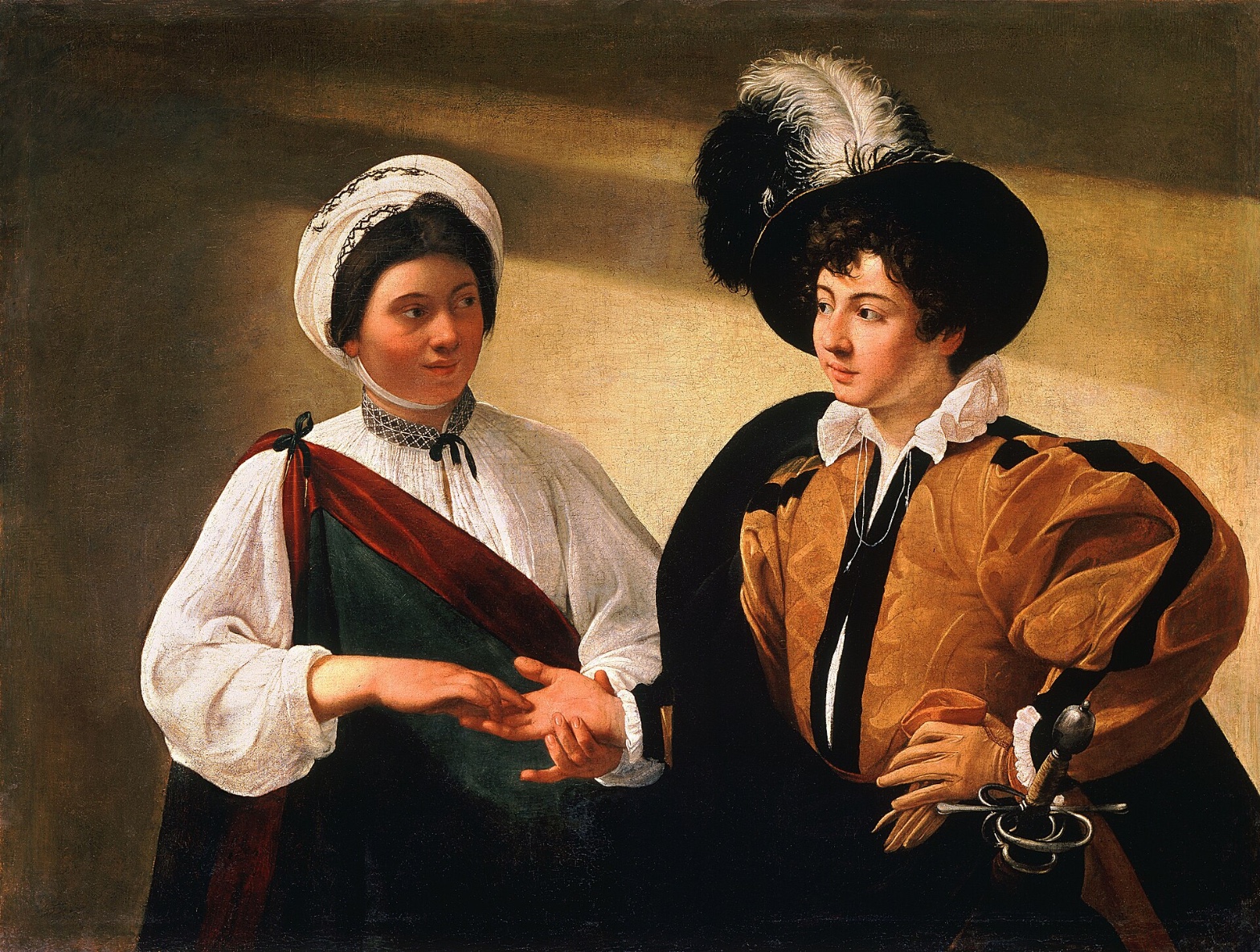
Four domains agree on one thing: this is a painting built on contact. The perceptual pull toward the meeting hands matches the material handling at that same spot and matches the cultural function of the fortune-teller theme. That much is aligned.
The tension starts with gaze. Multiple observation runs disagree on who looks at whom. That disagreement is not noise to throw out. It is the perceptual fact the painting produces: reciprocity is not settled by looking at it. The conceptual reading (a story about deception, about who has the upper hand) depends on knowing who is watching whom. The image will not give that up cleanly. So the conceptual argument about theft and vulnerability runs ahead of what the perceptual record can confirm.
Material handling stabilizes the composition rather than complicating it. Sharp edges at flesh and white cloth, soft dissolving edges at hat-into-cloak, one hard reflective accent at the sword hilt: these choices reinforce where the eye already wants to go. The material domain is not fighting the perceptual domain here. It is quietly obedient to it.
Cultural placement introduces the real friction. A genre scene of low-life trickery, painted at a scale and with a physical presence usually reserved for religious or history painting, creates a category conflict. That conflict is legible as a deliberate move within Caravaggio's early Roman output, read as a possible position rather than a fact about reception.
The unresolved question the work sits inside: does the woman take the ring, or does the man simply not notice her hand yet? The painting withholds the tense.
PERCEPTUAL
The eye lands on the hands first. Two half-length figures fill almost the entire canvas, cropped tight to the picture plane, so there is nowhere else close for the eye to go. The meeting point of the hands sits near the center of the canvas and functions as the clearest Anchoring and Reference Point in the image. Sharp edges at the fingers and at the white cuffs surrounding them pull focus through Edge Detection; everything else in the frame is comparatively softer.
From the hands, the eye moves outward along two paths. One path rises to the faces, where Gaze Direction / Social Attention is active between the two figures rather than toward the viewer. Whether that gaze is mutual or one figure looks past the other is not something the eye can resolve at first pass. That ambiguity itself becomes a perceptual event: the eye keeps returning to the faces looking for confirmation it cannot get.
The other path drops to the lower right, where the sword hilt gives a small, hard, cool Specularity/Surface Reflection against the surrounding cloth. This acts as a secondary stop, a Visual Pop-out point by contrast of temperature and hardness against soft fabric.
Value Structure/Massing does the heavy lifting for composition. Light faces, hands, and white fabric sit against a near-black hat and cloak. That contrast is stronger than any color contrast in the painting and organizes the read before color registers at all. The black hat-into-cloak passage is where the eye lets go: Figure-Ground Relationships collapse there, the shape dissolves into undifferentiated dark, and attention has nothing to hold onto so it drifts back toward the lit hands and faces.
Depth reads through Overlap/Occlusion alone. The two bodies stack against a shallow warm wall; there is no Linear Perspective doing any work. A diagonal band of lighter light crosses the background, which reads as Light Source Logic pointing from upper left, but it does not create real spatial recession, only a lighting event on a flat wall.
The visual requests are not fully in conflict but they do compete: the sharp hands ask for close, sustained looking; the dissolving black mass asks to be skipped past quickly. The result is a fast circuit between two or three fixed points rather than a slow scan across the surface.
MATERIAL AND FORMAL
Oil on canvas, a little over three feet wide, a little over three feet tall: a scale close to a small table, close enough that a viewer standing in front of it meets the figures near life-size at the hands and faces. That scale matters for the sword hilt and the hands: their handling only pays off at close range.
The hand of the painter is most visible in two contradictory ways. At the faces, hands, and white cloth, the paint is controlled, the edges crisp, the transitions between light and shadow narrow and precise. At the hat and cloak, the paint handling loosens. Black moves into black with soft, blended transitions, no attempt to describe individual fold or fabric structure once value drops that low. This is not a failure of skill. It reads as an economical decision: paint hard where the eye needs to stop, let paint go soft where the eye is meant to pass through.
The metallic accent at the sword hilt is a small, separate performance. A tight highlight against a cool ground sits in contrast to everything around it; it is the one place in the painting where the paint imitates a hard reflective surface rather than skin or cloth or plume.
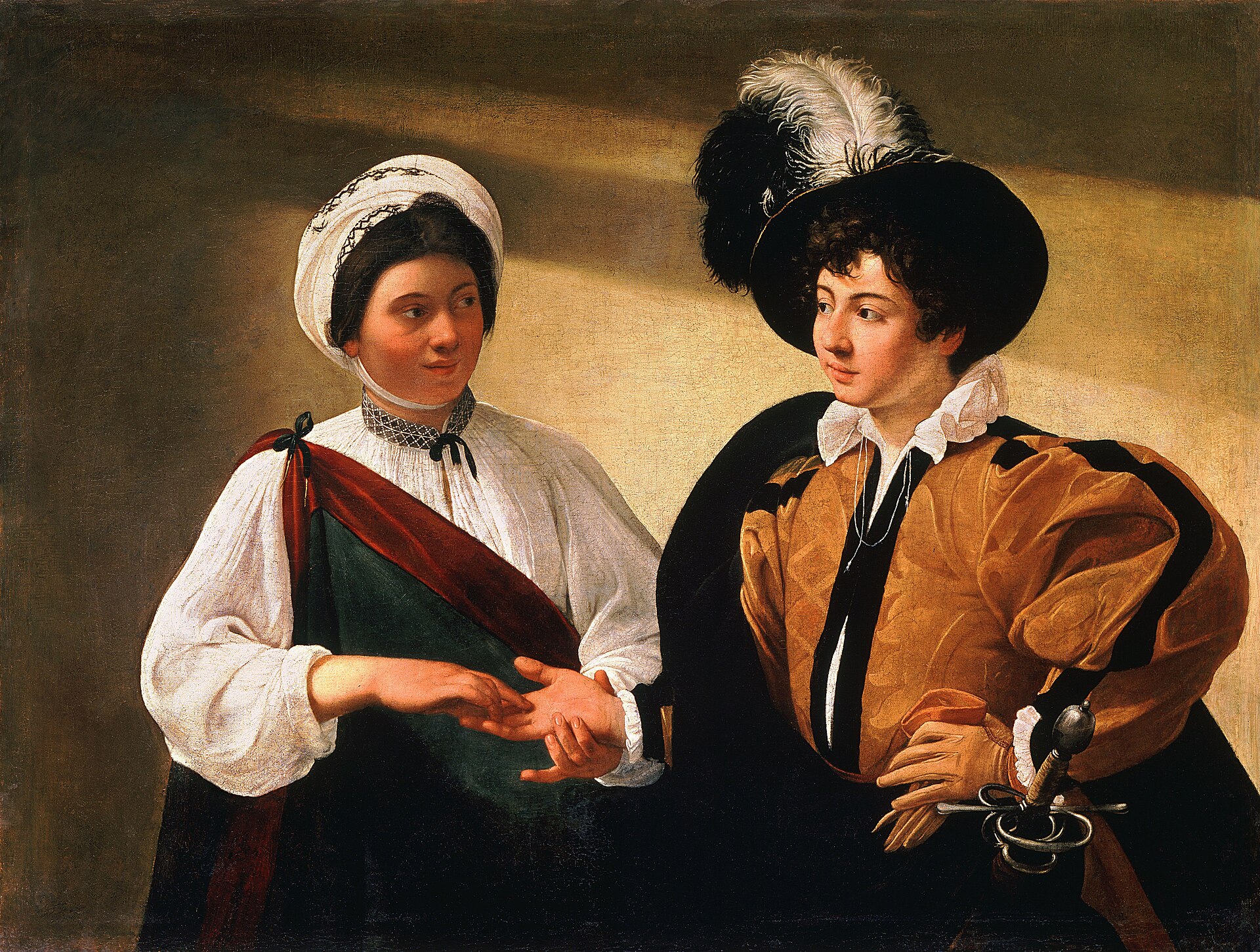
The described craquelure across background and flesh passages, where present, points to the age of the varnish and ground layers rather than to anything in the original design; it is a condition of the object now, four hundred years on, not a formal choice from 1594.
Up close, the painting asks the viewer to notice where description stops: the black cloak has almost no internal information once you are inches from it. At a normal viewing distance, that same area reads simply as weight, as mass, not as absence. The material choice supports the perceptual logic rather than contradicting it: economy of paint at the darks, density of paint at the point of contact.
CULTURAL
A possible reading: this painting enters the genre-scene tradition of card sharps, gypsies, and confidence games that circulates in late sixteenth-century Rome, a tradition usually treated as minor, moralizing, or comic. Painting that subject at half-length, close to life-size, with the same physical seriousness usually given to a saint or a history subject, is one way this work could be read as taking a low subject and giving it the visual weight of a high one.
A possible reading of audience: the immediate Roman audience of collectors and clergy, particularly del Monte's circle, would recognize both the genre type (theft dressed as fortune-telling) and the elevation of that type into a large, physically commanding composition. That combination is legible to a period audience trained in both hierarchy of genres and connoisseurship of naturalistic painting.
A further possible reading concerns institutional placement now: in the Louvre, the painting sits among history painting and religious commissions of comparable scale. Its subject, a street con, is smaller than its company. That mismatch is part of what makes it interesting to modern museum audiences trained to expect subject and scale to correspond.
Whether the ambiguity around gaze and hand-agency was legible to a period viewer as deliberate theatrical suspense, or whether it simply reflects how these figures were arranged as models in the studio, is not something the image alone can settle. That is a hypothesis about intention, not a claim about reception.
CONCEPTUAL
One possible argument this painting makes: naturalism itself can carry moral or narrative weight without gesture, allegory, or a clear moralizing frame. The faces do not perform obvious expressions of virtue or vice. The theft, if it is a theft, happens at the level of a hand and a ring, not through symbolic staging.
This connects to a broader position in early Caravaggio: that ordinary transactions between people, observed at close range, are sufficient subject matter for large-scale painting. The tight cropping and the half-length format, both already established features of the composition, support that position: there is no room in the frame for landscape, narrative digression, or allegorical apparatus. The argument is made entirely through two bodies and the space between two hands.
The unresolved gaze direction may be the conceptual point rather than a defect in the reading. If the viewer cannot confirm who is watching whom, the painting places the viewer in the same position as anyone watching a con from outside: aware something is happening, unable to fully verify it. That is a possible reading, not a settled one; it depends on treating the gaze ambiguity as intentional rather than as an artifact of how the models were posed.
A weaker, unsupported claim would be that the ring theft is the single fixed subject of the painting. Hypothesis (insufficient visual evidence): a specific theft of a ring is not directly confirmed by the described observations, only the meeting of hands and a general genre association; treat any reading naming a ring specifically as art-historical convention brought to the image, not something the image itself establishes.
NOISE: CONSOLIDATED
PERCEPTUAL: The specific conflict is gaze direction. Some accounts of the looking have the woman looking at the man while he looks elsewhere; others have both figures looking directly at each other. The eye cannot resolve this on its own pass, and that unresolved status is itself a real perceptual finding, not just an artifact of description.
MATERIAL: No real fight here. The crisp handling at flesh and cloth and the soft handling at the blacks work together rather than against each other; the one candidate for tension, disagreement over whether the hat-to-cloak edge is fully dissolved or only broadly soft, is a matter of degree, not a contradiction in the painting's logic.
CULTURAL: What prevents a fully clean read is the mismatch between a low, comic genre subject and a scale and seriousness of handling usually reserved for higher subjects. A viewer expecting either a straightforward moral genre scene or a straightforward history painting gets neither cleanly.
CONCEPTUAL: The argument that ambiguity of gaze equals a deliberate statement about deception is not fully supported by two independent observations; it relies on treating a disagreement in the observational record as if it were a stable feature of the image. That is the point where the conceptual reading gets ahead of the evidence.
Intentional versus accidental: the crisp-edge/soft-edge material contrast is very likely a deliberate choice serving the perceptual anchoring. The gaze-direction ambiguity is genuinely unresolved across the observation record itself and should be treated as an open question, not folded into either the material or conceptual arguments as settled fact.