OVERVIEW
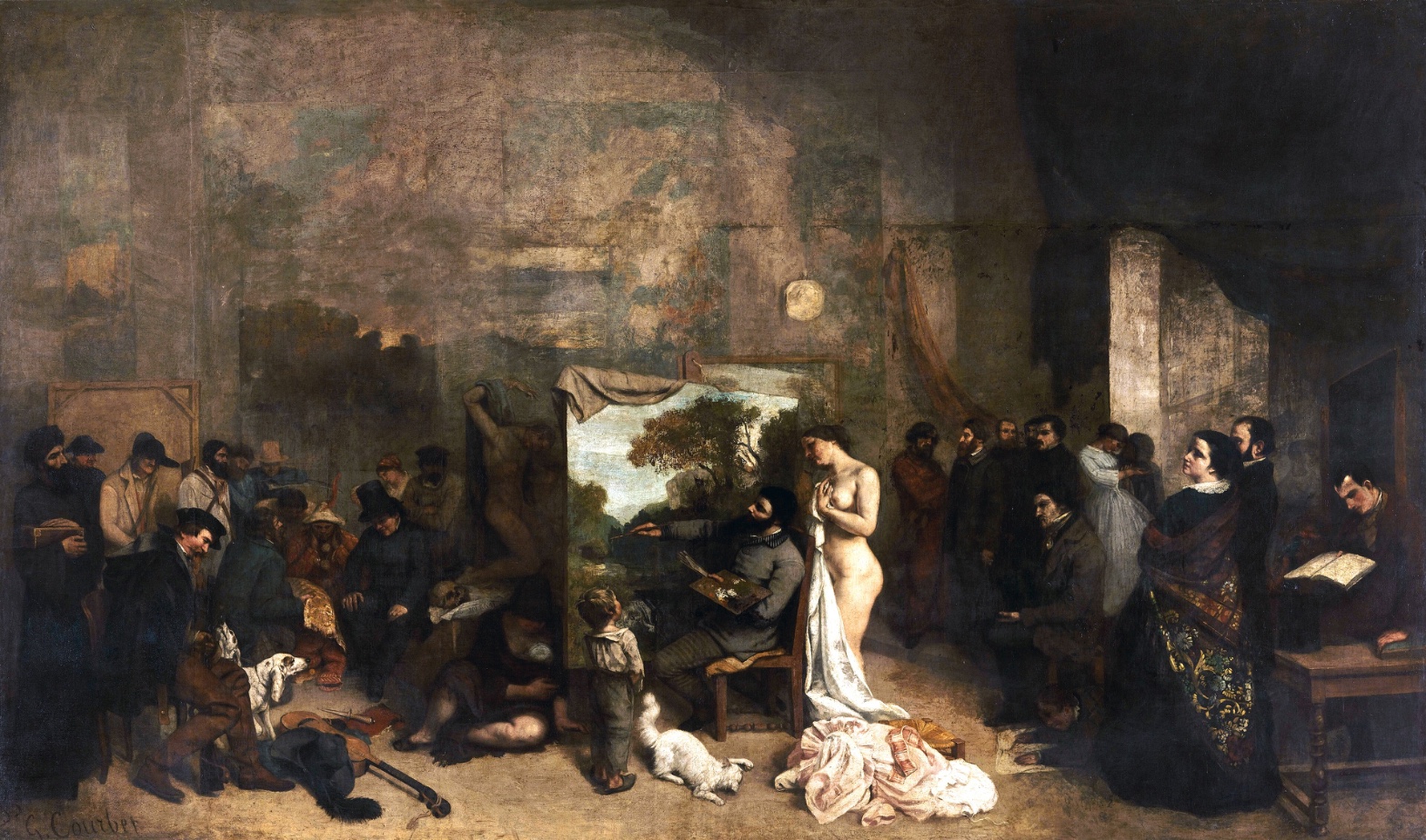
The four domains split into two behaviors that don't fully talk to each other. The perceptual and material domains agree: attention snaps to the nude and painter, edges sharpen there, paint thickens there, and everything else goes soft, dark, and dry. That's a coherent optical machine. The cultural and conceptual domains disagree with each other about what that machine is for. Culturally, the piece asks to be read as a manifesto, a real name for a real studio practice, submitted to a real Salon jury and rejected by it. Conceptually, it asks to be read as an allegory, a diagram of "real allegory" (Courbet's own subtitle) where specific people stand for abstract categories: art, politics, society, the poor, the state. The eye can't do both jobs at once. It can find the painter's group fast. It cannot, from looking alone, sort the crowd into "senator" or "poacher" or "priest." That sorting requires text, biography, a key the painting itself withholds. So the perceptual clarity at the center and the conceptual density at the periphery are working at cross purposes: the parts that carry the most intended meaning (the crowd) are the parts painted with the least resolving power. Material handling doesn't resolve this. It confirms it. The scumbled, thin paint of the crowd matches its scumbled, thin legibility. The most significant unresolved tension: whether the crowd's illegibility is the conceptual point (allegory as unfinished, unresolvable history) or a failure of the same optical logic that makes the center so effective.
PERCEPTUAL
The eye goes to the standing nude first. She's the brightest value in the field, wrapped in white drapery, set against a dark ground on both sides. That's straightforward Visual Pop-out: light shape against dark surround, no competition in that band of the canvas. From her the eye drops to the painter at the easel and the small landscape painting he's working on, because Gaze Direction points there. The child watching also directs attention back into that cluster. This central group reads fast and holds: Contour Quality is sharp, edges are drawn, forms don't bleed into one another. The white dog at the child's feet acts as a second, smaller pop-out, a bright accent that keeps the eye circulating within the group rather than escaping it.
Then the eye tries to move outward and the machine changes. Contours dissolve. The crowd on the left is a mass of merging dark clothing, faces losing separation from each other, a clear Detail Density Gradient running from sharp center to soft edge. The dark mass upper right (curtain, shadow) does the same job on the other side, so Value Structure/Massing brackets the bright column between two dark fields, left and right. This is a strong compositional lock: dark, bright, dark, like a doorway. But it also means the crowd never gets enough Edge Detection to hold attention on its own. The eye visits it, finds no individual face to land on, and returns to the center. The reading gentleman at far right, sitting in dim light, is one of the last stops precisely because nothing there pops, no sharp contrast, no bright value, just a dim figure the eye reaches only after everything else is exhausted.
The request the painting makes is split. It wants the eye to stop at the center (and the perceptual mechanics deliver that cleanly) and it wants the eye to eventually process a crowd of individuals (and the perceptual mechanics actively resist that, because low contrast and blurred contour are exactly the conditions that prevent sustained attention). Those two requests are not compatible in the first seconds of looking.
MATERIAL AND FORMAL
This is oil on canvas, close to twenty feet wide and just under twelve feet tall, larger than most domestic walls could hold. That scale alone tells you the hand that made it was working history-painting scale into a subject nobody had used it for before: a room, a studio, contemporary people in contemporary dress instead of gods or battles.
The paint handling is not uniform, and it's honest about that. Up close, the background wall shows a dry, scraped, thin application, brush dragged over canvas weave, weave visible through paint. The crowd figures are built with similar thinness and looseness, strokes that describe mass but not particular anatomy. The central group is different: the nude's flesh and the white drapery carry denser, more opaque, more blended paint. You can see the difference in load, not just in outcome. This is not a case of the painter running out of energy toward the edges. It's differential effort, visible as differential paint thickness, and it maps exactly onto differential finish: more finished paint where the eye is meant to stop, less finished paint where the eye is meant to pass through.
At a distance this works as intended: the room reads, the figures separate by mass, the composition holds. Up close it stops being legible as anecdote and becomes legible as procedure: you see the scumble, the dry drag, the visible weave, and the illusion of a crowded room becomes a demonstration of how little paint it actually takes to suggest a person if the person is not where attention is supposed to land. The surface is honest about its own economy. It does not pretend every inch got equal labor.
CULTURAL
Rejected by the 1855 Exposition Universelle jury, this canvas became the reason Courbet built his own pavilion outside the official fair and charged admission, calling it the "Pavilion of Realism." One reading of where this work sits institutionally: it's less a submission to Salon culture than a rebuttal of it, staged in the same year and same city as the official exhibition, competing for the same audience by refusing the same venue. That's a legible signal to French painting culture in the 1850s, which was organized around jury approval, history painting hierarchies, and mythological or religious subject matter as the top tier. Putting a working studio, a naked model, a crowd of named contemporaries, and the artist's own likeness at that scale, the scale reserved for history painting, reads as a direct claim: contemporary life deserves the largest canvas in the room.
That signal may not have been legible in the same way to a general public unfamiliar with who the crowd figures were meant to represent. Courbet reportedly identified specific sitters (Baudelaire, Proudhon, patrons, a Jewish old-clothes dealer standing for religion, a poacher standing for opposition to the Empire) but the painting withholds captions. A viewer without that key sees a crowded room, not a coded roll call. One reading: this illegibility is deliberate transgression, a rebuke aimed at Salon audiences trained to read allegory through classical attributes (laurel, sword, halo) rather than through contemporary dress and unlabeled portraiture. Another reading: it's simply a private register, legible to Courbet's own circle and opaque by default to everyone else. Either way, the work is asking a bourgeois exhibition culture that valued programmatic clarity to accept a program it cannot fully decode from the image alone. Institutions that would recognize this move: Musée d'Orsay's own placement of it as a manifesto-work of Realism, and any history of independent/self-financed exhibition, which this canvas is often cited as anticipating.
CONCEPTUAL
Courbet's own subtitle, "A real allegory summing up seven years of my artistic and moral life," is the argument stated outright: allegory built from real, specific, named people instead of personified abstractions. That's a position against the entire convention of allegorical painting up to that point, where Liberty, Justice, or Death appear as invented figures with attributes. Here the abstraction (Art, in the person of Courbet at the easel; his supporters on the right; the exploited and ordinary on the left) is supposed to be carried by actual social types instead of costumed symbols.
The perceptual evidence supports part of this argument and undercuts another part. It supports the argument at the center: Courbet painting a landscape while a nude model stands beside him is a clear, resolvable claim about what real allegory looks like, art-making shown as material labor, truth (the nude, often read as Courbet's muse or Truth itself) standing beside the working painter rather than descending from a cloud. That's allegory made legible through Overlap/Occlusion and Value Structure, not through classical attribute.
It undercuts the argument at the periphery. If the crowd is supposed to carry equally specific allegorical weight, some for Empire, some for the people, some for critics, the paint doesn't give the eye the resolving power to sort them without outside information. Hypothesis (insufficient visual evidence): the low Detail Density Gradient in the crowd is a deliberate formal argument that history's supporting cast is inherently less resolvable than the artist's own act of seeing. That's a reading, not something the image alone can prove; it also fits a simpler explanation, that Courbet gave finishing attention to the parts of the canvas nearest his own self-image and let the rest thin out.
Historical precedent worth naming: this sits against Ingres and academic history painting, where allegorical clarity is achieved through symbolic props and legible hierarchy. Courbet's move, replacing invented symbols with actual acquaintances at Salon scale, is the argument. Whether the painting's own paint layer fully executes that argument, or partially betrays it through uneven finish, is the live question the piece leaves open.
NOISE: CONSOLIDATED
PERCEPTUAL: The composition bracket (dark left crowd, bright center, dark right mass) is efficient for stopping the eye at center but works against the crowd ever getting sustained attention. A viewer's first several seconds deliver the painter-nude-canvas group cleanly and the crowd almost not at all. That's a direct conflict between the "read this as democratic panorama" ambition and the actual optical hierarchy on the canvas.
MATERIAL: The dry, thin, scumbled paint handling in the crowd is formally consistent with the low-attention zone the composition creates, so material and perceptual logic agree here rather than fight. The friction is instead between distance-viewing (room reads coherently) and close-viewing (the same passages register as visibly unfinished, thin, weave-showing), which can read either as confident economy or as incomplete labor depending on how close the viewer is asked to stand, and this canvas, at almost twenty feet wide, cannot be viewed at both distances at once by one person in one position.
CULTURAL: The specific identities of the crowd figures aren't encoded in the image; they require outside text (Courbet's own letters, later scholarship) to access. A general audience meeting this only in a museum without wall text gets the manifesto gesture (this room, this size, this jury-rejected canvas) but not the coded portrait gallery. That gap between institutional framing and unaided viewing is real and not obviously intentional.
CONCEPTUAL: The argument claims equal allegorical seriousness across all figures, real people standing for real historical forces. The execution gives unequal pictorial seriousness, sharp and dense at center, thin and merged at the edges. If the argument requires the periphery to carry real weight, the paint doesn't hand the viewer the tools to feel that weight unassisted.
The center's clarity (perceptual and material working together) looks intentional, serving the conceptual claim about art and truth. The periphery's illegibility (perceptual weakness, material thinness, and cultural opacity all landing in the same place) is harder to call deliberate outright; it may serve an allegorical argument about history's crowd being harder to see than the artist's own hand, or it may simply be where the labor ran out.