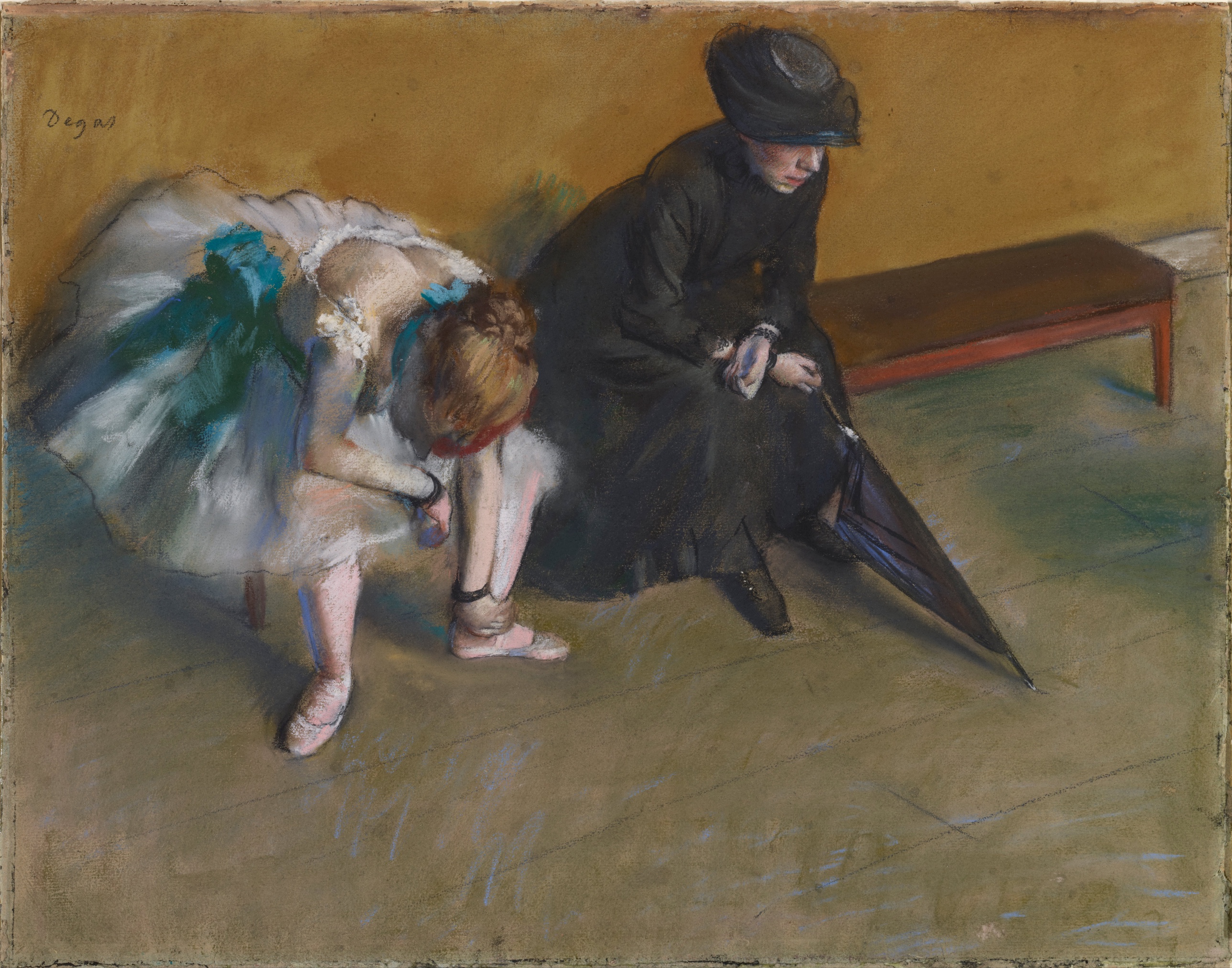
Edgar Degas — Waiting
October 14, 2026 at 10:11 AM
Model: claude-sonnet-5
These 58 principles are perceptual mechanisms that influence what gets noticed, how forms organize, and how space is inferred - all before conscious interpretation. They do not determine meaning.
the world it entered
Paris in the early 1880s had an appetite for ballet, but mostly for the stage version: tutus under gaslight, legs mid-air, the spectacle sold nightly at the Opéra. Degas kept painting the parts nobody paid to see. This picture gives us two women in a hallway, not a performance. One reading of where "Waiting" sits is that it belongs to Degas's ongoing refusal of the ballet-as-spectacle subject that made his dancer pictures sellable in the first place: no footlights, no audience, no pointed toe held for effect. The seated woman in black, closed umbrella touching the floor, reads as someone who has come in from the street and is killing time. That's a domestic, almost bureaucratic moment, and it would have been legible to the same Impressionist-adjacent audience that collected his pastels precisely because it withheld the thing they expected. A century later, the Norton Simon's ownership of the work signals a different kind of validation: American collecting of French Impressionism as blue-chip culture, the picture now read less as a provocation than as a connoisseur's object, prized for the pastel handling rather than its original friction with the ballet-picture market.
the point it's making
The dancer's face is gone, dropped toward her ankle, hidden by the bend of her own body. The seated woman's face is the one resolved, lit passage in an otherwise flat black mass. Two observations, one reading: the picture seems to be arguing that attention and legibility aren't given to the performer, they're given to the chaperone, the audience of one. That inverts the usual hierarchy of a dance picture, where the dancer's face and expression carry the meaning. One plausible position the work is taking, building on Degas's long habit of catching dancers off guard, mid-stretch, mid-fatigue, is that the ballet world runs on waiting and bodily strain as much as on performance, and that the glamour is a small, late moment inside a much longer stretch of boredom and labor. The umbrella, upright and closed, functions almost as a stand-in for the seated woman's patience: an object built for use that is, for now, just being held.
what stops you
The eye goes first to the black shape of the seated woman, because nothing else in the room is that dark or that large. Then it drops to the bent dancer beside her, whose head has disappeared into her own lap. The turquoise of the tutu is the only cool, saturated color in a room built from brown and ochre, and it keeps pulling the eye back even after it's been seen once.
what hits you first
- Value Structure/Massing makes the seated woman's black coat and skirt the heaviest single shape in the picture, impossible to look past.
- Overlap/Occlusion stacks the figures front to back, dancer over seated woman over bench over wall, so the depth of the room is built entirely from what covers what.
- Postural Affect reads the dancer's downward bend toward her ankle as physical effort, not pose.
- Visual Pop-out sets the small turquoise passages of the tutu against the ochre and black field, so they register before the eye has parsed anything else.
- Contour Quality runs hard charcoal lines along the umbrella shaft and ankle against soft, dissolved edges on the tutu and skirt hem, so some forms feel fixed and others feel like they're still forming.
what holds you there
- Face Detection gives the seated woman's lit, pink-toned face the only resolved features in the picture, which makes it the place faces normally are, in a composition that otherwise withholds them.
- Gaze Direction / Social Attention is frustrated on purpose: the dancer's face is turned away and down, so there's no meeting of eyes anywhere in the scene.
- Light Source Logic puts the light high and to the left, catching the dancer's back and the seated woman's face and hands while everything else stays in soft, diffuse shadow.
The picture asks the eye to do two incompatible things at once: settle on the one resolved face, and track the strain in a body whose face it can't see. Weight sits low and dark on the right, color and motion sit active on the left, and the eye keeps swinging between the two because neither fully answers the other.
how it was made
Up close, the pastel sits dry and chalky on paper with visible grain, no shine anywhere, not on the umbrella's black shaft, not on the dancer's satin-adjacent tutu. From across a room, the strokes resolve into shape but never quite smooth out: the floor is a scatter of diagonal marks that never commits to a grid, the wall is a thin, scrubbed field of warm color with the paper tooth still showing through.
what hits you first
- Texture keeps the whole sheet matte and light-absorbing, so no passage, including the umbrella's black surface, ever reads as reflective or wet.
what holds you there
- Optical vs. Physical Color Mixing leaves the white and turquoise strokes of the tutu unblended, laid side by side so the eye does the mixing rather than the hand.
- Edge Detection shows where charcoal was pressed hard, at the umbrella's shaft, the shoe, the ankle, against where it was dragged soft, at the tutu and hem.
- Color Temperature sets the warm ochre wall and brown floor against the cool turquoise accents, the only temperature contrast in an otherwise warm room.
- Economy of Means lets a few diagonal strokes stand in for floorboards without resolving into an actual drawn grid.
The hand worked fast and left evidence of it: strokes that don't fully cover the paper, a floor that gestures at structure without building one, a surface with no gloss anywhere to suggest finish in the traditional sense. That roughness is consistent through the whole sheet, so it doesn't read as an unfinished picture so much as one that was always going to stay at this level of resolution.
where it fights itself
The composition wants the eye on the seated woman's face, the only resolved feature in the work, and at the same time wants the eye on the dancer's bent body, the only figure in motion. Those two pulls don't resolve into a single point of focus, and nothing in the picture tries to make them. The floor compounds this: the loose diagonal strokes suggest recession without ever committing to a vanishing point, so the room never quite locks into a stable space, even as the overlapping figures insist on a clear front-to-back order. The matte, light-absorbing surface works against any sense of material richness in the women's clothing, the umbrella and the skirt are both flat black with no differentiation in finish, which flattens two objects that would, in the room itself, have felt very different to the touch. None of this looks like failure. The withheld face, the unresolved floor, the flat black surfaces: all of them keep the picture from settling into a single legible story, which seems to be exactly what it's after. What looks more like an accident of the medium is the floor's refusal to resolve into geometry. Pastel dragged quickly doesn't want to make a grid, and here it doesn't.
what stays unresolved
The darkest shape and the only lit face both belong to the same figure, and the eye and the light source agree on her as the picture's anchor. The sharpest conflict sits elsewhere: a dancer whose bent, straining body asks for attention her hidden face refuses to give back. The surface never resolves this either, since the same dry, matte pastel covers both women without distinguishing their fabrics, their postures, or what each is owed by the viewer's attention. The question the picture leaves open is whether waiting belongs to the dancer, worn out by it, or to the seated woman, built for it, her umbrella already planted and ready to leave the moment the waiting ends.
WAYS OF LOOKING
The seated woman's face is the only resolved feature in a picture that otherwise hides faces, turns heads down, drops them toward ankles. The analysis noticed that and then asked what the eye is being told to do with it: settle here, even though the dancer's strained body is pulling attention somewhere else entirely. That's a habit worth stealing. Don't just catalog what's legible and what's hidden. Ask which parts of a picture are competing for the same attention, and whether the artist ever lets one win.
The umbrella's black shaft and the woman's black coat get the same flat, matte treatment, no shine, no differentiation in surface. A lazier read would call that a limitation of pastel as a medium. The analysis instead treats it as a choice with consequences: two objects that would feel completely different to the touch end up visually identical. That's the habit of reading material flatness as information, not as an absence of information. When a medium refuses to distinguish between things, ask what gets lost, and whether the artist seems to mind.
The floor "suggests recession without ever committing to a vanishing point." Rather than treating that as unfinished drawing, the analysis lets the ambiguity stand as part of the picture's logic, consistent with a figure whose face is withheld and a composition that won't resolve into one center. The habit here is refusing to fix what the work itself leaves open. An unresolved passage isn't always a problem to solve for the viewer; sometimes it's the most honest description available.
WHAT THIS WORK MAKES VISIBLE
Look at the tutu up close: strokes of white and turquoise sitting right next to each other, never blended. Your eye does the mixing, not the pastel stick. Most paintings hide this process under layers of glaze or blending; here the raw, unmixed marks are sitting on the surface, visible as marks. Next time you're in front of any pastel or any loosely brushed Impressionist canvas, get close enough to lose the image and just watch the colors separate back into individual touches. That's where you can actually catch the eye in the act of building color instead of just receiving it.
The darkest shape in the room and the only lit face belong to the same figure. That alignment of weight and visibility is unusually clean here, easy to point to, because the rest of the picture is so sparse: two figures, a bench, a wall, nothing competing for your attention. In a busier painting this kind of alignment, where mass and illumination back each other up, gets buried under incident. Here it's bare enough to see exactly how a painter can make one figure the obvious anchor without a single dramatic gesture, just by controlling where the dark goes and where the light lands.
Looking vs. Knowing
These are the analysis's own words, nothing added.
What the Work Shows Us
These are the claims that hold up when you look: each one is rooted in something the image actually puts in front of you, not from what we already knew—or thought we knew—about it.
Readings That Came From Outside
Not wrong, necessarily—but these readings didn't come from looking: they came from biography, cultural context, critical tradition, to complete what the image left open.
Alternative Interpretation
Pulled directly from this analysis's own language — nothing added.
The analysis reads the seated woman's lit, resolved face and massive dark shape as the picture's anchor, the place attention naturally settles. But it also holds, without resolving, the competing claim that the bent, faceless dancer is the true subject, her straining posture demanding a kind of attention her hidden features refuse to repay, so the composition splits its authority between the figure it lets us see and the figure it makes us work for.
Questions Raised
Whether "waiting" in the title and composition belongs primarily to the dancer (worn down by rehearsal and labor) or the seated woman (professionally poised to wait, umbrella planted), a split the analysis names explicitly but leaves open.
Whether the floor's unresolved diagonal strokes represent a deliberate refusal of spatial logic consistent with the picture's other withholdings, or simply an "accident of the medium" from fast pastel work, a distinction the analysis raises but doesn't settle.
Whether the flattening of the umbrella and the skirt into identical matte black is a meaningful choice (equating two objects/textures) or a limitation of the pastel medium itself, which the analysis notes but doesn't determine.
Pass 1 — blind observation used
The first thing that catches is the mustard-gold wall, flat and unbroken across the top two-thirds of the sheet, against which the two figures read as dark and light cutouts. The bent dancer's tutu pulls the eye first by Visual Pop-out: the white and blue-green pastel strokes are the lightest, most saturated marks in the composition, sitting against the warm ground.
From there the eye drops to her bent form. Her back and arms are rendered in loose, overlapping pastel hatching, the flesh tone built from pink, ochre, and pale green strokes side by side rather than blended, an instance of Optical vs. Physical Color Mixing. The contour of her spine and shoulder blade is a firm charcoal line, but it dissolves where it meets the tutu, the skirt's edges fraying into chalky smudges rather than resolving into cloth. Her hair is a tighter mass of russet marks, bound by a red ribbon that is the only pure warm accent against all the cooler pinks nearby.
The seated woman in black holds the eye next by sheer Value Structure/Massing: she is the single largest dark shape in the picture, her coat and hat rendered in near-featureless charcoal and black pastel with almost no internal modeling. Her face is the only passage of close value control on her figure, pale and softly shaded, turned downward, which pulls my attention along her sightline to her hands and the umbrella. This is Gaze Direction / Social Attention doing real work: she looks at the umbrella tip, and so do I.
Her hands, pale against the black sleeves, form a small bright node of contrast, wrists lightly scribbled with white highlight strokes. The umbrella itself is a hard diagonal, its point driven into the floor and its fabric a flat near-black triangle, one of the few crisp geometric edges in the whole sheet, functioning as an Anchoring and Reference Point against the loose organic contours of the two bodies.
The floor is built from loose diagonal pastel lines in olive, blue-gray, and brown, crossing each other to suggest floorboards or tile without ever resolving into a consistent grid; this is Linear Perspective gestured at rather than constructed, enough to place the figures on a receding plane without a vanishing point I can actually locate. The bench at the right, rust-red legs under a dark seat, overlaps the wall behind it and is itself partly overlapped by the woman's shoulder, giving a clear Overlap/Occlusion sequence: wall behind bench, bench behind figure.
Edges throughout alternate between hard charcoal underdrawing (the dancer's shoe strap, the umbrella's rib, the woman's hat brim) and passages where pastel has been rubbed into soft bloom (the tutu, the wall, the shadow beneath the dancer's foot). No surface here would reflect light; the pastel sits matte and chalky, grain of the paper visible through thin patches, especially in the gold background where strokes don't fully cover tooth.
Scale-wise the dancer is noticeably smaller and lower in the frame than the seated woman, though they occupy roughly the same ground plane; the woman's bulk and the dancer's compressed, bent posture create an asymmetrical balance, the dark mass on the right weighted against the pale, more fragmented shape on the left.
The last thing I find is the artist's signature, "Degas," in loose cursive at the upper left, sitting directly on the flat gold wall, isolated from everything else in the image.