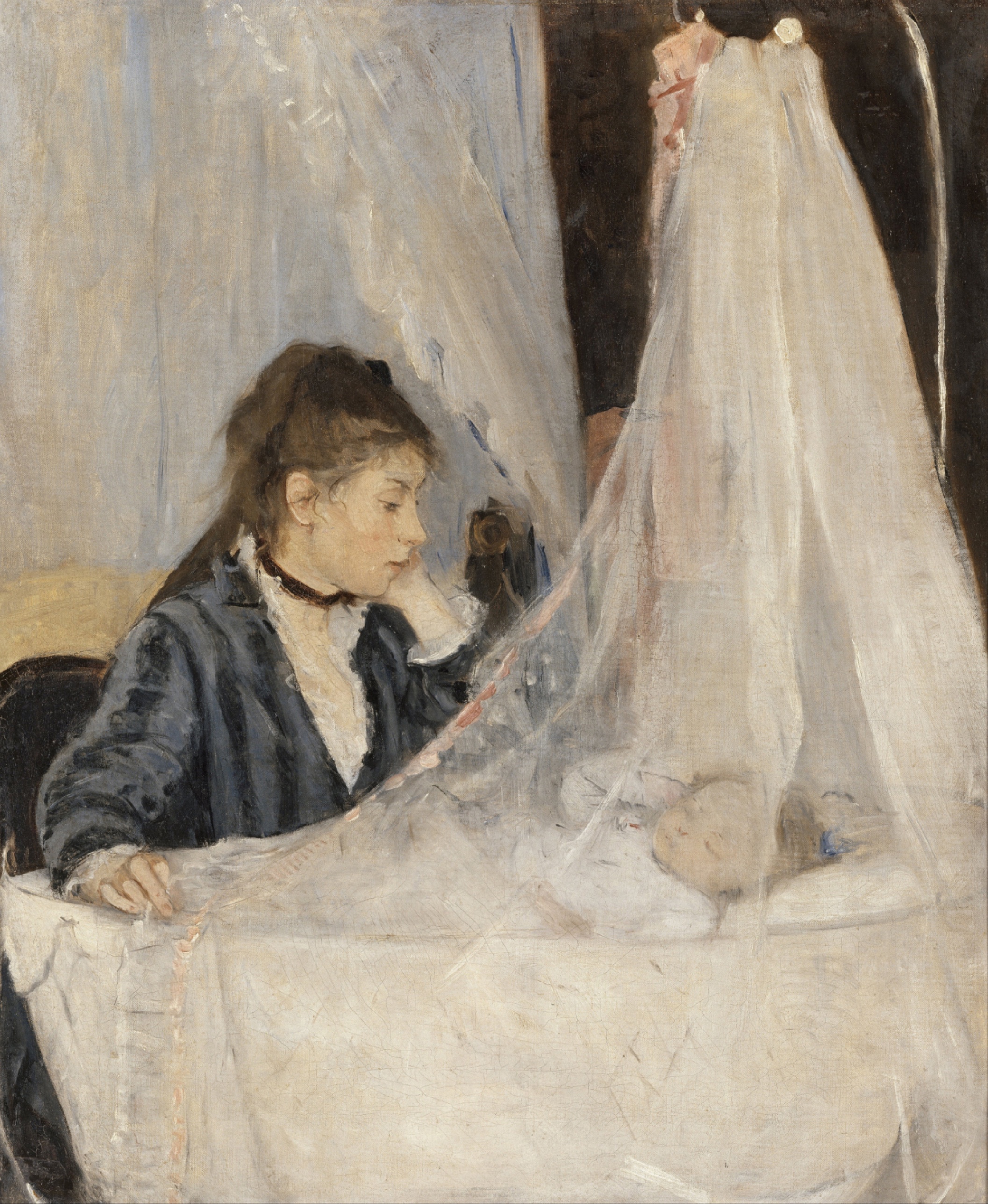
Berthe Morisot — Le Berceau (The Cradle)
August 30, 2026 at 5:37 PM
Model: claude-sonnet-5
These 58 principles are perceptual mechanisms that influence what gets noticed, how forms organize, and how space is inferred - all before conscious interpretation. They do not determine meaning.
the world it entered
Morisot painted this in 1872, two years before she showed it at the first Impressionist exhibition. The room she was entering already had opinions about what counted as serious painting: history, myth, allegory, done at scale, exhibited at the Salon. A woman leaning over a cradle in a small room was not that. It was the subject matter assigned to women painters as a ceiling, not offered to them as an opening.
One reading of where this work lands is that it takes the ceiling and paints through it. The scale stays modest, the subject stays domestic, but the handling doesn't apologize for either. The brushwork on the netting is as loose and unresolved as anything Monet or Renoir were doing that same year. Morisot's sister Edma, who had given up painting for exactly this life, is very likely the woman in the chair. If that's right, the painting is looking at a life its own maker declined. The Impressionist circle that took the picture in was small and knew what it was seeing; the wider Salon public, trained on finish and narrative clarity, might have read the loose fabric as unfinished rather than deliberate. The signal was legible to the room that mattered to Morisot and possibly not to the room that mattered to her reputation for another century.
the point it's making
The composition puts the mother's face in focus and the child in doubt. Her features are drawn with a precision the picture withholds from everything else. The infant, if that's what the pale shape at lower right is, barely exists as a form; it has to be assembled by the viewer out of a few strokes. One reading of that gap is that it is the whole argument: watching, not the watched, is the subject. The netting between them isn't there to hide the baby. It's there to show what looking through gauze does to attention, the way it holds the eye without letting it settle.
Read this way, the painting is less a record of maternal tenderness than a study of vigilance itself, the particular attention of someone who is doing nothing but looking. The downward angle of her head, the stillness of her arm on the rail, argue for care as a posture rather than an action. Whether the visual choices actually support this reading depends on how much weight you're willing to put on a single tilted head and one soft accent of pink. The picture doesn't insist. It just keeps its clearest paint on her face and its vaguest paint on the reason she's looking.
what stops you
You see a woman's profile first, sharp against a lot of softness. Her head is tipped down and to the right, toward something the picture won't quite bring into focus. A wall of pale, torn-looking white takes up most of the right side of the canvas, and behind it, a wedge of near-black, the darkest thing in the picture, doing the quiet work of holding everything else in place.
what hits you first
- Face Detection locks the eye onto her profile before any other shape in the canvas has finished registering.
- Gaze Direction / Social Attention sends the eye down her sightline toward the pale shape at lower right, doing the composition's real work of directing attention.
- Edge Detection catches hardest at the boundary where the dark wedge behind her meets the pale netting, the single sharpest value jump in the picture.
- Contour Quality tightens around her nose, brow, and mouth, then gives up entirely once it reaches the fabric.
- Value Structure/Massing builds the whole picture from three broad zones, dark wedge, pale netting, and her dark jacket, rather than from individual objects.
- Overlap/Occlusion tells the eye that her arm is in front of the rail and the rail is in front of the child, without a single line of perspective to help it.
what holds you there
- Transparency/Opacity keeps the netting readable as gauze, thin enough to imply a shape behind it without ever resolving that shape.
- Postural Affect reads her stillness and the downward tilt of her head as watchfulness rather than rest.
The eye doesn't want to leave her face, and the picture doesn't make it. It sends you down and to the right instead, into a mass of white that keeps refusing to become anything specific. That refusal is doing the work: you keep going back to her face because the fabric never gives you an alternative place to land. The one note of saturated color, the pink edge low in the picture, is nowhere near her face, so it pulls the eye without ever competing for it.
how it was made
Up close this is a painting built out of restraint. The oil is thin in most places, dragged rather than loaded, and nowhere does it catch light the way a varnished highlight would. From across a room the face reads as finished; standing in front of it, that finish turns out to be maybe a dozen confident strokes.
what hits you first
- Texture separates the tight, built-up paint of her face from the dry, broken paint of the netting, so the surface itself tells you where to look before the subject does.
what holds you there
- Detail Density Gradient runs from resolved (her features) to unresolved (the child) in a single continuous fall-off, with no hard boundary between the two.
- Economy of Means gets the whole cradle and its netting from a handful of dragged, unblended strokes, no more paint than the shape needs.
what surfaces on a longer look
- Specularity/Surface Reflection is absent everywhere, even in the whites, which keeps the fabric looking like cloth and not like paint pretending to shine.
The canvas is small, a little smaller than a window pane, and the paint never asks you to stand back the way a Salon history painting would. It asks you to come close enough to see that the netting is barely painted at all, a few strokes of white and gray dragged over bare-looking canvas, and then to notice that this thinness is exactly what makes it read as sheer fabric rather than solid form. The economy is doing representational work, not standing in for it.
where it fights itself
The picture wants two things from the eye at once: settle on her face, and follow her gaze into the uncertainty at lower right. Those pull against each other. The face is so finished, so anchored, that the eye keeps returning to it rather than completing the journey her gaze proposes, so the child she's supposedly watching stays perpetually secondary, almost incidental, to a viewer who hasn't been told what to expect. A viewer who doesn't already know the title might reasonably take a while to understand that there's an infant there at all; some viewers, working from the same unresolved shapes, have read the scene as being about the fabric itself rather than about a child beneath it. That's a real interference, not a subtle one.
The economy that makes the netting so convincing as gauze is also what makes the subject hardest to parse. Those two effects come from the same brush decision, so it's difficult to call one intentional and the other accidental. Everything about the face argues for control; everything about the cradle argues for withholding it. The likeliest reading is that both are doing the same job on purpose: keep the vigilance sharp, keep its object soft, because sharpening the object would turn a mood into an anecdote.
what stays unresolved
The paint agrees with the argument at exactly one point: the face is finished and the reason for her looking is not, and that gap is where the picture's tenderness actually lives. The conflict is that the same looseness meant to protect the child's privacy also risks losing the child from the composition altogether, turning vigilance into ambiguity for anyone not already told what they're seeing. The pink accent, the one loud color in the room, sits nowhere near either the face or the child, refusing to resolve the question of where feeling is supposed to concentrate. What the picture leaves open is whether watching, rendered this quietly, is enough to make the watched thing matter to a viewer who has to work to find it at all.
WAYS OF LOOKING
The analysis noticed that the woman's face is built from tight, resolved brushstrokes while the cradle and child dissolve into loose, unresolved ones, and it treated that difference in handling as information rather than just style. That's a habit worth stealing for any painting: read the gradient of finish across a canvas as a map of where the artist wanted attention to stick, not as a technical inconsistency to smooth over in your head.
It also stayed with a genuine disagreement instead of resolving it. Three separate readings of this picture couldn't agree on whether the woman is watching a sleeping infant or handling a piece of fabric, and rather than picking a winner, the analysis let both readings sit and asked what in the paint itself was causing the confusion. That's a different move than interpreting: it's noticing that ambiguity can be a fact about the object, not a failure of the viewer.
There's also a moment where the analysis catches the composition working against itself, the way the finished face keeps pulling the eye back toward it, which stalls the very journey her downward gaze is supposed to send you on. Naming that friction, a work setting up two demands on attention that can't both be satisfied at once, is a way of finding the argument inside a picture instead of just describing its content.
And it kept asking what a single visual choice was doing double duty for: the same dry, sparse brushwork that makes the netting look convincingly sheer is what makes the child underneath it nearly unreadable. Tracing one formal decision to two different effects, one gained, one lost, is how you find out whether a painting is in control of its own quietness or just running out of paint.
WHAT THIS WORK MAKES VISIBLE
Because the netting is painted with almost nothing, a few dragged strokes over bare-looking canvas, you can watch, in real time, how little information the eye needs to accept "sheer fabric" as fact. Stand close and the illusion collapses into scribble; step back and it's cloth again. Look for this in any painting with veils, smoke, or water: the point where economy of paint and legibility of subject are fighting for the same square inch of canvas.
The picture also isolates one saturated color, a small pink or rust edge, against a nearly colorless field, so you can see with unusual clarity how a single chromatic accent pulls the eye independent of where the subject or the meaning actually is. Watch for that split in any low-palette painting: where your eye goes for color and where it goes for content aren't always the same place.
Looking vs. Knowing
These are the analysis's own words, nothing added.
What the Work Shows Us
These are the claims that hold up when you look: each one is rooted in something the image actually puts in front of you, not from what we already knew—or thought we knew—about it.
Readings That Came From Outside
Not wrong, necessarily—but these readings didn't come from looking: they came from biography, cultural context, critical tradition, to complete what the image left open.
Alternative Interpretation
Pulled directly from this analysis's own language — nothing added.
The primary reading holds that the picture's soft, unresolved treatment of the child is deliberate: it keeps the subject as vigilance itself rather than an anecdote about a baby. The competing reading, which the analysis flags but doesn't resolve, is that this same looseness may simply fail as depiction for a viewer without the title, making the scene read as being about fabric rather than about a watched child at all.
Questions Raised
Whether the woman in the chair is actually Edma Morisot is presented as likely but unconfirmed, and the analysis doesn't know how much of its "life declined" reading depends on that identification being correct.
Whether the fabric's looseness was legible as intentional to Salon-trained viewers or would have simply read as unfinished is left open, since the analysis can only speak to what the Impressionist circle saw, not the wider public.
Whether the face's precision and the child's vagueness are the same deliberate choice or one is control and the other an unintended cost of that control is acknowledged as genuinely hard to settle from the paint alone.
Pass 1 — blind observation used
The first thing I find is the diagonal made by the woman's forearm meeting the sheer curtain of the cradle, that pale triangle of fabric cutting the canvas almost in half. The white netting catches the eye before the figure does: Visual Pop-out / Pre-attentive Features, the density of white brushwork against the dark ground on the right pulls attention before I even register there's a face on the left.
Her profile resolves next. The edge of her forehead and nose is drawn with a firmer line than almost anything else in the painting, a hard contour against the pale blue-grey wall behind her. That contour quality holds the eye briefly before it drops down her arm.
Gaze Direction: her eyes point down and to the right, toward the cradle, and that direction pulls my own eye along the same path, from her face down her bent arm to the curtain edge to the shape resting inside the crib. It's a clean vector across the canvas.
Edges behave differently depending on where I look. Her face has the tightest, most resolved edges in the painting: the line of the nose, the dark ribbon at her throat, the crisp white collar peeking from under the dark jacket. Move to the drapery and edges dissolve into long vertical strokes, some scraped thin enough to show canvas weave underneath. The netting over the cradle on the right is almost all dissolved edge, a scumbled white mass with only a few darker strokes suggesting where the fabric folds.
Value structure is simple: a dark register (her jacket, the chair back, the deep brown behind the netting) bookends a light register (the wall, the netting, the bedding) with her flesh tones sitting in the middle. The darkest passage is the brown-black wedge between the two curtains at the top right, almost a void. The lightest passage is the netting itself, built up in thick strokes of near-white with faint blue and pink undertones.
Light source logic: there's no cast shadow with a hard edge anywhere, which tells me the light is diffuse, coming from the upper left based on how the wall is brighter there and darkens toward the right side of the canvas. Her face is lit from that same direction, the shadow side of her nose and cheek falling toward the viewer, soft-edged, no crisp shadow line.
Color is restrained: blues and greys in the wall and jacket, warm ochre in the small patch of exposed wall at left, flesh tones in her face and hands, and the dominant near-white of the linens running through both curtain and cradle. The ribbon at her neck is one of the only saturated notes, a small dark red-brown against her pale throat, and it functions as an anchoring point, the one place color pulls slightly warm and dense in an otherwise cool, thinned-out passage.
Surface handling: the paint stays matte throughout, no gloss or specular highlight anywhere, even on the white netting, which is built from dry, dragged strokes rather than any wet-on-wet blending. The brushwork on the jacket sleeve is loose, almost scribbled, several directions of stroke laid over each other. The face, by contrast, is built with smoother, blended paint, barely any visible stroke direction.
Overlap does the work of establishing depth: her arm overlaps the curtain, the curtain overlaps the cradle's far side, and the near rail of the cradle overlaps the infant's blanket. There's no linear perspective scaffolding, no floor line, no converging orthogonals. Depth is read entirely through this stacking of forms and through the scale drop from her head, large and near, to the small pink shape of the infant's head, smaller and further back, tucked under the netting.
The eye eventually arrives at the infant, the smallest and least resolved shape in the whole composition, a soft pink oval barely differentiated from the white bedding around it, only a few strokes of deeper pink and a shadow indicating the closed eyes. It is the last thing found because everything else, her gaze, the overlapping curtain, the darker framing edges, points toward it.