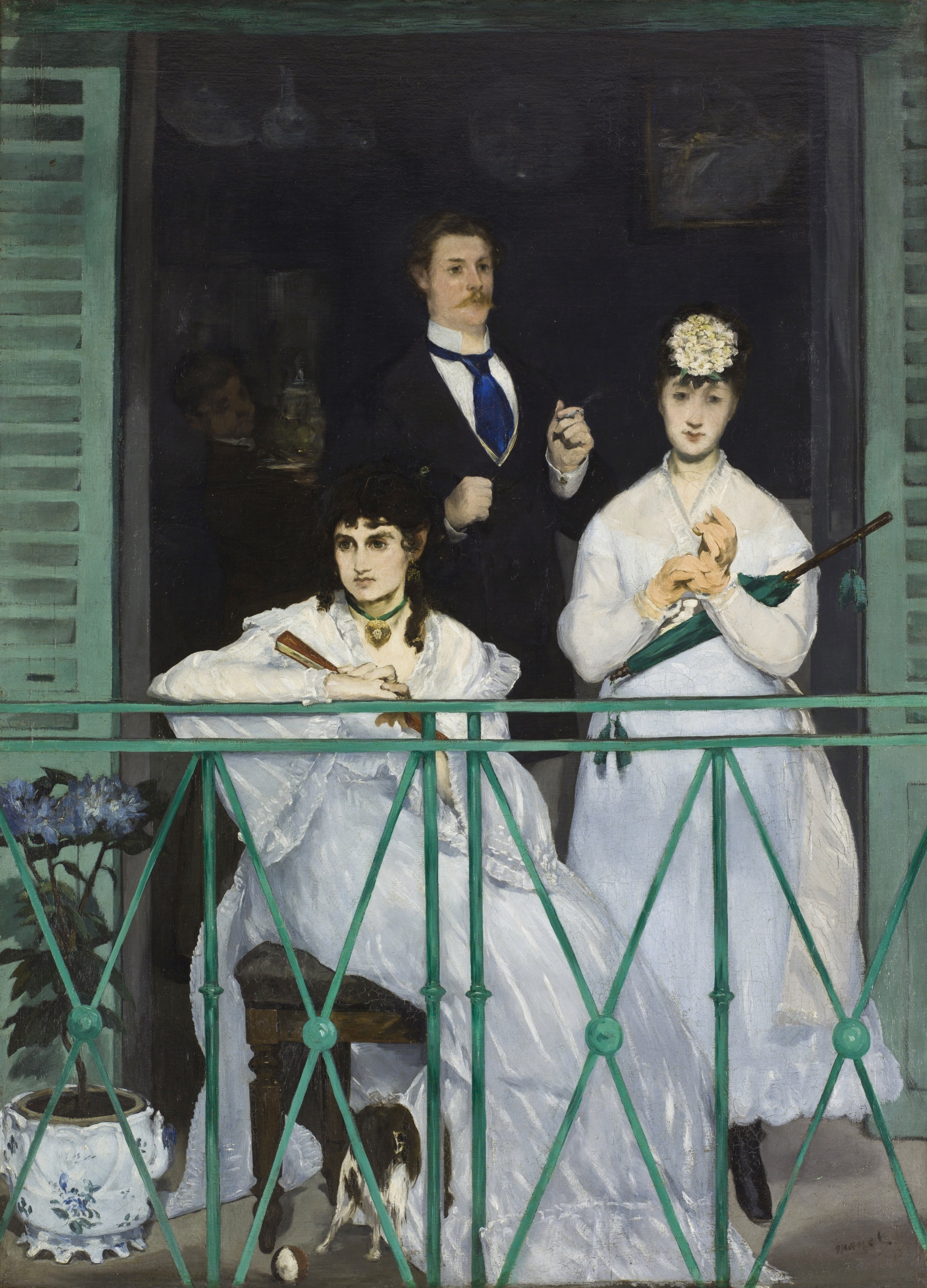
Édouard Manet — The Balcony
August 27, 2026 at 8:56 AM
Model: claude-sonnet-5
These 58 principles are perceptual mechanisms that influence what gets noticed, how forms organize, and how space is inferred - all before conscious interpretation. They do not determine meaning.
the balcony
the world it entered
Paris in 1868 was building a taste for scenes of modern leisure, and the balcony was becoming one of its stock settings: a place to watch the boulevard and be watched from it. Manet shows three people who have stepped out onto one and done neither. One likely reading places this canvas in direct conversation with Goya's earlier balcony scenes of women watching a public they never quite engage, a lineage Manet's contemporaries would have recognized in the pose and the framing device, even if the disengagement here reads as colder. The Salon of 1869, where the picture was shown, wanted its balconies to tell a story: flirtation, gossip, display. This one refuses. Critics at the time reportedly found it strange and a little hostile, and one plausible account of its later standing is that the same refusal that alienated its first audience is what secured its place in the run-up to Impressionism, as an early instance of a painting more interested in optical fact than social narrative. The Musée d'Orsay now holds it as a hinge picture, and that placement depends on reading the flatness and the withheld eye contact as forward-looking rather than unfinished.
the point it's making
The three figures share a rail and nothing else. None of their eyes meet, not each other's, not the viewer's, and one reading of the standing woman's downward glance is that she's absorbed in her own gloved hand rather than in the street she's supposedly come out to see. That withdrawal, paired with an interior behind them rendered as a near-black mass instead of a legible room, argues for a kind of privacy that painting doesn't usually grant. A conventional balcony scene tells you what's being watched. This one keeps that information from you on both sides: the street isn't shown, and the room isn't either. The picture's position seems to be that modern city life produces people standing shoulder to shoulder without exchange, three bodies organized by a rail rather than by attention. The near-illegibility of the fourth figure in back, present but barely resolved, isn't a lapse; it supports the same argument that this is a scene about proximity without contact.
what stops you
The green railing hits first, a hard bright bar across the bottom of the canvas that has nothing else in the picture to match it. Behind it two white dresses sit like lit shapes against almost no room at all. Nobody in the group is looking at anybody.
what hits you first
- Visual Pop-out / Pre-attentive Features pulls the eye straight to the saturated green railing before any figure is read.
- Figure-Ground Relationships sets the white dresses as bright, solid shapes against an interior with almost no value distinctions at all.
- Value Structure/Massing does the same work at the scale of the whole canvas, splitting it into one pale mass and one dark one with almost nothing in between.
- Gaze Direction / Social Attention keeps every eye in the group pointed somewhere other than at another person, so the group never resolves into a scene.
what holds you there
- Color Temperature sets the cool green of the railing and shutters against the warm accents of the blue tie, the gold jewelry, the skin, so the eye keeps returning to those small warm notes.
- Anchoring and Reference Points uses the railing's crisp horizontal to fix depth and scale for everything behind it, the dog, the plant, the skirts, all measured against that one bar.
- Postural Affect reads in the stiffness of the standing woman and the closed fan and closed parasol both figures hold, neither open, neither in use.
what surfaces on a longer look
- Closure/Negative Space asks something of the near-black interior, where a faint rectangle and a half-formed fourth figure invite the eye to complete shapes the paint never finishes.
The eye does not travel through this picture so much as bounce off its front layer, the railing, the dresses, the closed accessories, and refuse to go further back. That's partly the point: the darkness behind the figures gives the eye nowhere productive to go, so it returns to the surface, to the accents of blue and gold, to the small gap between two people who aren't speaking.
how it was made
Up close the dresses are built from loaded, visibly dragged paint, ridges of white and gray you can see standing across the room. The dark interior behind them is thinner and flatter by comparison, almost undifferentiated paint rather than drawn form. The railing is painted with a harder, more graphic edge than either.
what hits you first
- Edge Detection separates three different kinds of mark in this single canvas: the crisp linear railing, the loaded, ridged brushwork of the dresses, and the soft-edged, barely blocked interior, each edge type doing different work.
what holds you there
- Texture contrasts the impasto of the white fabric against the comparatively flat, thin paint of the dark room behind it.
- Color Harmony Systems holds the whole canvas to green, white, and black, with the blue tie and gold jewelry standing as the only real departures.
- Contour Quality softens around the faces and hands while staying hard along the ironwork, so the body reads as touched by light and the railing reads as fabricated object.
what surfaces on a longer look
- Specularity/Surface Reflection shows up faintly on a glass vessel described deep in the dark interior, one of the only glints of reflected light in a canvas otherwise built from matte, absorbed color.
The paint itself argues for what the composition argues visually: attention concentrated at the front plane, thinned out and withheld toward the back. Manet spent real working time on the dresses and the railing and comparatively little defining the room, and that unevenness is legible without magnification. It asks a viewer to read the canvas the way the figures read their own balcony: engaged with what's immediately at hand, incurious about what's behind it.
where it fights itself
The tight cropping, shutters at both edges, figures cut at the waist, flattens the space into a shallow strip, and the extreme value contrast between the dresses and the interior flattens it again in a different way, so depth gets undercut twice by two different mechanisms working toward the same end. That doubling looks deliberate rather than accidental: a Salon audience trained to read depth through modeling and perspective would have had almost nothing here to hold onto, and that withholding matches the withholding in the gazes. The identity of the fourth figure is a real crack, though: without it resolving into a specific person doing a specific thing, the picture's argument about a room full of unconnected people gets an unintended fourth confirmation, a figure so unresolved it barely counts as a person at all. Whether that reads as reinforcing the theme or as simple underpainting depends on how much credit you give Manet for the murk. The gaze ambiguity in the standing woman, whether she looks out or down, isn't a flaw in the paint so much as a genuine perceptual toss-up the canvas itself won't settle, and that instability seems to serve the same withholding logic rather than fight it.
what stays unresolved
The strongest agreement here is between what the paint does and what the people do: thick, present brushwork up front, unresolved paint behind, matched by three figures fully present in body and absent in attention. The sharpest conflict is between the railing's insistence on solid, measurable depth and the interior's refusal to give that depth anything to contain. The dresses are lit like objects worth looking at hard; the room behind them is barely looked at at all. What the canvas never answers is whether that darkness is where something is happening that the figures, and the viewer, aren't allowed to see, or whether it's simply empty, and the not-knowing is the whole subject.
WAYS OF LOOKING
The green railing gets named as the first thing the eye hits, before any figure, before any face. Only after establishing that does the analysis explain why: saturated color and a hard edge will always win a first look over something as slow to read as a facial expression. That's a habit worth stealing for any painting: notice what your eye does before you decide what the painting is "about," because the order of noticing is data, not noise.
The analysis also treats the disagreement between the three research passes, over who the fourth figure is, over which way the standing woman is looking, as material rather than error. Instead of picking a winner, it asks what work the ambiguity does. That's a habit: when a painting won't resolve, don't force a resolution. Ask what the picture gains by staying unsettled.
There's also a move where paint handling gets read as an argument, not just a technique. The dresses are built up thick and worked; the room behind them is thin and barely touched. The analysis connects that unevenness directly to the emotional claim, that these people are engaged with what's in front of them and indifferent to what's behind. Material choices carry meaning even when nobody in the picture points at them.
Last, the analysis keeps returning to what a period audience would have expected, a legible flirtation, a street to watch, and measures the actual painting against that missing scene. Reading a work against the genre it's supposedly filling, and clocking exactly where it declines to fill it, is a durable way to find what a painting is actually doing.
WHAT THIS WORK MAKES VISIBLE
Three people share one rail and not one shared glance. Because the composition is so simple, three figures, one horizontal line, it isolates gaze direction as a variable almost like a controlled experiment. In a busier painting, crossed or averted eyes get buried in incident; here, with almost nothing else happening, you can watch a group fail to become a scene in real time. Next time you're in front of any group portrait, count the eye-lines before you read the mood.
The canvas is also cut nearly in half by value: white dresses against an almost solid dark room. That extremity makes it unusually easy to see how figure-ground contrast does the eye's sorting before any story does. Most paintings blend their values enough to hide this; here the split is total, so you can watch it work.
And the uneven finish, thick paint up front, thin paint in the dark, sits in plain sight because there's so little competing detail elsewhere. Look for that unevenness in any painting with a shallow, cropped space: it often marks exactly where the artist wants your attention to stop.
Looking vs. Knowing
These are the analysis's own words, nothing added.
What the Work Shows Us
These are the claims that hold up when you look: each one is rooted in something the image actually puts in front of you, not from what we already knew—or thought we knew—about it.
Readings That Came From Outside
Not wrong, necessarily—but these readings didn't come from looking: they came from biography, cultural context, critical tradition, to complete what the image left open.
Alternative Interpretation
Pulled directly from this analysis's own language — nothing added.
The analysis reads the murky, near-illegible fourth figure and the interior's darkness as deliberate reinforcement of the painting's theme of proximity without attention. But it also admits this could simply be underpainting or unresolved technique that happens to align with the theme by coincidence, and it explicitly says the credit given to Manet for "the murk" determines which reading holds.
Questions Raised
Whether the darkened interior represents something withheld from the viewer's sight or is simply empty space with nothing to show, a question the analysis says the canvas never answers.
Whether the standing woman's downward gaze is directed at her own hand or out toward the street, a perceptual ambiguity the analysis calls a genuine toss-up rather than a resolved reading.
Whether the fourth figure's near-illegibility is an intentional formal choice supporting the painting's argument about disconnection or an artifact of unfinished underpainting given retrospective meaning.
Pass 1 — blind observation used
The green ironwork grille reads first, before the faces do. It sits flush across the width of the canvas as a raised trellis pattern of diamonds and rings, painted a saturated blue-green that reads as pure Local vs. Atmospheric Color: the paint stays that exact hue whether it crosses a white skirt, a dark suit, or the shadowed doorway behind it, with no shift toward the tones of what's behind it. The railing functions as an Anchoring and Reference Point, a horizontal band the eye returns to after moving up into the figures.
Three figures stand behind it, a fourth barely visible deeper in the room. The two women wear white, and their dresses are the largest light-value shapes in the painting, built from thick strokes of white, cream, and pale gray that catch a flat, even light with no strong directional shadow modeling the folds. The seated woman's dress especially is handled as broad slabs of paint rather than traced fabric lines, up close it's just loaded brushwork sitting on the canvas surface; back up and it resolves into ruffled cloth. That's Detail Density Gradient at close range versus normal viewing distance.
Value Structure here is stark: the whites of the dresses and the man's shirt-front sit at one extreme, the doorway interior behind them is nearly black, and the green railing and shutters occupy a middle band that separates the two. This dark backdrop makes the figures read as pale shapes pushed to the front of the space, a straightforward Figure-Ground Relationship with almost no gradation between figure and ground to soften the transition.
Edges vary a lot. The women's faces have crisp, fully resolved contours, dark hair against pale skin, and their eyes hold direct, unmatched Gaze Direction, none of the three main figures look at each other. The standing woman looks straight out at the viewer while adjusting her glove; the seated woman also faces out but with a more slack, distracted Postural Affect, her arm draped heavily over the rail. The man behind them looks off to his own right, disengaged from both women, holding a cigarette between two fingers with the smoke barely indicated. Toward the room's interior, edges dissolve: the dim fourth figure at the table left of center is barely blocked in, a smear of tone rather than a described form, an example of Focal Blur reserved not for optical softness but for spatial recession into shadow.
Color temperature splits the picture in two: the cool greens of the ironwork and shutters and the cool whites of the dresses dominate, set against small pockets of warm color, the man's ochre mustache, the seated woman's gold earrings and green choker with its pendant, and lower left a potted plant with blue-violet flowers in a white ceramic pot with blue floral decoration. That pot, plus a small brown-and-white dog just visible under the rail and what looks like a dropped ball near its feet, anchor the lower corner and establish Overlap: the pot's rim crosses in front of the railing's base, placing it nearer to the viewer than the ironwork itself.
Scale relationships push the three upper-body figures to fill nearly the entire vertical height of the canvas, cropped at mid-thigh by the bottom edge, an assertive Cropping/Framing choice that flattens the sense of a full standing room and compresses the space into the balcony strip alone. The shutters at both far edges, painted the same green as the railing, close the composition symmetrically, though the figures themselves are grouped asymmetrically toward the right and center, leaving the potted plant to balance the visual weight on the left.
The last thing the eye settles on is that standing woman's face on the right: lit slightly brighter than the other two, her direct stare aimed outward past the picture plane, hands occupied with the glove, holding a closed green parasol against her shoulder.