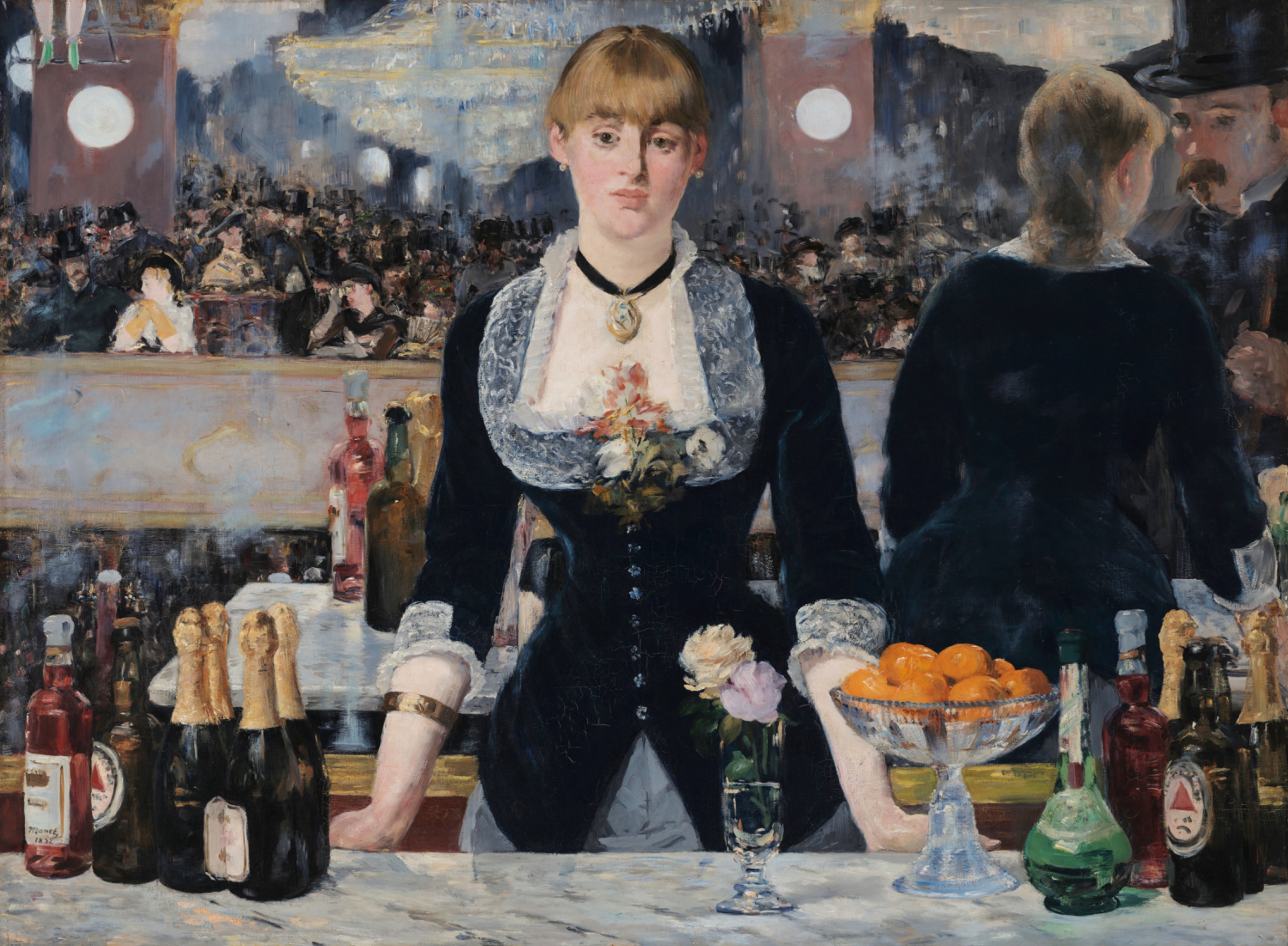
Édouard Manet — Un bar aux Folies Bergère
August 24, 2026 at 12:27 PM
Model: claude-sonnet-5
These 58 principles are perceptual mechanisms that influence what gets noticed, how forms organize, and how space is inferred - all before conscious interpretation. They do not determine meaning.
the world it entered
Paris in 1882 wants its pictures either finished and legible in the Salon sense or radical and proud of it. Manet gives the jury something that looks Salon-ready from ten feet: a woman, a counter, bottles, fruit, all rendered with enough clarity to read as a genre scene. Up close the crowd behind her dissolves into unresolved paint, and the mirror does something no honest mirror does. One reading of where this lands is: an artist near the end of his life still trying to have it both ways, respectable subject, disreputable handling, and daring the Salon audience not to notice the trick. The Folies-Bergère itself was a place polite society visited and did not fully admit to visiting, a music hall where a barmaid's status hovered between service and solicitation. A viewer who knew the venue would have known what her flat, unmet gaze might mean; a viewer who didn't would just see a face that refuses to greet them. The picture asks its audience to bring outside knowledge to complete it. Not every audience had that knowledge, and Manet does not seem to have cared.
the point it's making
The argument, so far as the surface supports one, is about what a painting owes to the logic of a mirror versus the logic of paint. A real reflection would put the man in the top hat directly in front of her, roughly where the viewer stands. Instead he appears off to the side, and the crowd behind her reflects light and color rather than resolvable figures. This is not a mistake a painter of Manet's skill makes by accident; the specularity on the bottles and the fruit bowl proves he could render precise optics when he wanted to. The gap between the two states a position: that the picture in front of you does not have to obey the physics of the room it depicts. It can hold two conflicting spaces if paint says so. The barmaid's unmet gaze does the same work on the level of address. She stands exactly where a transaction would happen, facing the viewer's position, and does not look at it. The painting sets up an encounter and then declines to complete it, which is itself a stance on what a picture is allowed to withhold from the person standing in front of it.
what stops you
The face arrives first, pale and still, floating above a black dress that swallows everything around it. Then the eye drops to the counter, where the bottles throw hard points of light and the fruit sits in a small pile of orange that has no business being that warm this close to so much black and gray. Only after that does the background register at all, and by then it barely resolves.
what hits you first
- Face Detection pulls attention to her features before anything else in the canvas has finished registering.
- Figure-Ground Relationships separate her body from the crowd behind her by pushing the crowd into a soft, undifferentiated field.
- Gaze Direction / Social Attention sets up a face aimed at the viewer's position and then denies the exchange, holding attention through the withholding.
- Overlap/Occlusion stacks bottles, bowl, hands and body in a shallow front-to-back order that reads instantly as space.
- Specularity/Surface Reflection puts hard glints on the bottles and the crystal bowl that outshine every other value in the painting.
- Contour Quality keeps her outline crisp against a background where no other contour survives.
- Detail Density Gradient runs from the sharp still life at the bottom to the dissolved crowd at the top, so the eye reads distance as blur without needing perspective lines.
- Value Structure/Massing anchors the whole composition on the single black mass of her bodice.
The eye lands on her face because nothing else in the picture holds a shape that firm. It drops to the counter because that's where the light concentrates. It tries to travel back into the crowd and gives up, because there's nothing there to resolve into, and comes back to her. The picture is built to circle: face, counter, face again, with the background functioning as a kind of noise floor the eye can't rest in.
how it was made
Up close the dress is barely dress at all, just dragged black with a crack or two showing its age. The lace at her collar is a scatter of comma-shaped touches that read as trim only from several feet back. The bottles and bowl, by contrast, hold their edges at any distance; someone spent real time there.
what holds you there
- Light Source Logic governs the bright, consistent highlights across the bottles and bowl even where the background light source is unaccountable.
- Texture shifts from the built-up, worked surface of the still life to the thin, quick strokes of the crowd, telling the hand's speed at each zone.
- Optical vs. Physical Color Mixing lets the loose dabs of the background crowd fuse into a sense of moving color only at viewing distance.
what surfaces on a longer look
- Focal Blur/Depth of Field sets the crowd at an effective soft focus that a period camera couldn't yet achieve, done here by hand.
Manet worked the still life like a Dutch painter and the crowd like an Impressionist standing across the room from his own canvas, and he did both in the same sitting. The surface never pretends to be anything but paint; the cracking in the dark passages, the visible drag of the brush in the lace, none of it is hidden. What it hides is intention: whether the crowd is unfinished because it's far away, or unfinished because finishing it would have competed with her face for attention.
where it fights itself
The mirror is the clearest fight. A faithful reflection puts the man in the top hat where the viewer stands; here he's shifted to the side, and the crowd he stands among is rendered with less resolve than the objects nearer the front glass surface, which is backwards if the mirror is doing normal optical work. That contradicts the painting's own evident skill with reflection, visible in every highlight on the bottles. It doesn't read as failure. The still life proves Manet could paint a mirror correctly; he chose not to here, which suggests the space is arranged for the picture's logic, not the room's.
The gaze does similar work against the composition's invitation. Everything about her placement, dead center, facing out, hands flat on the counter, sets up a direct transaction with whoever stands in front of the canvas. Her eyes don't meet that person. That's a real tension, not a flaw: the picture stages an encounter and then won't finish it.
The detail gradient, by contrast, isn't a fight at all. Sharp foreground, soft background, is just how the eye already understands depth, and the painting uses that expectation instead of undercutting it.
what stays unresolved
The still life and the mirror agree that this room does not have to hold together as one legible space; the same conviction, precise where it wants precision, loose where precision would cost it something. The sharpest conflict sits in her face: rendered with total clarity, aimed at no one. The painting gives the viewer a body positioned for an exchange and a mirror that displaces the man who should be having it, so the transaction that should be happening in front of her is happening somewhere just to the side of where you're standing. Whether that's her refusal or the picture's is the question it never answers.
WAYS OF LOOKING
Notice how the analysis treats the mismatched mirror. It doesn't say "Manet made an error" and move on; it uses the still life, painted with obvious optical skill, to rule that out, then asks what the error is doing instead. That's a habit worth stealing: when something in a work looks wrong, check whether the artist demonstrates competence elsewhere in the same piece before deciding it's a mistake. If they clearly could have gotten it right, the wrongness is information.
Watch how much weight gets put on where the eye actually goes, in order: face, then counter, then a failed attempt at the crowd, then back to the face. The analysis doesn't just list what's in the painting, it tracks the sequence of attention, and reads meaning into the fact that the background offers nowhere to land. Following the eye's actual path, not just cataloguing content, turns a description into an argument.
Look at how the gaze gets handled. Three observers agreed her eyes are averted; one thought she met the viewer's. Rather than pick a winner, the analysis treats the disagreement itself as evidence, of ambiguity built into the painting, not just into the panel of viewers. When smart people looking at the same mark disagree, that's often the artist's doing.
And notice the move of pairing brushwork with subject: tight, dense strokes on the bottles, loose dabs on the crowd. The analysis doesn't just note the technical difference, it asks what each style is for, still life demanding proof of skill, crowd needing only to suggest motion and noise. Matching where the hand slowed down to what the picture needed there is how you find intention in brushwork instead of just describing texture.
WHAT THIS WORK MAKES VISIBLE
The gap between a mirror's physics and a painting's logic is unusually easy to catch here because Manet gives you the correct version right in the foreground: the crystal bowl's facets, the bottle glass, all reflecting light exactly as glass should. So when the big mirror behind her breaks the rules, you have a built-in control to measure it against. Look for this in any painting with more than one reflective surface, compare them before assuming either one is just decorative.
The detail gradient, sharp counter, dissolving crowd, is a clean example of how painters fake depth without a single perspective line. It works because the contrast is extreme: objects you could still-life on their own next to a background that's barely figures at all. In portraits with busy backgrounds, check whether blur is doing the job that vanishing points usually do.
Looking vs. Knowing
These are the analysis's own words, nothing added.
What the Work Shows Us
These are the claims that hold up when you look: each one is rooted in something the image actually puts in front of you, not from what we already knew—or thought we knew—about it.
Readings That Came From Outside
Not wrong, necessarily—but these readings didn't come from looking: they came from biography, cultural context, critical tradition, to complete what the image left open.
Alternative Interpretation
Pulled directly from this analysis's own language — nothing added.
The analysis's primary reading treats the mirror's impossible geometry as a deliberate assertion that paint's logic overrides the room's physics, a formal argument staged by a skilled painter who knew exactly what he was distorting. The competing reading it also holds open is that this same distortion enacts the barmaid's psychological displacement, so the man in the top hat is shifted aside because the transaction itself is being deflected or refused, making the mirror a statement about her rather than about painting. The analysis never picks between these two, ending on the explicit admission that whether the displacement is "her refusal or the picture's is the question it never answers."
Questions Raised
Is the crowd left unresolved because it's meant to read as spatially distant, or because finishing it would have competed with the face for attention? The analysis flags both as possible and doesn't settle it.
Does the barmaid's unmet gaze register as her own withholding (a social or psychological stance) or as the painting's formal decision to deny the viewer's implied position? The analysis raises this without resolving whose refusal it is.
How much of the picture's meaning depends on a viewer's outside knowledge of the Folies-Bergère's reputation, and how does the picture function for a viewer who lacks that context? The analysis notes the gap but doesn't determine what the image itself secures without it.
Pass 1 — blind observation used
The woman's face holds the eye first: pale, symmetrical, set dead-center against the blur of the balcony crowd behind her. Her gaze doesn't meet mine directly; it's aimed slightly off, past my shoulder, flat and unfocused. Face Detection pulls attention there instantly even amid the visual density of the background, because the crowd is all broken color and no resolved features, while her face is the one area of clear, continuous contour in the upper half of the canvas.
The marble counter runs the width of the lower third, and on it the bottles and fruit bowl are rendered with more paint-thickness and edge-clarity than almost anything else in the picture. The champagne bottles at left have hard, bright highlights, single dabs of pure white-yellow catching the light source coming from above and slightly in front (the same source that lights the crystal bowl of oranges and throws a soft dark shadow under its base). Specularity is sharpest on the glass: the liqueur glass with the rose has a ring of white reflection at its rim, and the bowl's cut facets break into small hard-edged flashes rather than one continuous highlight, telling me the glass is faceted rather than smooth.
Behind her, the mirror reflection occupies the whole right two-thirds of the canvas, but it's handled with looser, smeared brushwork than her figure. The back of her head and dress appear reflected, but positioned to the right rather than directly behind her, an occlusion mismatch: her reflected body overlaps a top-hatted man's figure at the edge, and the angle doesn't match where I'd expect the reflection to fall given her position at the counter. This is the one place the painting breaks physical perspective logic outright.
Edges: her face and torso have firm, dark contour lines, especially where the black velvet bodice meets the white lace trim, a hard value jump from near-black to bright white. The lace itself is built from loose comma-shaped strokes, not resolved individual threads, so up close it dissolves into gesture. Same with the crowd above: hats, faces, and balcony rail become dashes and blobs of black, brown, and mustard-yellow, no individual figure holding a clear boundary, an effect of atmospheric-perspective-like blurring though the crowd isn't actually far away in depth, just far in focus.
Color-wise, the palette turns on the opposition of the woman's near-black dress against the white marble and white bib-front, with small hits of saturated warm color breaking the cool field: the orange bowl of fruit, the pink-and-white corsage at her chest, the red-labeled bottles at both ends of the counter. These warm notes are pre-attentive pop-outs against all the black, grey, and muted rose-pink of the background architecture.
Two soft white globes (lamps) sit high in the background, echoed by the round shapes of bottle-tops and the coin-like reflection of a spotlight further back, on the right, a small pale disk that reads as distant even though the brushwork there is as loose as everything else, so scale-diminishment (that disk is much smaller than the foreground bottles) is what carries the far-space read, not focus.
The last thing I find is her hands: barely differentiated from the marble counter in value, resting flat, fingers unclear, easy to miss below the more insistent color and edge work of the bowl of oranges beside them.