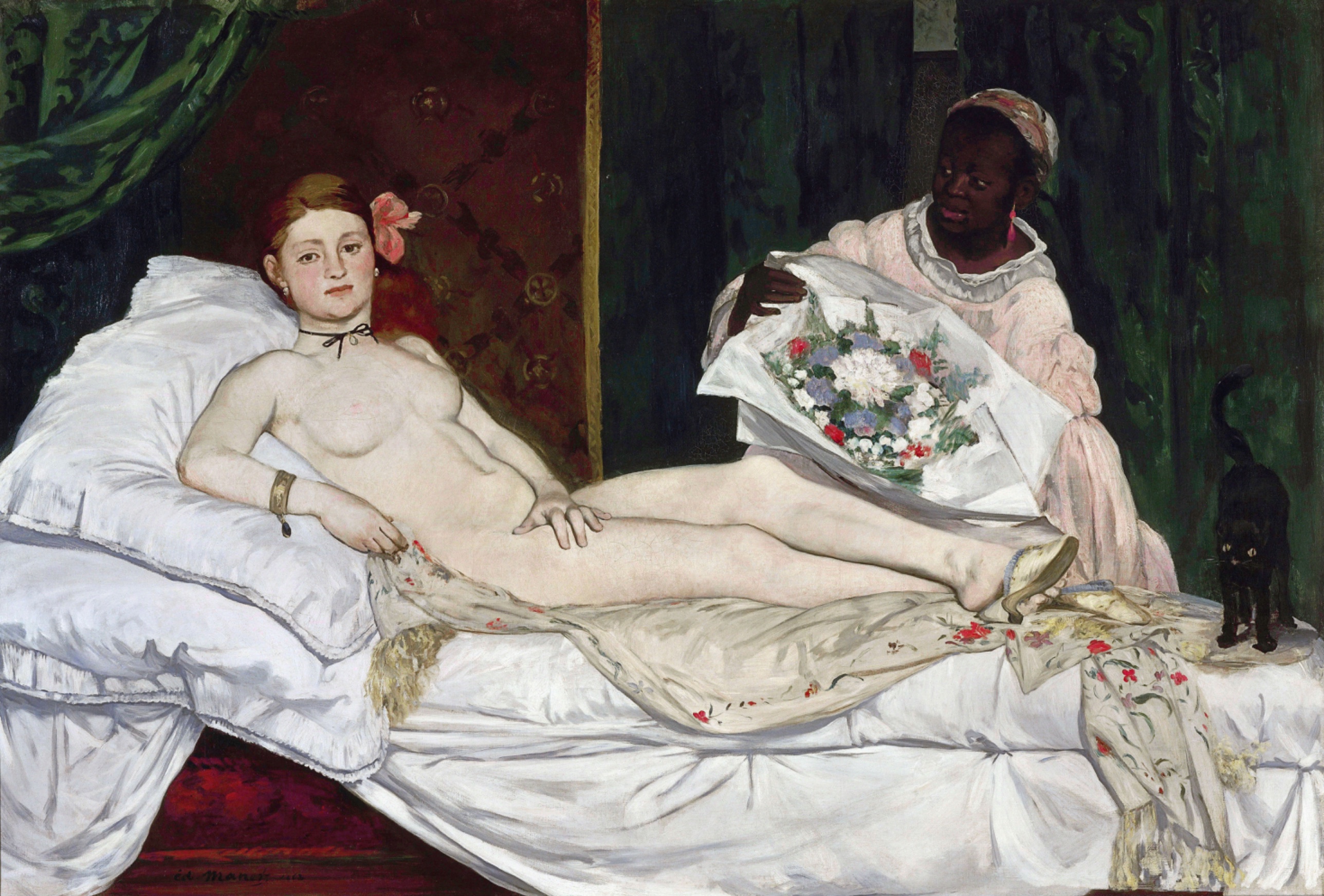
Édouard Manet — Olympia
August 23, 2026 at 6:00 PM
Model: claude-sonnet-5
These 58 principles are perceptual mechanisms that influence what gets noticed, how forms organize, and how space is inferred - all before conscious interpretation. They do not determine meaning.
the world it entered
Salon audiences in 1865 knew how to look at a reclining nude. Titian's Venus of Urbino had given them the pose a century before, and the Salon walls were full of its descendants: nudes softened into myth, skin rendered as something closer to marble than flesh, always with an alibi. Olympia offers the same pose and refuses the alibi. She's not Venus. She's not asleep, not modest, not lit by some golden Venetian glow. She stares back.
That stare is the whole scandal, or one reading of it. A Salon-going public would have recognized the pose instantly and felt the substitution just as instantly: a courtesan in the place of a goddess, a direct gaze in place of averted eyes, a black ribbon standing in for classical drapery. The picture doesn't hide from the institution that would judge it. It uses that institution's own visual language against itself. Whether that reads as attack or as simple honesty about who actually posed for these paintings all along is a question the picture leaves open, and one reading is that leaving it open was the point.
the point it's making
The argument, on one reading, is about looking itself: who gets looked at, who does the looking, and what the picture does when the looked-at person looks back. The tradition Manet is answering is the tradition of the nude as idealized object, unaware of and unbothered by the viewer's presence. Olympia is aware. Her gaze meets the viewer's with the same directness the maid's presented bouquet meets her: something has arrived, someone is here, and the picture is not going to pretend otherwise.
The flattening of the body under hard, frontal light supports this. There's little of the modeling that would make her flesh feel like sculpture, like something safely aestheticized. The paint stays close to the surface of what's depicted rather than sinking into illusionistic depth elsewhere in the canvas too. One reading: the refusal to idealize the light is the same refusal as the stare. The picture won't do the work of making her comfortable to look at. It just shows her, appraising the viewer as frankly as the viewer appraises her.
what stops you
The face finds you before the body does, pale and direct against dark surroundings. Then the eye catches on the seam where her body meets the black background, a hard line that holds the whole figure in place. Only after that does the rest of the room start to resolve: the maid, the flowers, the cat crouched at the foot of the bed.
what hits you first
- Face Detection pulls attention to Olympia's face before any other element in the picture has registered.
- Gaze Direction / Social Attention locks the viewer into her direct stare, reversing the usual arrangement where the nude doesn't know she's watched.
- Edge Detection sharpens the boundary between pale skin and the dark curtain into the single firmest line in the composition.
- Figure-Ground Relationships stack the pale body against the burgundy wall and green curtain so the body reads as a flat, isolated shape rather than a form in space.
- Light Source Logic flattens the body under even, frontal illumination, killing the shadow that would otherwise model her into three dimensions.
- Overlap/Occlusion stacks the maid behind the bouquet, the legs over each other, the cat over the sheet's edge, building the shallow space entirely through what covers what.
- Visual Pop-out / Pre-attentive Features makes the bouquet's dense, unblended color the one place in the picture that reads as active brushwork rather than description.
- Contour Quality keeps the outer silhouette hard while letting the skin-to-sheet boundary go soft, so the body reads as cut out of its background rather than resting in it.
what holds you there
- Agency Attribution reads the maid's presented bouquet as an action directed at Olympia, giving the second figure a purpose the composition otherwise withholds from her.
The eye doesn't wander so much as get stopped and redirected. It starts at the face, slides down the hard outer contour, loses the thread where skin meets sheet, and has to work to find the black cat crouched at the foot of the bed, nearly indistinguishable from the shadow it sits in except for two small yellow eyes. The picture asks the viewer to do the work of assembling a shallow, cluttered room out of overlapping shapes rather than reading depth automatically, and that friction, small and constant, is part of what keeps a viewer standing in front of it.
how it was made
Up close the paint is broad and flat in the body, laid down with little blending, the transitions from light to shadow handled in narrow bands rather than gradual passages. The bouquet is the exception: thick, separate strokes of red, blue and white sit close together, visibly worked. From across the room the body reads as one clean pale shape and the flowers as one bright, busy accent.
what hits you first
- Value Structure/Massing organizes the canvas into two large blocks, the pale body against dark ground, before any smaller detail registers.
what holds you there
- Specularity/Surface Reflection concentrates what little shine the painting has into a few small points, the earring, the bracelet, the slipper, leaving the rest of the surface matte.
- Detail Density Gradient runs from the tightly worked bouquet to the broadly handled body and bedding, so the hand's effort is visibly uneven across the canvas.
what surfaces on a longer look
- Texture separates the loaded, distinct strokes of the flowers from the thinner, flatter paint everywhere else, a difference you only notice once you stop looking at the woman.
The picture doesn't hide its own construction. The flat handling of the body isn't a failure to model form, it's a choice to leave the body looking painted rather than sculpted, and the one place Manet lets the brush show is the bouquet, a small patch of visible labor set against long stretches of flat, economical paint. The surface asks little of the viewer at a distance and a fair amount up close, where the discrepancy between the tightly worked flowers and the broadly stated body becomes hard to unsee.
where it fights itself
The picture wants a viewer to read Olympia's stare as an act of confrontation, but that argument depends on legibility the body's own flatness partly undercuts. The hard contour along her outer edge holds her as a distinct shape, which serves the confrontation; but the soft, nearly lost edge where skin meets sheet works against clean figure-ground separation exactly where the eye tries to settle. The bouquet, meant on one reading as a narrative cue, an offering, competes with the face for first attention because it's the most saturated, most worked passage in the canvas. That's a real interference: the picture's most active brushwork sits away from its most important gaze.
The black cat creates a similar problem. It's nearly invisible, merging into shadow, and different viewers' eyes finish on it, on the bouquet, or on the hand at unpredictable points, meaning the picture doesn't fully control its own ending the way the opening stare is controlled.
The bouquet's brightness looks intentional, a counterweight built to slow the eye down before it leaves the canvas. The uncertain terminal point looks more like an accident of the composition's flatness, not a directed choice.
what stays unresolved
The strongest agreement here is between the stare and the flat, unmodeled paint: both refuse to soften Olympia into something comfortable to look at, and both do it in the same register, directness without ornament. The sharpest conflict is between that directness and the bouquet, painted with far more visible pleasure and color than the body it's meant to serve, pulling attention toward decoration just where the argument wants it fixed on confrontation.
The live question the canvas keeps open: whether a body can look back hard enough to stop being merely looked at, or whether the act of painting it, however flatly, always puts it back on display.
WAYS OF LOOKING
The analysis notices that the eye finds Olympia's face first, then slides down the hard black line where her body meets the curtain, then loses the thread entirely where pale skin meets pale sheet. That's not a vague impression. It's a trained habit of tracking the difference between a strong edge and a weak one, and asking why the painter put the strong ones where he did. Anyone can learn to ask: where does this piece hold a boundary firmly, and where does it let one dissolve? Those choices are rarely accidental.
Notice, too, how the analysis treats the bouquet: the densest, most worked passage of paint in the whole canvas, sitting right next to a face that's supposed to be the picture's main event. Instead of picking one and calling it "the point," the analysis lets both claims stand and watches them compete. That's a habit worth stealing for any argument about a work: find the place where the thing you think the piece is doing runs into a passage that pulls attention somewhere else, and treat that friction as information, not a problem to smooth over.
There's also the move of comparing this painting to the one it's clearly answering, Titian's reclining Venus. The scandal only becomes visible once you know the pose it's quoting. Reading a single work well often means knowing its household, the other paintings hovering behind it that a period audience would have recognized instantly.
WHAT THIS WORK MAKES VISIBLE
Look at how Manet lights Olympia's body: flat, frontal, almost no gradual shadow. Most reclining nudes before this one are modeled like sculpture, shadow rolling gradually across form to make flesh feel round and soft. Here the light refuses that job. Once you've seen a body go flat like this, on purpose, you start noticing lighting choices everywhere as arguments, not just as description. A softly modeled face reads as flattering. A flatly lit one reads as blunt, sometimes even confrontational.
The other thing this painting hands you cleanly is the gap between a person's outer silhouette and their gaze. Olympia's contour against the dark curtain is sharp and sure. Her stare, though, is what actually holds you. Most paintings blur that distinction, letting a strong outline do the work that a strong gaze should. Here they're separable, so you can watch each one operate on its own. Once you've caught that trick in a Manet, you'll start seeing it in a photograph, a poster, any image built to stop someone walking past.
Looking vs. Knowing
These are the analysis's own words, nothing added.
What the Work Shows Us
These are the claims that hold up when you look: each one is rooted in something the image actually puts in front of you, not from what we already knew—or thought we knew—about it.
Readings That Came From Outside
Not wrong, necessarily—but these readings didn't come from looking: they came from biography, cultural context, critical tradition, to complete what the image left open.
Writing guardrail
The house style rules this writing was asked to follow, and where it didn't. Flagged after the fact. Nothing was rewritten.
Pass 3
- Used a banned construction: that's not X, it's Y (bare)
Alternative Interpretation
Pulled directly from this analysis's own language — nothing added.
The analysis's primary reading holds that Olympia's direct stare and the painting's flat, unmodeled handling work together as a unified refusal to soften her into a comfortable object, making the confrontation legible and controlled. The competing reading, held simultaneously, is that this same flatness undercuts the confrontation it's supposed to serve: the soft lost edge at skin-and-sheet works against the clean figure-ground separation the stare needs, and the bouquet's superior brushwork pulls the eye toward decoration rather than the face, so the picture may not fully control the confrontation it's credited with staging.
Questions Raised
Whether the stare should be read as attack on Salon convention or as honest acknowledgment of who actually posed for these paintings — the analysis explicitly leaves this open rather than resolving it.
Whether the viewer's eye reliably ends at the cat, the bouquet, or the hand — the analysis states this varies by viewer and that the composition doesn't control its own terminal point, without determining which (if any) ending is intended.
Whether the picture's final claim succeeds — whether a painted body can "look back hard enough to stop being merely looked at," or whether painting it at all, however flatly, still puts it on display — is named outright as a live, unresolved question the canvas doesn't settle.
Pass 1 — blind observation used
The eye lands on the reclining woman's face first, pale against the white pillow, before dropping to the flat plane of her body. Face Detection pulls attention there before anything else registers: the dark choker at her throat, the direct, unblinking stare aimed straight out of the canvas.
The body itself reads as almost shadowless. Light falls evenly across the torso and legs with none of the soft roll-off of a modeled form; the transition from lit plane to shadow happens in narrow, hard-edged bands, most visible along the underside of the left arm and beneath the raised knee. Light Source Logic suggests a flat, frontal illumination, maybe a studio lamp close to the picture plane, because it kills the gradation a raking or angled light would produce.
Color Opponent Channels organize the whole picture: the cool blue-black of the deep green curtain and dark background sits against the warm reds of the wall hanging and the pinks of the maid's dress, with the white linens acting as a neutral bridge between them. That white is the loudest value in the painting, Value Structure/Massing puts almost all the lightest tone into one connected shape, the bedding, the pillow, the sheet, the flowered wrap held by the maid, so the eye keeps circling back through that pale mass.
Edges behave differently depending on what they're doing. The outline of the body against the white pillow is drawn with a hard, almost graphic contour, no soft transition, no lost edge. The fabric folds in the sheet are looser, brushed in with visible strokes that don't fully resolve into individual threads of cloth, they read as fabric mainly through Pattern Completion, the small red and gold floral motifs scattered over the wrap are enough for the mind to finish the idea of embroidery without every stitch being painted.
Occlusion carries most of the spatial reading. The maid's body is partly hidden behind the flowers and cloth she holds, the cat's hindquarters run off the edge of the bed's white sheet, the reclining figure's raised leg crosses in front of the draped cloth beneath it. There's little atmospheric depth, no haze or softening with distance, so the room reads as a shallow stage rather than a deep space; Overlap/Occlusion does the work that would otherwise fall to perspective or value shift.
The black cat at the lower right functions as a Visual Pop-out, its solid dark silhouette against the white sheet is the highest-contrast note in the lower half of the canvas, and its arched back and raised tail give it Postural Affect, an alertness distinct from the flat calm of the reclining figure.
Surface handling stays consistent across different materials. The skin, the linen, the dark curtain are all painted with comparable matte flatness, no separate technique marks specularity on skin versus fabric; nothing in the image looks like it would throw back a sharp reflection. Brushwork is visible throughout but subordinated to the drawn contours, thicker and more visibly gestural in the flowers and the cat's fur, smoother and more restrained across the figure's skin.
Scale relationships keep the two figures close in size despite one standing and one reclining, which flattens the sense of who is nearer the viewer; only the occlusion of the standing figure by the bed's edge clarifies that she stands slightly behind and to the side. The pink bow in the reclining figure's hair and the gold bracelet on her wrist are small, saturated notes that anchor the eye briefly before it moves on to the denser accumulation of flowers held between the two women, which is where the eye's activity finally settles, drawn there by the concentration of small-scale color variation, red, blue, white, green packed into a tight area, against the surrounding plainness of the sheets.