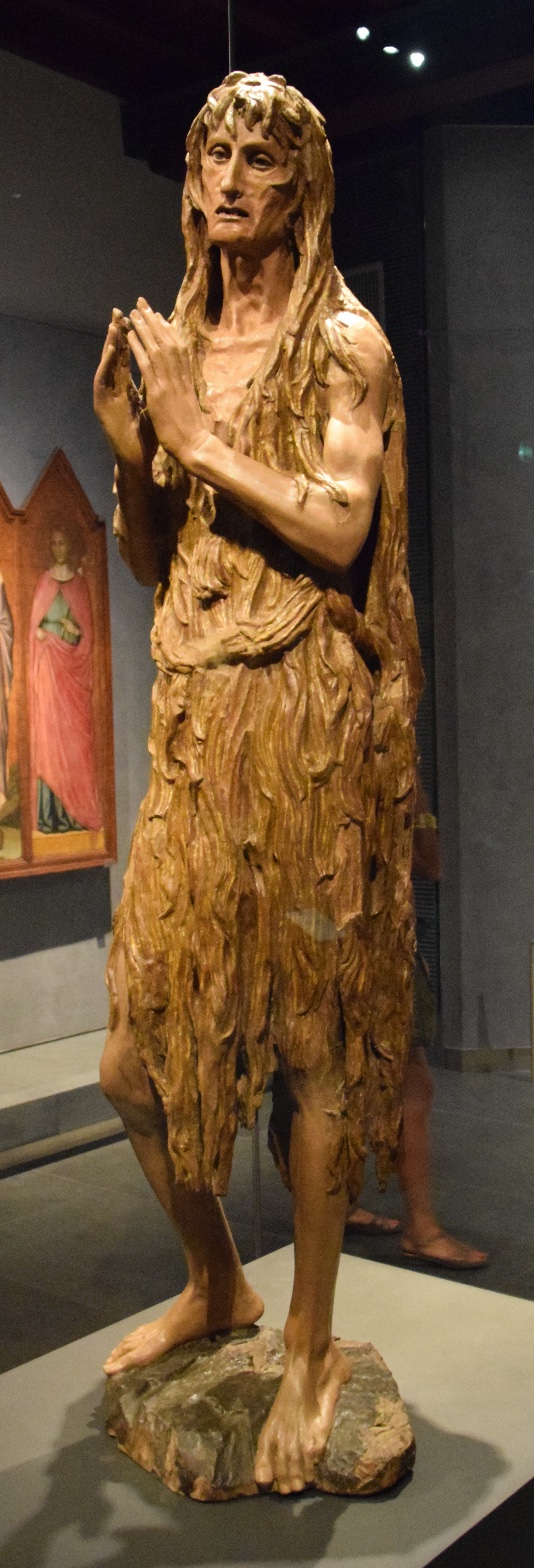
Donatello — Penitent Magdalene
July 29, 2026 at 3:57 PM
Model: claude-sonnet-5
These 58 principles are perceptual mechanisms that influence what gets noticed, how forms organize, and how space is inferred - all before conscious interpretation. They do not determine meaning.
what stops you
The face gets you first. Not because it's beautiful but because it isn't trying to be. The eye sockets are hollowed out to real shadow, the cheekbones sit close under the skin, the mouth hangs open like something caught mid-breath or mid-collapse. You expect a saint. You get a woman who looks like she has been starving herself in a cave for thirty years, because that is exactly the story Donatello is telling.
Then the hands. They're pressed together at her chest, fingers laced, and the gesture reads two ways at once: prayer, or a body folding in on itself to keep from falling apart. The eye keeps returning there, between the ruined face and the clenched hands, because that's the emotional circuit the sculpture wants you running.
What's strange is what happens below the neck. The hair and the garment (they've fused into one mass, you can't tell where one ends and the other begins) is cut into deep vertical gouges, rough as bark, rough as rope. But her forearms and lower legs are smooth, carved with a clean and almost tender precision. The eye moves from the wrecked, over-worked surface of the torso to these two quiet passages of bare skin and feels relief, then alarm, because bare skin on a body this depleted isn't comforting. It's evidence.
how it was made
This is wood, not bronze, though it's easy to think otherwise standing in front of it. The surface has been built up and gilded and painted over centuries of restoration until it reads, at a glance, like cast metal with a brown patina. But the gouges in the hair-and-robe mass are the signature of a carver working with a blade against grain, not a sculptor modeling wax. You can see the strokes stacking, ridge after ridge, each one slightly different in depth and angle, which is why the surface catches light unevenly (bright on the ridges, black in the grooves) even under the flat wash of gallery lighting.
The smooth forearms and shins are a different decision entirely. Someone, working at a different register, slowed down and polished. That contrast (rough mass, smooth extremity) isn't an accident of tool or time. It reads as intentional: the parts of the body still recognizably human, still capable of being seen, are finished with care. The parts consumed by penance are left raw, matted, closer to material than to flesh. The wood is doing the theological work. The carving of the hair is not hair, exactly. It is fur, the medieval and early Renaissance shorthand for the hermit's garment grown from her own body after decades in the wilderness.
what it was entering
By 1440 Florence had spent a generation building a vocabulary for the ideal human body. Ghiberti's doors, the young Donatello's own bronze David, ancient sculpture surfacing out of the ground and demanding imitation: all of it pointing toward proportion, poise, the body as an argument for order. The Magdalene answers that argument with a body that has been used up. This isn't a refusal of the new naturalism so much as an extension of it into territory nobody else was willing to carve. Donatello had already spent his career finding faces that didn't flatter: the bald, sunken St. Jerome-like ascetics, the aged prophets on the Campanile. The Magdalene takes that same unsparing eye and puts it on a subject usually rendered erotic or penitent-but-lovely in the painting of the period. She was the reformed sinner, and painters loved to show her weeping prettily with her hair loose. Donatello shows her after the weeping has stopped mattering. Wood, not marble or bronze, was itself a choice with weight: wood was the material of church furniture, of processional sculpture meant to be carried, touched, lived with rather than admired from a plinth. It put her closer to devotion than to art.
what it demonstrates
Stand close and you can see the specific mechanism at work: detail concentrates in the face, thins out through the hair-mass, and returns, briefly, in the forearms and shins. That gradient is not decoration. It's a way of directing where a viewer's empathy lands. The eye is pulled to resolve the face because faces are where we look for a person, and Donatello over-resolves it, gives it more anatomical specificity than the rest of the body earns, so the suffering registers as particular rather than generic. The coarse ridges of the garment-hair do the opposite job: they read at a distance as texture, almost as pattern, so the body disappears into its own penance before the eye gets close enough to individuate it. You see a person in the face and a condition in the body. That's the whole argument, delivered without a word.
Once you've watched that gradient work here, you start seeing it elsewhere: any figure sculpture where the maker has decided some passages deserve resolution and others don't. It's a lesson in economy. Not every inch of a body needs the same attention. Where attention lands is where meaning lands.
why it holds
The Magdalene still unsettles because it refuses the deal most religious sculpture makes with a viewer, which is to show suffering at a safe distance, softened by beauty or by symmetry, so that admiration and horror stay separate feelings. Here they don't separate. You are drawn to look, the way the face demands looking, and what you find is a body that has punished itself past the point where punishment reads as virtue. It sits in that discomfort and doesn't resolve it. Five centuries of restoration, fire damage from the 1966 flood, new lighting, new plinths, a new museum built partly around this one object: none of it has given the figure anywhere softer to stand. She is still gaunt, still clenched, still asking whether penance is holiness or something closer to ruin. That question hasn't aged. It just waits for whoever is standing close enough to the face to ask it again.
WAYS OF LOOKING
The analysis notices the face is carved with more anatomical specificity than the body deserves, given how the rest of her has been reduced to bark-like ridges. That's not just a description, it's a measurement: the analysis is tracking where detail concentrates and where it thins out, then asking why the maker made that choice rather than an even one. Any figure, any object, has a detail gradient. Learning to find it, and to ask what the maker is directing your empathy toward, works on a portrait, a building facade, a piece of furniture.
The analysis also catches itself getting the material wrong before correcting it: this reads like bronze at a glance, but it's wood, restored and gilded over centuries until it fooled everyone into seeing metal. That correction matters more than getting it right the first time would have, because it shows a habit worth stealing: check what the surface is claiming to be against what it actually is. Materials lie under restoration, under photography, under gallery lighting. Naming the discrepancy is often where the real observation starts.
The analysis places the sculpture against Ghiberti's doors and Donatello's own earlier bronze David, not to compare quality but to show what argument the Magdalene was refusing to make. A single work only means something in relation to what its moment expected. Knowing the surrounding vocabulary, what the culture around a piece was reaching for, lets you see a work's refusals as clearly as its ambitions.
WHAT THIS WORK MAKES VISIBLE
The transition from the smooth forearms to the gouged torso happens right at the wrist, sharp enough that you can put a finger on the exact line where the carver switched registers. Most sculpture blends its surfaces gradually enough that you can't isolate the decision point. Here you can, and that makes visible something usually invisible: sculpture is a series of separate decisions about how much attention each part of a body gets, not one continuous act of rendering.
The hollow eye sockets and open mouth also make legible how a face can carry more resolution than its context justifies, so that the emotional weight of an object concentrates in one small carved area while the rest recedes into texture and pattern. Look for this in any figure where the face is disproportionately worked relative to the body: it usually means the maker wants you to find a person before you find a condition.
Looking vs. Knowing
These are the analysis's own words, nothing added.
What the Work Shows Us
These are the claims that hold up when you look: each one is rooted in something the image actually puts in front of you, not from what we already knew—or thought we knew—about it.
Readings That Came From Outside
Not wrong, necessarily—but these readings didn't come from looking: they came from biography, cultural context, critical tradition, to complete what the image left open.
Writing guardrail
The house style rules this writing was asked to follow, and where it didn't. Flagged after the fact. Nothing was rewritten.
Pass 3
- Used a banned construction: not just X, but Y
Alternative Interpretation
Pulled directly from this analysis's own language — nothing added.
The analysis reads the clasped hands as a single gesture carrying two incompatible meanings without settling between them: prayer, an act of devotion, or a body physically folding to keep itself from collapsing. Similarly, the piece frames her ascetic extremity as ambiguous rather than resolved, ending on the unanswered question of "whether penance is holiness or something closer to ruin."
Questions Raised
The analysis asserts the rough/smooth contrast between the hair-mass and the limbs "reads as intentional" theological signaling, but concedes the surface has been "built up and gilded and painted over centuries of restoration" — it doesn't establish how much of that contrast is original to Donatello's carving versus a product of later intervention or differential wear.
It claims the detail gradient (face resolved, body coarse, extremities resolved again) is a deliberate device "directing where a viewer's empathy lands," but doesn't address whether this gradient could instead result from practical carving constraints (grain, tool access, drying/checking of wood) rather than authorial intent.
The piece treats the fur-like hair as legible "shorthand" for the hermit's penitential garment grown from her own body, an iconographic convention it asserts rather than demonstrates with external evidence about period viewers' actual recognition of the motif.
Pass 1 — blind observation used
I move first to the face — Face Detection pulls the eye there immediately, the deep-set hollow eyes and open mouth reading as an expression before I register anything else about the figure. The face is gaunt, cheekbones pushing against thin skin, and the gaze doesn't meet mine but seems to angle slightly upward and past me.
The figure stands isolated on a circular gray stone base set into a herringbone terracotta-tiled floor, Figure-Ground Relationships establishing it as the sole subject against the museum's neutral architecture. Contour Quality is aggressive throughout — the entire surface is broken into shredded, ragged vertical striations that read as matted hair or tattered fur/hide covering the body from scalp to ankle. Edges never resolve into smooth planes; even the arms and lower legs, which are bare and comparatively smoother, still carry rough, gouged Texture consistent with the tool-worked bronze or wood surface.
Value Structure/Massing is fairly unified — a warm mid-brown to dark umber tonality throughout the sculpted figure, with Specularity/Surface Reflection catching along the raised ridges of the carved strands, giving small glints of lighter warm gold against the darker recessed grooves. This repetition of vertical gouged lines creates Rhythm and Repetition down the whole torso and skirt-like lower garment, almost like bark or flame licks.
The Postural Affect is central to the reading: hands clasped at the chest, fingers interlaced upward near the sternum, shoulders slightly hunched — a gesture of penitence, prayer, or supplication rather than any neutral stance. The bare feet stand on a roughly modeled uneven rock-like plinth, Anchoring and Reference Points at the very bottom of the composition.
Depth in the photograph is established architecturally — Linear Perspective in the receding staircase, glass display cases, and doorway behind the figure, all converging toward a central background archway, giving Atmospheric layering purely through diminishing scale and cooler gray tones of the architecture versus the warm advancing bronze figure (Color Temperature contrast reinforcing Figure-Ground separation).
Scale Relationships position the figure as human-sized, standing solidly in the frame against the taller ceiling and stairs, making it feel life-sized and immediate rather than monumental.
The eye ultimately settles last on the clasped hands — the visual endpoint of the vertical figure, where the gesture crystallizes the entire posture into a single legible point of emotional focus.