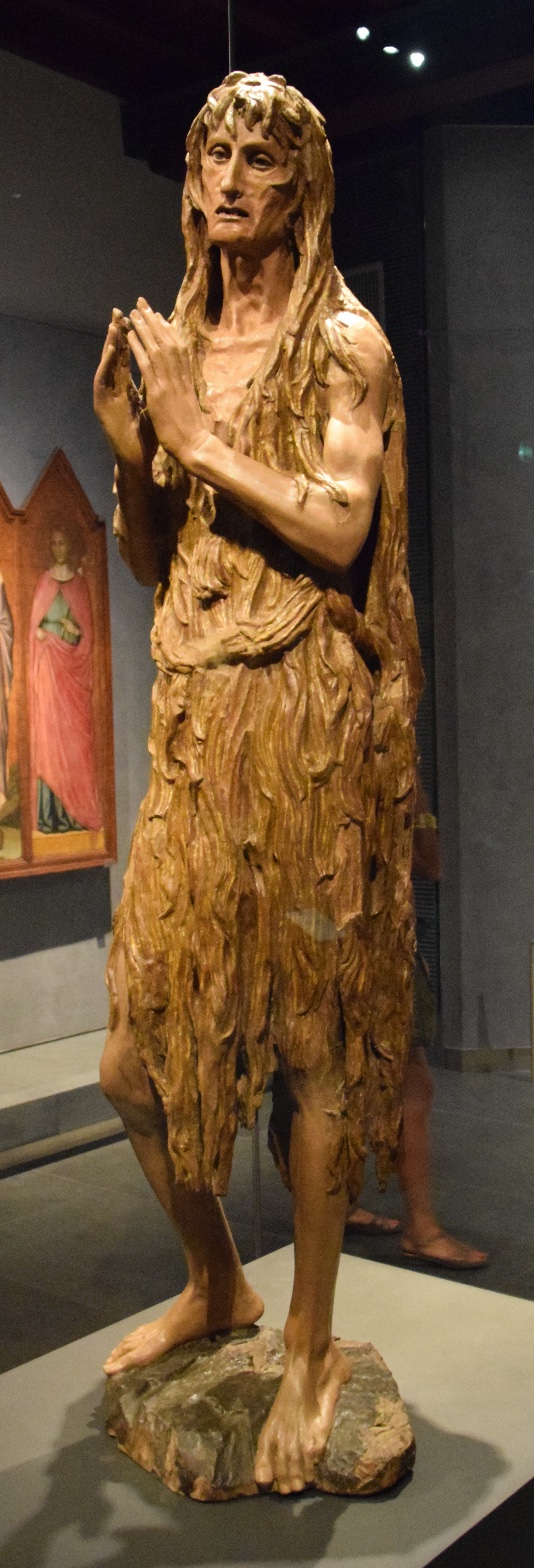
Donatello — Penitent Magdalene
July 28, 2026 at 2:57 PM
Model: claude-sonnet-5
These 58 principles are perceptual mechanisms that influence what gets noticed, how forms organize, and how space is inferred - all before conscious interpretation. They do not determine meaning.
what the eye does
The face gets you before you've processed that you're looking at a saint. It reads, for half a second, as a skull. The eye sockets are carved so deep they hold real shadow, not painted shadow, and the mouth hangs open in a way that looks less like prayer and more like exhaustion that's stopped being polite about itself. Only after that jolt do you notice the hands, pressed together at the chest, fingers laced tight. That's the whole gesture of the piece, really: a face that's given up and hands that haven't. Then the eye starts moving down, and something odd happens. The torso and the hair aren't carved so much as gouged, deep vertical ridges running the length of the body like something between matted fur and tree bark, and it's genuinely hard to tell where the hair ends and the wasted body begins. But the forearms and shins are comparatively smooth, almost calm, with clean edges. So the eye keeps swinging between two registers: chaos and clarity, ruin and control, without ever settling. That oscillation is the experience of looking at this thing.
how it's made
It's carved wood, not cast bronze, though the deep brown surface and the way light catches on the ridges make people misread it as metal more often than you'd expect. Donatello worked poplar here, and the tool marks are not hidden. You can see the gouge strokes that built up the hair and drapery, left rough and irregular on purpose, while the anatomy underneath, where the wood does the work of being a body rather than hair or cloth, gets smoothed into something closer to naturalism. The surface itself was originally polychromed and gilded, traces of which remain, so what you're looking at is a faded version of something that was once more vivid, more like flesh in color rather than the uniform umber the wood has settled into over five centuries. The roughness isn't a lack of finish. It's finish deployed as a decision, texture used as information about what kind of body this is and what it's been through.
where it lives
Stand in front of it at the Museo dell'Opera del Duomo and the case around it is quiet, climate-controlled, pale stone and glass, which makes the figure look even more like it doesn't belong there, like it walked in from somewhere much harder. That contrast isn't an accident of museum design so much as a strange echo of what the piece was doing when Donatello carved it around 1440. This is Florence at the height of confident, idealized figure sculpture, bodies getting more classical, more balanced, more beautiful by the year. Donatello had already made work in that vein. Here he goes the other direction entirely, toward the Magdalene as an old woman wrecked by decades of penance in the desert, her body given over entirely to spiritual extremity rather than physical grace. It was carved for the Baptistery in Florence and stood there for centuries before flood damage in 1966 brought it to the museum for conservation and eventual permanent display. The record on its immediate reception is thin, but its influence on later, more expressive religious sculpture in Italy is not in question.
what it's arguing
The piece is arguing that suffering has a body, and that body isn't beautiful. Most religious sculpture of the period wants you to see holiness through physical harmony, faces at peace, drapery falling in ordered rhythms. This one wants you to see holiness as a cost. The gouged, ungainly surface isn't a failure to idealize; it's a refusal to. Donatello seems to be betting that a wrecked, near-collapsing body tells you more about decades of penance than a serene one ever could, and that the hands still pressed together, still trying to pray, matter more because everything else about her has given out. It's a hard, unsentimental piece of devotion. There's nothing decorative in it, and I think that's exactly the point Donatello wanted made.
what it holds open
The gaze doesn't resolve. Some who've stood in front of it read her looking past the viewer, others read it as averted downward, and the ambiguity feels less like a flaw in observation than something built into the carving itself, a woman who isn't fully present to this world anymore. Whether that expression is agony or a kind of exhausted peace past agony is a question the wood doesn't answer, and every viewer ends up deciding it a little differently, which seems right for a figure who was, by every account, somewhere between the two.
WAYS OF LOOKING
The face reads as a skull for half a second before it reads as a saint, and the analysis catches that misfire instead of correcting it too fast. That's a habit worth stealing: trust the first, wrong read, because it tells you what the piece is actually doing to a viewer before knowledge kicks in and smooths things over. Most people rush past that gap to get to the "right" interpretation. The better move is to sit in the gap a beat longer.
Notice how the analysis keeps swinging between the gouged, chaotic torso and the comparatively smooth forearms, and never lets one cancel out the other. That's reading a work by its inconsistencies rather than despite them. A piece that's uniformly rough or uniformly polished doesn't ask much of you. One that changes register from limb to limb is handing you a decision about where the artist wanted control visible and where they wanted it to look like it had failed. Find the seam where the technique changes, and you've usually found the argument.
The piece pulls in one clear historical contrast: Florentine sculpture in 1440 was getting more balanced, more classical, more beautiful, and this figure goes hard in the other direction. That's placing a single work against the norm of its moment rather than describing it in isolation. You don't need a full art history course for this. You just need one solid fact about what everyone else was doing at the time, so the choice in front of you looks like a choice and not just a style.
And the analysis is honest that the gaze direction never resolves, that different viewers see her looking past you or looking down, and it doesn't force a winner. That's a discipline: naming what the work leaves open is as important as naming what it settles. A confident case doesn't mean pretending every ambiguity has an answer.
WHAT THIS WORK MAKES VISIBLE
Look at the ridges running down the hair and body. In a painting, texture is usually implied, brushwork standing in for surface. Here the texture is the actual depth of the wood, gouged out, so you can watch the tool decide where roughness ends and smoothness begins. Carved and cast work makes that decision physically legible in a way flat paint rarely can. Next time you're in front of a sculpture, look for where the surface finish changes across the same figure. That shift is information, not inconsistency.
And look at how uncertain the material itself is. People keep mistaking this wood for bronze because five centuries of handling and lost paint have flattened the color to one uniform brown. That's a reminder to ask, in any historical object, how much of what you're seeing is the artist's decision and how much is just time.
Alternative Interpretation
Pulled directly from this analysis's own language — nothing added.
The analysis's primary reading treats the Magdalene's expression as exhaustion, "agony that's stopped being polite about itself," a body given over to collapse. But it also flags a genuine competing reading in its final section: the same face might register as a kind of exhausted peace past agony rather than suffering itself, with the gaze read by different viewers as looking past the viewer or averted downward, and the analysis explicitly declines to settle which it is.
Questions Raised
Whether her expression and gaze depict active agony or a state that has moved beyond agony into something closer to peace is left unresolved, with the analysis stating the wood itself doesn't answer this.
The analysis admits "the record on its immediate reception is thin," meaning how contemporary Florentines actually responded to this deliberately unbeautiful devotional figure is unknown rather than inferred.
The original polychromed and gilded surface survives only in traces, so how the piece's meaning or emotional effect shifted between its vivid original coloring and its current faded, uniform-brown state is a gap the analysis notes but doesn't resolve.
Pass 1 — blind observation used
I move first to the face — Face Detection pulls the eye there immediately, the deep-set hollow eyes and open mouth reading as an expression before I register anything else about the figure. The face is gaunt, cheekbones pushing against thin skin, and the gaze doesn't meet mine but seems to angle slightly upward and past me.
The figure stands isolated on a circular gray stone base set into a herringbone terracotta-tiled floor, Figure-Ground Relationships establishing it as the sole subject against the museum's neutral architecture. Contour Quality is aggressive throughout — the entire surface is broken into shredded, ragged vertical striations that read as matted hair or tattered fur/hide covering the body from scalp to ankle. Edges never resolve into smooth planes; even the arms and lower legs, which are bare and comparatively smoother, still carry rough, gouged Texture consistent with the tool-worked bronze or wood surface.
Value Structure/Massing is fairly unified — a warm mid-brown to dark umber tonality throughout the sculpted figure, with Specularity/Surface Reflection catching along the raised ridges of the carved strands, giving small glints of lighter warm gold against the darker recessed grooves. This repetition of vertical gouged lines creates Rhythm and Repetition down the whole torso and skirt-like lower garment, almost like bark or flame licks.
The Postural Affect is central to the reading: hands clasped at the chest, fingers interlaced upward near the sternum, shoulders slightly hunched — a gesture of penitence, prayer, or supplication rather than any neutral stance. The bare feet stand on a roughly modeled uneven rock-like plinth, Anchoring and Reference Points at the very bottom of the composition.
Depth in the photograph is established architecturally — Linear Perspective in the receding staircase, glass display cases, and doorway behind the figure, all converging toward a central background archway, giving Atmospheric layering purely through diminishing scale and cooler gray tones of the architecture versus the warm advancing bronze figure (Color Temperature contrast reinforcing Figure-Ground separation).
Scale Relationships position the figure as human-sized, standing solidly in the frame against the taller ceiling and stairs, making it feel life-sized and immediate rather than monumental.
The eye ultimately settles last on the clasped hands — the visual endpoint of the vertical figure, where the gesture crystallizes the entire posture into a single legible point of emotional focus.