Gustave Caillebotte — The Floor Scrapers
August 4, 2026 at 4:27 PM
Model: claude-sonnet-5
These 58 principles are perceptual mechanisms that influence what gets noticed, how forms organize, and how space is inferred - all before conscious interpretation. They do not determine meaning.
what the eye does
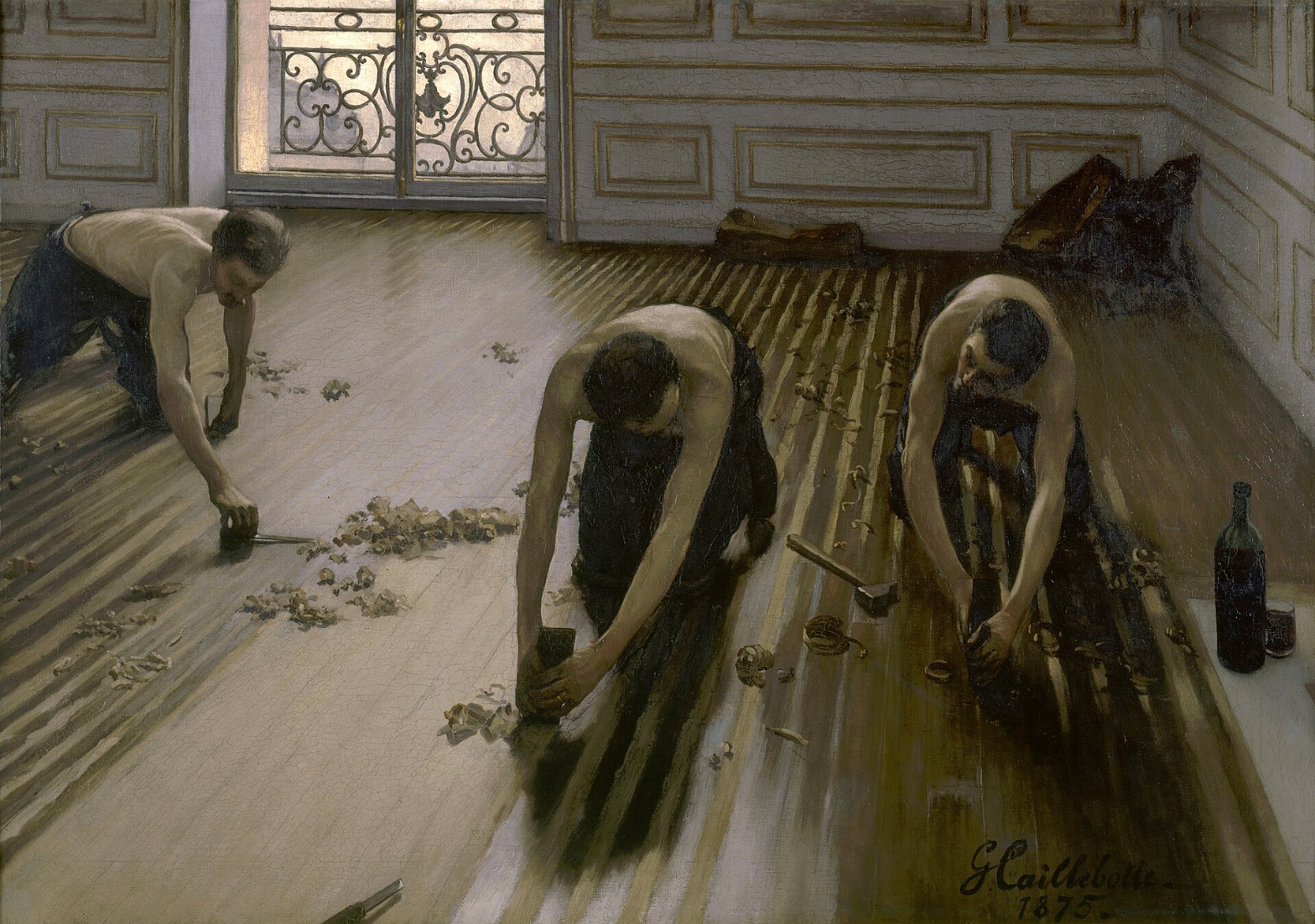
The first thing that gets you is how much light is doing the work of a floor. Three men are on their knees stripping the finish off bare wood, and the wood itself is the brightest thing in the room after the window. Your eye doesn't start with the men. It starts with the pale channel of scraped floor running back toward that window and the iron balcony grille beyond it, and only then does it come forward again to find the bodies bent over the boards, curls of shavings scattered around their knees like something a lathe would leave behind. The floorboards themselves do the pulling: their lines converge toward the back wall with a kind of insistence, so even before you've registered three men doing manual labor, you've been sent on a track through the room. Then the bodies catch you, because they're arranged almost like a flip-book, same pose, three times, at slightly different points along that diagonal, and you find yourself reading them left to right or right to left the way you'd read a sequence of film stills of one man moving. The wine bottle and glass in the corner are a small, dark, almost startling accent against all that pale wood, easy to miss and hard to un-see once you've caught it.
how it's made
The paint itself splits into two very different kinds of handling. The floor is built from long, controlled, almost architectural strokes that follow the direction of the boards, smooth and tight, the kind of brushwork that wants to disappear into the illusion of wood grain. Then the shavings on top of it are thick, curled, sculptural little marks, laid on with more paint and less patience, so the surface has an actual raised texture where the debris sits, a real ridge you could probably feel if you ran a finger over it. The wrought iron of the balcony grille is picked out with hard, precise edges, almost drawn rather than painted, while the men's bodies dissolve into shadow at the trousers and along the floor, edges going soft exactly where light stops reaching. Caillebotte was trained in a fairly academic, exacting hand before he ever showed with the Impressionists, and it shows here: the drafting is careful, almost close to a study in perspective, laid under paint handling that's freer where it can afford to be.
where it lives
Caillebotte submitted this painting to the Paris Salon of 1875, and it was rejected. The jury's discomfort wasn't really about technique. Bare-chested laboring men, painted with this much specificity, close to eye level, filling most of a canvas nearly five feet wide, was not a subject the Salon had a category for. Peasants in fields were acceptable; the working body of urban craft labor, shown this plainly, without allegory or sentiment attached, was not. Caillebotte showed it instead at the second Impressionist exhibition in 1876, where it drew attention and some genuine bafflement for its almost photographic exactness, at a moment when Monet and Renoir were dissolving edges rather than sharpening them. The painting is in the Musée d'Orsay now, hung among works that argued for softness and atmosphere, while this one still argues for structure and fact.
what it's arguing
The painting insists that manual labor is worth the same formal attention as a ballroom or a riverbank picnic, painted with the same command of perspective and light that a history painter would bring to a battlefield. There's no moral being delivered about the dignity of work, no sentimentality in the faces, because you can't really see the faces. What you get instead is posture, effort held in the spine and shoulders, and a room built with the same rigor as an architectural drawing. Caillebotte, who had money and didn't need to sell paintings to eat, seems to have been drawn to labor precisely because it wasn't romantic to him. It was just true, and worth looking at as carefully as anything else.
what it holds open
You never see these men's faces clearly enough to know what any one of them is thinking about while he works, and the painting doesn't seem to want you to. That withholding keeps them from becoming a symbol of labor in general and lets them stay three specific bodies doing one specific afternoon's job. The wine bottle sits there unexplained, break time or just a fixture of the trade, and nothing in the picture tells you which.
WAYS OF LOOKING
Notice how the analysis doesn't start with the men, it starts with tracking where the light actually is: the scraped floor, then the window, then back to the bodies. That's a habit worth stealing. Before you decide what a painting is "about," walk the actual path your eye takes first, second, third. The subject often isn't where the eye lands first, and knowing the order tells you what the artist wanted you to feel before you understood anything.
The write-up also catches something easy to skip past: the wine bottle in the corner is rendered with the same care as everything else, but nobody explains it, and the analysis lets that stand. Instead of forcing a meaning onto a detail, it names what's unresolved and leaves it there. Good looking sometimes means clocking a detail's weight without demanding it pay off.
There's a real payoff in noticing where the brushwork changes register, tight and controlled on the floorboards, thick and loose on the wood shavings, hard-edged on the iron grille, soft where skin meets shadow. That's reading technique as information rather than as evidence of skill. Every shift in handling is a decision about what the artist wanted to feel important versus atmospheric, and once you start tracking those shifts, you can find them almost anywhere.
Finally, the analysis reaches for the Salon's rejection to explain why the painting matters, not just what it looks like. Facts about who saw it, who refused it, and why, turn a formal observation into an argument. A painting's meaning often lives partly in the room it was rejected from.
WHAT THIS WORK MAKES VISIBLE
The repeated pose, three men in nearly the same crouch, staggered across the floor, makes visible something that's usually invisible: how a single body multiplied along a path can suggest motion or time passing, even in a still image. Look for this trick in any painting with more than one figure doing the same thing.
The floorboards make the mechanics of linear perspective, the trick of parallel lines converging to a point that reads as depth, almost embarrassingly obvious. You can watch the illusion happen in real time. Next time a floor, road, or ceiling beam runs toward a vanishing point, notice how hard it's working to drag your eye somewhere specific.
And the total absence of visible faces, despite three bodies at full attention, shows how posture alone can carry all the emotional weight a face usually does. Watch for this in any painting where the artist hides expression on purpose: the body starts talking louder.
Alternative Interpretation
Pulled directly from this analysis's own language — nothing added.
The analysis reads the withheld faces as evidence that the painting resists turning the men into a symbol of labor, keeping them as three specific bodies on one specific job. But it also floats a competing possibility in the wine bottle detail: the scene could carry an unstated narrative marker (break time, a fixture of the trade) that would push it back toward genre-scene specificity rather than pure formal study, and the analysis admits it can't settle which.
Questions Raised
Whether the wine bottle and glass signal a narrative beat (a pause in work) or are simply an incidental object of the trade with no significance beyond décor.
Whether the men's obscured faces reflect a deliberate choice to avoid sentimentality/symbolism or is simply a byproduct of the chosen vantage and lighting.
What the three repeated poses are meant to suggest, sequential movement of a single figure across time, or three separate men caught in coincidentally similar posture, is left as an observation about how the eye reads it rather than a settled claim about the artist's intent.
Pass 1 — blind observation used
My eye enters through the tall window at upper left — the wrought-iron balcony grille catches the brightest light in the painting, functioning as an Anchoring and Reference Point against which everything else reads as darker interior. The light falling through that window establishes Light Source Logic: it rakes across the floor from upper left, explaining the long cast shadows and the raking highlights on each floorboard.
Three shirtless men occupy the floor in a diagonal Rhythm and Repetition — bent at nearly identical angles, scraping wood with the same tool, their backs forming a receding row that reinforces Linear Perspective already set up by the converging floorboards. The floorboards themselves are the strongest Directional Force/Implied Movement in the image, their parallel strips narrowing toward the back wall and pulling the eye deep into the room.
Value Structure/Massing is built on a narrow, warm range: pale ochre floor, warm grey-white paneled walls, and darker umber figures. The men's bent torsos are the darkest value masses, grounding the composition against the light floor — a clear Figure-Ground Relationship where the pale striped floor becomes almost a pattern the figures interrupt.
Edges shift according to distance: the nearest figure at left has crisper contour along his back and arm, while the two further figures show softer, more blended edges into the shadowed floor — an Edge Detection gradient supporting Atmospheric Perspective within an interior.
Postural Affect reads clearly in all three bodies — the identical forward curl of the spine, tension in the shoulders, and lowered heads communicate strain and repetitive labor without any visible faces.
Small still-life notes anchor the right side: a dark wine bottle and glass on the floor near the back wall, plus curled wood shavings scattered in loose, organic clusters (Texture) that contrast with the hard-edged geometric floor strips (Pattern vs. Figure).
The signature and date, "G. Caillebotte 1875," sit lower right, the eye's final resting point after tracing the diagonal of workers back toward the front of the room.