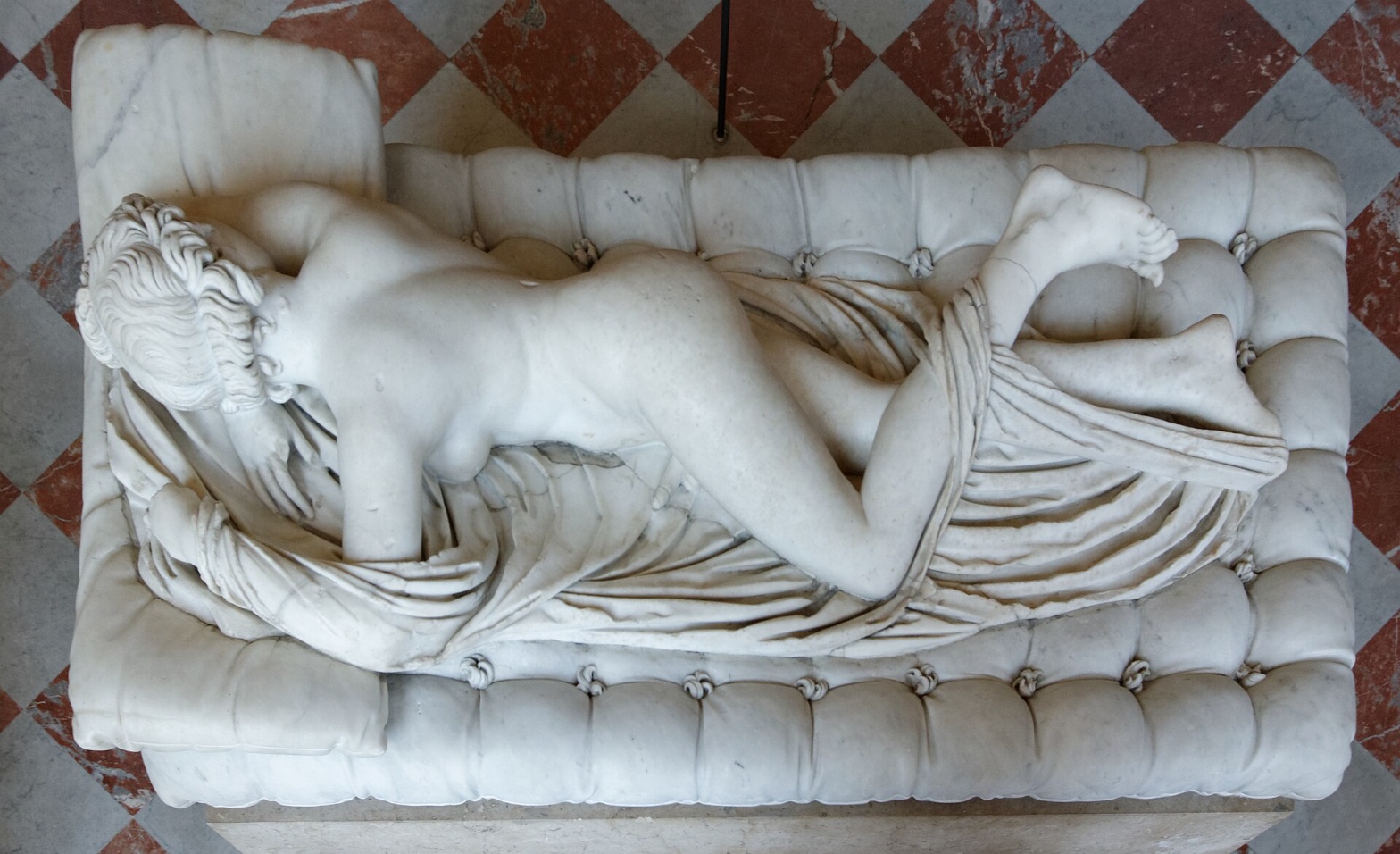
Unknown (original sculpture) Gian Lorenzo Bernini (mattress) — Sleeping Hermaphroditus
July 18, 2026 at 6:55 PM
Model: claude-sonnet-5
These 58 principles are perceptual mechanisms that influence what gets noticed, how forms organize, and how space is inferred - all before conscious interpretation. They do not determine meaning.
OVERVIEW
The perceptual system and the conceptual system pull in the same direction here. Both organize around delay. The eye travels the diagonal, gets stopped by drapery density, gets stopped again by hair, never resolves the face — and the conceptual argument (a body that resists single-sex reading) is also structured as withheld resolution. That's a rare alignment: form and idea doing the same work.
The material domain sits at an angle to both. The marble is carved by two different hands three centuries apart — ancient body, Bernini mattress — and the material record doesn't announce this split. Surface handling is continuous. So the material domain stabilizes what the eye sees (one coherent object) while destabilizing what the object actually is (two authors, two eras, fused). That's a tension the viewer can't perceive directly. It has to be known.
Cultural domain conflicts with the other three. The work's institutional legibility (Louvre masterpiece, canonical antique-into-Baroque object) depends on knowing the collaboration, knowing the twist ending built into the sculpture's rear-view design. None of that is available from a top-down photographic vantage alone. The image as given doesn't stage the reveal the sculpture is famous for.
So the domains split into two pairs: perceptual/conceptual align on suspended resolution; material/cultural align on invisible authorship. The two pairs don't talk to each other.
Unresolved tension: the sculpture's whole historical identity depends on a frontal-then-rear viewing sequence that this vantage point structurally forecloses.
PERCEPTUAL
The eye lands on the pale marble body first. Reason: strong figure-ground relationship against the warm terracotta-and-gray checkerboard floor. Color temperature contrast does the initial work — cool white figure against warm ground — before any shape recognition happens. This is pop-out, pre-attentive, fast.
From there the eye follows the diagonal. Head upper left, torso and hip rising through the middle, raised foot lower right. This is directional force, plain and strong. Nothing else in the frame offers a competing vector, so the diagonal wins.
But the diagonal keeps getting interrupted. Detail density gradient concentrates at the drapery — dense parallel grooves demand a pause. The hair is a second density knot, ridged and repetitive, and it sits right where the face should be. The eye goes looking for a face — face detection engages automatically, it's a reflex — and finds none. The head is turned away. That's a stall, not a stop. The eye doesn't disengage, it searches longer than it would for a resolved face, then gives up and continues along the body.
Edge quality reinforces this rhythm. Torso and hip edges are soft, continuous, low-information — the eye slides over them fast. Drapery, hair, and tufting edges are sharp and crisp — the eye slows there. Visual weight is distributed unevenly on purpose: the smooth expanses are where the eye moves, the carved-dense passages are where it stops.
Value structure supports the same read. Highlights sit on the projecting hip and back — the tallest points of the diagonal — while shadow pools in the tuft indentations and drapery folds. So light is doing the same job as the diagonal: guiding across the peaks, letting the recesses hold the eye briefly before releasing it.
The final stop is contested — some tracking ends at the raised foot, some loops back toward the crossed-foot crevice, some returns to the obscured head. That instability at the endpoint matters: the composition doesn't give the eye a clean terminus. It gives it a return loop between two unresolved zones — the hidden face and the tangled feet. Both are anatomically ambiguous zones. The eye's confusion about where to land tracks the body's own refusal to resolve into a single legible identity from this angle.
MATERIAL AND FORMAL
The stable medium is marble, one physical material, one continuous surface. But two acts of carving separated by over a thousand years sit inside that one surface: the ancient body, the seventeenth-century mattress. The mattress is where the tool marks are sharpest and most legible — tufted buttons, repeating quilted geometry, hard edges. This is the newer carving and it reads as the highest-confidence, highest-precision passage in the object. The body is the older carving, and it carries the softer, more continuous contours — centuries of a different chisel logic, then subsequent polishing.
Detail density gradient here is not just a compositional device, it's a material fact: the drapery and mattress folds are where the most recent tool work concentrates, and that's also where the carving is most virtuosic. Bernini's addition doesn't try to hide itself as an addition, but it also doesn't announce itself as one to a casual viewer. The stone doesn't change color or grain visibly between the two periods, so the material record reads as continuous even though the authorship isn't.
Up close, the piece asks the viewer to register tool differential — the crispness of the quilting versus the worn, softened flesh planes. At a distance, none of that differential matters. The whole object reads as one smooth event: a sleeping body on a bed. The material is honest at the level of touch and detail, but it withholds its two-stage history at the level of overall silhouette. That's not deceptive — it's simply not visible without prior knowledge, which pushes this fact out of the perceptual domain and into the cultural one.
CULTURAL
One reading: this object sits at the seam between antiquity-worship and Baroque intervention. Collecting an ancient Hermaphroditus and then commissioning Bernini to carve a matching mattress is a specific, legible move within seventeenth-century collecting culture — it says the antique fragment isn't a relic to be left alone, it's raw material to be completed, staged, activated by a living virtuoso. Institutions like the Louvre inherit and continue that logic: the object is displayed as a single continuous artwork, not as fragment-plus-addition.
A second reading: this positions the work inside a long tradition of ambiguous-body statuary — Hellenistic and Roman interest in hermaphroditic and androgynous figures as a category of erotic and philosophical fascination. Audiences fluent in classical reception history would recognize the iconography immediately. Audiences without that training would likely read it simply as a sleeping female nude from this vantage — the top-down angle here doesn't offer the frontal view that reveals the figure's dual anatomy, which is the detail the whole cultural conversation about this object turns on.
That's a legibility gap. The sculpture's institutional fame rests on a reveal — walk around it, discover what the reclining pose conceals from the front. This image, shot from above, doesn't stage that reveal. So a viewer without prior knowledge of the piece's identity is cut off from the specific cultural conversation the object is famous for entering. Whether that's the photographer's choice or a structural feature of this angle, it changes which audience the image actually reaches versus which audience the sculpture as an object was built to reach.
CONCEPTUAL
Hypothesis (insufficient visual evidence): the work is making an argument about categorical instability — that binary sex categories collapse under close looking. This is the sculpture's known conceptual territory, but the two observable anchors available here (obscured head/face, densely carved concealing drapery) support withheld visual information generally, not sex/gender ambiguity specifically. The image alone doesn't show the anatomical detail that carries that argument; that argument requires the frontal view, which this vantage does not provide.
What the image does support: an argument about looking itself. The perceptual pattern — face detection triggered and denied, the eye stalled at density zones, no stable resting point — reads as a formal argument about delayed or refused recognition. The body offers itself as fully available (reclining, exposed, elevated in the picture plane, occupying almost the whole frame) while withholding the one feature — the face — that would let a viewer complete an identity. That's two independent anchors: postural openness plus facial concealment. That pairing supports a legitimate reading: the sculpture stages availability and withholding simultaneously.
Historically, this sits near a broader classical and Baroque interest in sleep as a state that suspends agency and consent — the sleeping figure can be looked at without the complication of a returned gaze. Gaze direction / social attention is switched off here: nobody in the image looks back. That absence is doing real conceptual work regardless of what's underneath the drapery. It turns looking into an one-directional act, uncontested by the subject.
Where perceptual thinness becomes the point: the work doesn't need facial detail to make its argument, because the argument is about the withholding, not about what's withheld. The refusal itself is the content.
NOISE — CONSOLIDATED
PERCEPTUAL: The eye's landing point is unstable across observers — some end at the raised foot, some at the crossed-foot crevice, some loop back to the head. This isn't a clean single-terminus composition; it's a genuine ambiguity in where the directional force actually resolves, and it's visible in the disagreement itself.
MATERIAL: The two-period carving (ancient body, Bernini mattress) creates a material history invisible in the surface continuity. The stone doesn't visually confess its split authorship, so the material logic and the actual making history are out of sync.
CULTURAL: The top-down vantage withholds the frontal reveal that the sculpture's entire cultural reputation depends on. A viewer relying only on this image cannot access the specific conversation (ambiguous/dual anatomy) that makes this object historically significant. That's a real gap between what's shown and what's famous.
CONCEPTUAL: The strongest available conceptual reading (looking, withholding, refused resolution) is well-supported. The more specific, historically correct reading (sex/gender ambiguity) is not supported by this image alone — it can only be imported from outside knowledge, which risks the conceptual analysis smuggling in a conclusion the visual evidence here doesn't earn.
Closing: the perceptual stall at the hidden face and the conceptual argument about withholding are very likely the same intentional device: everything else — the vantage cropping out the reveal, the invisible two-author material seam — reads as accidental interference, a function of angle and photographic choice rather than the work's own design.
WAYS OF LOOKING
The analysis noticed that the eye goes hunting for a face where the head is turned away, doesn't find one, and keeps moving anyway — a longer pause than usual, but not a stop. That's tracking a search-and-fail pattern rather than just describing what's there. Anyone can list what's visible. Fewer people notice when the viewer's own expectations get triggered and then denied, and fewer still treat that denial as information rather than an absence. Next time you're building a case for how a work operates, ask not just what's shown, but what a viewer goes looking for and doesn't get.
It also refused to let the sex/gender reading ride in on the sculpture's reputation. The analysis is explicit: this vantage doesn't show the anatomical detail that argument depends on, so the argument gets flagged as imported, not earned. That's a discipline — separating what the image proves from what you already know about the object. It's tempting to let outside knowledge do the seeing for you. Naming that boundary, out loud, is a habit worth keeping.
The material section drew a line between what's visible up close (tool marks, carving confidence, density of detail) and what's visible from a distance (one continuous smooth object). Two different carvers, centuries apart, and the seam between them only shows up at one of those two scales. That's a habit of checking your claims against viewing distance — some truths about a piece only surface when you get close, others only when you step back, and conflating the two produces false confidence.
Finally, the analysis kept the four domains — perceptual, material, cultural, conceptual — as separate columns, then noticed where they lined up and where they split. That's the real habit: don't let agreement in one domain stand in for agreement everywhere. Two domains cohering is a finding. Two domains conflicting is also a finding, arguably a more interesting one.
WHAT THIS WORK MAKES VISIBLE
Look at how the drapery folds and the hair curls are carved deep and repetitive, while the torso is carved smooth and continuous — that contrast in edge quality (how hard or soft a contour reads) is unusually easy to spot here because the material is uniform. One stone, two carving vocabularies, side by side. In a painted work, texture differences can be faked with a brush in seconds; in carved stone, they cost real labor, so when you see this kind of density gradient, you're watching where an artist decided your eye should slow down. Look for it in any sculpture with contrasting surface treatments — drapery against skin, hair against flesh.
The top-down vantage also makes visible something usually invisible: how much a single camera angle can foreclose an entire history. This sculpture is famous for a reveal you get by walking around it. Shot from above, that reveal simply isn't available. Next time you're looking at a photograph of a three-dimensional work, ask what angle is missing — and what argument depends on it.
Looking vs. Knowing
These are the analysis's own words, nothing added.
What the Work Shows Us
These are the claims that hold up when you look: each one is rooted in something the image actually puts in front of you, not from what we already knew—or thought we knew—about it.
Readings That Came From Outside
Not wrong, necessarily—but these readings didn't come from looking: they came from biography, cultural context, critical tradition, to complete what the image left open.
Writing guardrail
The house style rules this writing was asked to follow, and where it didn't. Flagged after the fact. Nothing was rewritten.
Pass 2
- Used a banned construction: not just X, but Y
- Used a banned construction: em dash
- Used banned word: masterpiece
Pass 3
- Used a banned construction: not just X, but Y
- Used a banned construction: em dash
- Used a banned construction: hedge (arguably)
Alternative Interpretation
Pulled directly from this analysis's own language — nothing added.
The primary reading holds that the sculpture's conceptual content is best supported as a general argument about looking, delayed recognition, and withholding — a claim the perceptual evidence (obscured face, stalled eye, unreturned gaze) directly earns. The competing reading — that the work argues specifically for the collapse of binary sex categories — is flagged explicitly as a hypothesis with insufficient visual evidence, since that claim depends on the frontal anatomical view this top-down vantage structurally withholds.
Questions Raised
Does the image's inability to stage the frontal reveal mean the sex/gender-ambiguity reading is simply unavailable here, or is it still latent in the work regardless of vantage — the analysis doesn't settle whether absence-from-view equals absence-from-meaning.
Where exactly does the eye's diagonal path actually terminate — raised foot, crossed-foot crevice, or looped back to the head? The analysis records disagreement among observers rather than resolving it.
Is the material seam between the ancient body and Bernini's mattress genuinely imperceptible to the naked eye at any distance, or only imperceptible from this photographic vantage — the analysis treats it as known-but-invisible without testing whether closer or different-angle viewing would surface it.
Pass 1 — blind observation used
The first thing that resolves is the reclining figure's torso — the smooth, continuously curving expanse of marble catching the most even light, set against the tufted, button-quilted surface beneath it. That contrast in texture is what holds the eye initially: skin rendered as unbroken polished plane versus the couch's repetitive diamond-stitched pattern with its small knotted tufts, a clear instance of Texture working against Pattern vs. Figure.
Moving along the body, the contour of the hip and waist forms the highest point of relief, catching the strongest light — a Value Structure/Massing where the lightest passage sits at the figure's midsection, and the values recede into shadow at the folds of drapery gathered beneath the hips and legs. The drapery itself creates a dense field of parallel and radiating grooves, a Detail Density Gradient running from the simplified, broad planes of the couch cushions to the intricate, deep-cut channels of cloth compressed between the legs.
The head, turned downward and resting on the folded arm, is angled away from the viewer — Postural Affect reads here as repose or collapse rather than alertness, the neck bent, shoulder rounded forward, weight sunk into the pillow. The hair is carved in tight overlapping waves, a rhythmic Pattern vs. Figure passage that contrasts with the long unbroken sweep of the back.
Edges shift in quality across the piece: the silhouette against the checkerboard floor behind is crisp, hard-edged Contour, while the transitions between flesh and drapery folds are softer, more gradual, letting Occlusion/Overlap establish which forms sit above others — the leg crossing over the bunched fabric, the arm tucked beneath the head and torso.
Behind the sculpture, the diamond tile floor in alternating red and grey creates a strong Grouping and Rhythm and Repetition, a geometric backdrop whose hard angularity throws the organic, curving marble forms into relief — a clear Figure-Ground Relationship where the biomorphic mass dominates against the rigid ornamental field.
Scale relationships are legible in the elongation of the couch relative to the figure, the bolster and cushions extending well beyond the body at both ends, emphasizing the reclining pose's horizontal Directional Force running left to right across the composition.
The eye finally settles on the drooping foot at the far right edge, extended off the raised leg, toes slightly curled — the visual endpoint after tracing the body's full length, a terminal point of Interval Relationships closing the compositional movement.