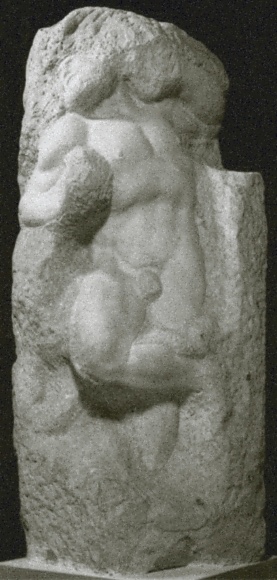
Michelangelo — Awakening Slave
August 4, 2026 at 6:43 AM
Model: claude-sonnet-5
These 58 principles are perceptual mechanisms that influence what gets noticed, how forms organize, and how space is inferred - all before conscious interpretation. They do not determine meaning.
OVERVIEW
The perceptual and material domains agree with each other almost completely. What the eye does in the first seconds matches what the stone is actually doing: a struggle between resolved form and raw mass. The cultural and conceptual domains have to work harder, because they depend on knowing this is Michelangelo, this is 1520s Florence, this is a tomb project abandoned mid-carving. Strip the caption and the image alone gives you a body fighting its way out of rock. Add the caption and it becomes a specific argument about unfinished work as intentional statement. That's the central seam in this piece: the perceptual record is agnostic about gender, agnostic about intent, agnostic about meaning. The cultural and conceptual readings are not. They import certainty the image doesn't supply on its own.
There's a second live tension inside the formal record itself. Three independent observation passes disagree on the anatomy: one reads it as male and muscular, one reads it as female with breasts and hip, one reads it as gender-neutral torso and limb. That's not a minor detail. It means the "unfinished" reading of the work, which depends on believing we're watching a specific body emerge, is standing on ambiguous ground. The stone does not resolve into one legible body. That ambiguity might be the most historically accurate observation in the whole set, because Michelangelo's Slaves are notoriously hard to gender at this stage of carving.
Material handling stabilizes the perceptual read (texture contrast, edge quality, and light direction all agree with each other) but destabilizes the cultural/conceptual claim that the piece is "about" incompletion as a finished statement, because incompletion here is also just the archival fact of an abandoned commission. The tension the work sits inside: is the unresolved head and torn anatomy a rhetorical device Michelangelo controls, or is it simply where the chisel stopped.
PERCEPTUAL
The eye lands first on the torso. It's the brightest, smoothest, most continuous surface in the frame, and it sits against a black field with almost no competing incident. That black background does the sorting work before anything else registers: figure-ground relationships are total and immediate, no gradient, no competing texture in the field itself. Once the eye is on the torso, it follows the crossing arm, because occlusion and overlap give it a clear direction: the limb passes in front of the chest and creates a shallow forward layer, a first "near" surface to rest on before anything else asks for attention.
From there the eye tries to climb toward the head and fails. Contour quality breaks down exactly where a viewer expects a face. The stone goes granular, the edges stop being edges, and pattern completion/closure kicks in without anything to complete: there's a moment where the eye searches for eyes, for a jaw, for a hairline, and finds only tangled, undifferentiated mass. That failure is the most active part of the looking experience. The eye doesn't drift past the head calmly. It hunts there and gets nothing back.
Light source logic reinforces the vertical hierarchy. Upper-left light catches the shoulder and chest at their most projecting points and drops into shadow at the hip and base, so visual weight sits high and center, exactly where the resolved carving is, and drains toward the bottom, exactly where the block goes raw. The right-side vertical plane, still flat and unworked, reads as a kind of visual wall: the eye touches it, gets no information, and bounces back to the modeled forms left of it. Detail density gradient does the final sorting: resolved center, coarse periphery, and the eye simply spends more time where there's more to resolve. Nothing in the frame competes for attention through color, because there is none. Contrast and edge quality are doing all the pop-out work here.
MATERIAL AND FORMAL
This is marble, worked with point chisel, claw chisel, and rasp at different stages, and the surface tells you exactly which tool touched which zone. Where the torso is smooth and worn-looking, the stone has been carried close to final polish. Where the surface goes pitted and granular, tool marks are still raw, still legible as chisel bite rather than finished skin. That contrast is not decorative. It's a direct record of sequence: Michelangelo worked from the most legible planes inward, and stopped before the excavation reached the head, the base, and the right vertical face of the block.
The right-side plane staying flat and unworked is a material fact before it's a symbolic one. It shows the original quarried face of the block, the surface the sculptor started with before any subtraction began. Keeping that face visible means the final object carries its own beginning inside it. You can see the block Michelangelo received sitting right next to the body he pulled from it.
Up close, this surface asks for tactile reading: the difference between polished flesh and torn stone is a hand thing, a friction thing, not just an optical one. At a distance, the black field flattens all of that into a single silhouette, and the figure-ground separation takes over as the dominant fact. The two viewing distances give two different objects: one a body, one a mass with a body caught in it. The material doesn't resolve that tension. It preserves it, because the carving stopped before resolution was physically possible.
CULTURAL
One reading: this object belongs to the archive of Michelangelo's non finito, the body of unfinished work tied to the Julius II tomb project, and it sits inside a specific institutional home, the Accademia in Florence, that stages it deliberately alongside the David as evidence of "process" as an aesthetic category. That framing didn't exist in the sixteenth century. It's a later critical position, largely a nineteenth and twentieth-century one, that reads incompletion as expressive rather than accidental. If this reading holds, the work speaks to a modern audience trained by Rodin, by minimalism, by the value placed on visible process, more than to Michelangelo's own contemporaries, who mostly saw incomplete work as failure or interruption, not as statement.
A second possible reading: the ambiguity in the anatomy itself (three independent viewings disagreeing on male versus female) tells us this image, absent its title and provenance, doesn't carry unambiguous cultural signals on its own. Recognition depends entirely on knowing the name attached to it. Strip the label and the piece could belong to almost any culture that carves partial bodies from stone. The Accademia's installation, the guidebooks, the reproductions in every survey of Western sculpture: all of that supplies the legibility the image itself doesn't fully deliver. That's not a failure of the object. It's a demonstration of how much cultural weight rides on attribution rather than on visible form.
CONCEPTUAL
The strongest argument this work supports, if we accept the non finito reading as a possible position rather than settled fact, is that the struggle between figure and stone stands in for the struggle between soul and matter, a Neoplatonic idea current in Michelangelo's Florence: form pre-exists inside the material and the artist's task is subtraction, not creation. The block's raw right edge, the unresolved head, and the smooth emergent torso are the visual argument for that idea, if the argument is being made at all. Hypothesis (insufficient visual evidence): that Michelangelo intended the incompleteness as a completed statement about matter and spirit. The formal record alone can't confirm intent. What it can confirm is the mechanism: a gradient from raw to resolved, organized so the eye reads emergence rather than damage.
The competing precedent is simpler and more mundane: unfinished commissions were common, tombs were abandoned, patrons died, contracts lapsed. Read this way, the work isn't arguing anything. It's a fragment of interrupted labor that later viewers re-narrated into philosophy. Both readings can be true at once and the object doesn't adjudicate between them. Its conceptual power, if it has any, sits exactly in that unresolved space: whether the unfinished body is a rhetorical device about the difficulty of embodiment, or a record of a job that stopped.
NOISE: CONSOLIDATED
PERCEPTUAL: The head, the single area a viewer most wants resolved, gives back the least information. Pattern completion actively fails there, and that failure competes with the otherwise strong, coherent read on the torso and limb. The eye gets pulled two directions: toward the smooth clarity of the chest and away from the fog at the top.
MATERIAL: The unworked right-side plane fights the illusion of a body escaping stone by keeping a large flat quarry face fully visible and undisguised. It's evidence of process, but it also interrupts the sculptural body it sits next to, working against continuity of form.
CULTURAL: Institutional framing at the Accademia asks viewers to read incompletion as intentional aesthetic argument. Without that framing, and without the attribution to Michelangelo, the object gives no strong signal of a "finished" cultural position. Legibility depends almost entirely on label and provenance, not on the stone.
CONCEPTUAL: The Neoplatonic reading of matter releasing spirit competes directly with the plainer historical fact of an abandoned commission. The work can't tell you which is true, and asserting the philosophical reading as settled fact goes past what the formal evidence supports.
Most of this noise is not intentional in any single domain: the raw right edge and unresolved head are functions of an interrupted process, not authored ambiguity, but later cultural and conceptual frameworks have converted that accident into a deliberate-seeming argument, and the real unresolved question is whether the block stopped speaking here or whether Michelangelo stopped it here on purpose.
WAYS OF LOOKING
Three separate viewings of this same photograph disagreed on whether the figure is male or female. Rather than pick a winner, the analysis treated that disagreement as data: it means the anatomy itself doesn't resolve into a single legible body, which turns out to be historically accurate for this stage of Michelangelo's carving. The habit here is to notice when independent readers can't agree, and to ask what that disagreement is telling you, instead of rushing to settle it. Contradiction is often the most honest thing in the record.
The analysis also kept separating what the eye does from what the caption tells you: strip the attribution to Michelangelo and the object gives you a body emerging from rock; add it back and it becomes an argument about incompletion as intention. Neither version is fake. But they're different claims, resting on different evidence, and the strength of the piece comes from never letting the second one borrow the certainty of the first. Ask, of any claim you're making: is this what I see, or is this what I know?
Notice, too, how a hypothesis gets flagged rather than smuggled in: "insufficient visual evidence" sits right next to the Neoplatonic reading of matter releasing spirit. That's a discipline worth stealing for any object with a big, tempting philosophical story attached. State the story, then state plainly whether the physical evidence actually supports it or just tolerates it.
WHAT THIS WORK MAKES VISIBLE
The right side of this block stays flat, unworked, still showing the original quarried face. That's rare to catch this cleanly: most finished sculpture erases its own starting point, but here the beginning and the result sit side by side in one object. Look for this in any work that shows its own process, a pentimento in a painting, an under-drawing left visible, a cast with mold lines intact. The material is telling you its own history if you let it.
The head is the one place a viewer most wants an answer, and it's exactly where the stone gives the least. Your eye searches for a face and finds tangled, granular mass instead. That failure is worth noticing in any image with a void where information should be: the missing part often gets more attention than the resolved parts around it, precisely because the mind keeps trying to finish it.
And the black background does something you can test on any figure-ground image: cover the torso, and the black field alone can't tell you where the body starts. Separation isn't a property of the object by itself. It's built jointly, by dark against light, and it collapses the moment you change viewing distance.
Looking vs. Knowing
These are the analysis's own words, nothing added.
What the Work Shows Us
These are the claims that hold up when you look: each one is rooted in something the image actually puts in front of you, not from what we already knew—or thought we knew—about it.
Readings That Came From Outside
Not wrong, necessarily—but these readings didn't come from looking: they came from biography, cultural context, critical tradition, to complete what the image left open.
Writing guardrail
The house style rules this writing was asked to follow, and where it didn't. Flagged after the fact. Nothing was rewritten.
Pass 2
- Used a banned construction: that's not X, it's Y (bare)
Alternative Interpretation
Pulled directly from this analysis's own language — nothing added.
The analysis reads the sculpture through non finito: the unresolved head, raw right edge, and smooth emergent torso as a deliberate Neoplatonic argument about spirit fighting free of matter. It holds an equally weighted competing reading against this: the incompletion is simply the archival fact of an abandoned tomb commission, a job interrupted by a lapsed contract, later re-narrated by nineteenth and twentieth-century viewers trained by Rodin and minimalism to see process as meaning. The analysis explicitly declines to adjudicate between the two.
Questions Raised
Whether Michelangelo intended the incompleteness as a finished statement is flagged as a hypothesis with "insufficient visual evidence" - the formal record confirms a mechanism (a gradient from raw to resolved) but can't confirm intent behind it.
The three independent perceptual passes disagree on whether the anatomy is male, female, or gender-neutral, and the analysis never resolves which reading the stone actually supports, only noting that this ambiguity undercuts confidence in what body we're watching emerge.
The analysis raises but leaves open whether the object carries any legible meaning independent of its label and provenance: stripped of the Michelangelo attribution and Accademia installation, does the stone itself signal anything culturally specific, or does all legibility come from external framing rather than visible form?
Pass 1 — blind observation used
The eye lands first on the torso — a partially carved human form emerging from a rough stone block, photographed against pure black. The figure occupies the center-right of the frame, its right side (proper) still fused to unworked matrix while its left side has been brought to a smoother finish.
The contour quality shifts dramatically across the piece: where the torso, shoulder, and hip have been worked, the edges resolve into soft, continuous curves — a clear boundary between flesh and air. Where the stone remains raw, the boundary dissolves entirely; the material breaks into jagged, granular edges that merge with the surrounding shadow, an instance of Figure-Ground Relationships where the sculpture doesn't fully separate from its own base material.
Value structure carries most of the information here, since there's no color to work with — this is grayscale, likely a photograph of white/cream stone. The lightest values sit on the raised planes of the chest, shoulder, and thigh, catching whatever light source is above and slightly to the left. The darkest values pool in the deep undercuts — beneath the arm, in the crease of the hip, and in the black void of the background, which reads as total absence rather than depth.
The detail density gradient is the most telling feature: the head and upper shoulder show tight, textured carving — small hollows and ridges suggesting hair or drapery — while the lower torso is broader, more generalized, with fewer incised marks. The proper right edge of the block retains toolmarks and a raw, chiseled texture, functioning as an anchoring reference point that reminds the eye this is stone, not flesh.
Occlusion is minimal but present — the near arm crosses in front of the torso, establishing a shallow, compressed spatial layering rather than deep recession.
Scale relationships are tight and vertical; the block is tall and narrow, cropping the figure at both top and bottom, denying a full view and reinforcing the sense of a fragment extracted from a larger, unseen whole.
The eye finally settles on the transition zone itself — the ragged seam where finished anatomy gives way to unworked rock, which becomes the most active passage in the piece, holding tension between completion and raw material.