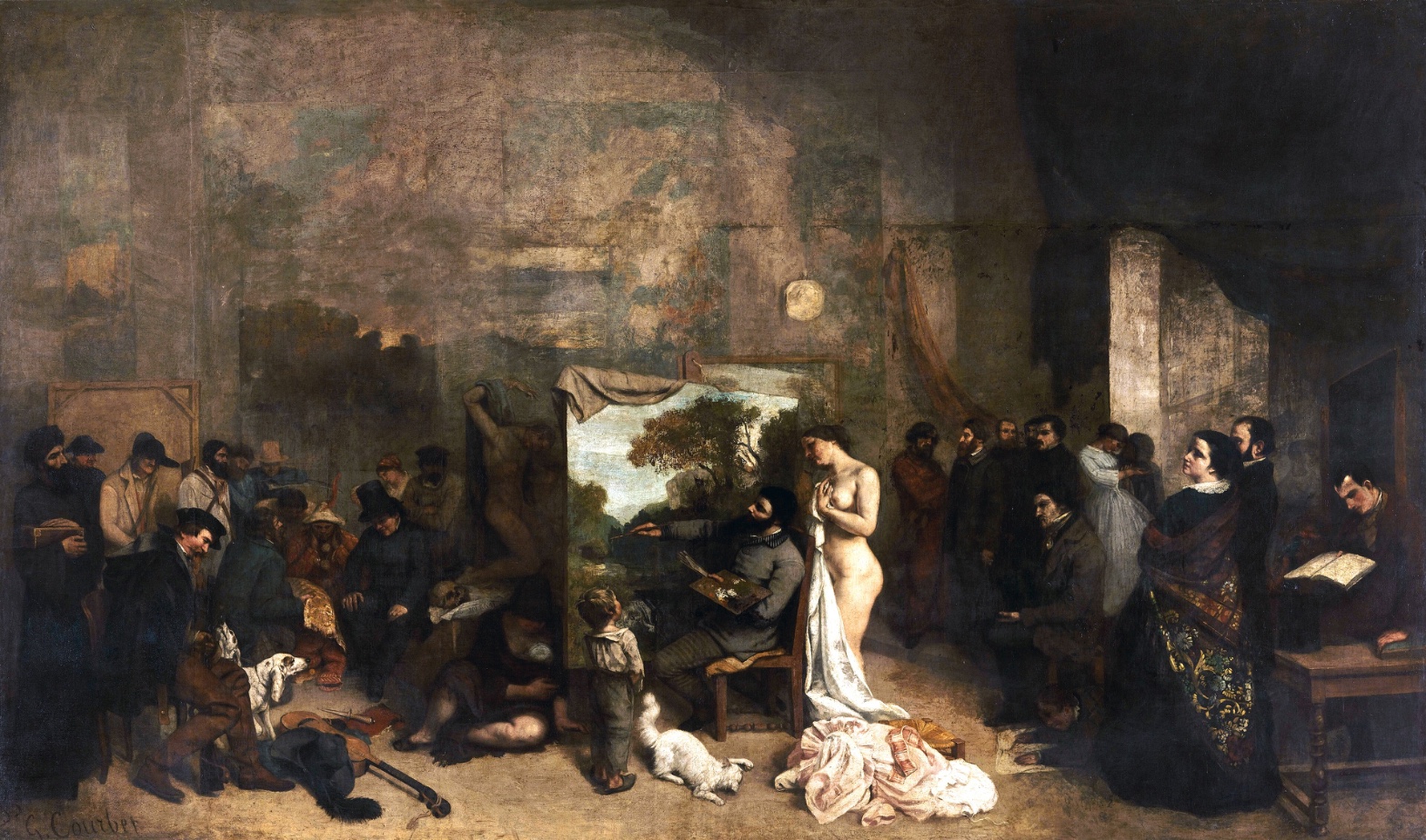
Gustave Courbet — The Painter's Studio
July 17, 2026 at 6:39 AM
Model: claude-sonnet-5
These 58 principles are perceptual mechanisms that influence what gets noticed, how forms organize, and how space is inferred - all before conscious interpretation. They do not determine meaning.
LOOKING PROMPTS
Look at the standing nude woman in the center — where does your eye go first, and how long before it moves anywhere else?
Move your eyes to the left crowd of dark-clothed figures — notice how their outlines blur and melt into one another the closer they get to the edge of the canvas.
Follow the small landscape painting sitting on the easel — notice how its cooler blues and greens sit apart from the warm browns filling the rest of the room.
Start here: Notice how the canvas splits into a sharply-focused bright center and a loosely-brushed dark periphery — once you see that split, watch how it organizes everything else in the room.
THE HOOK
Where do you think the light in this room is coming from? Look again — there's no single window, candle, or lamp doing this work. The brightest object in the entire canvas is the nude woman's body and the white cloth near her, and that light seems to come from nowhere and everywhere at once. Courbet isn't lighting a room. He's lighting an idea, and he wants you to feel the difference between the two even if you can't name it.
THE STORY
Gustave Courbet painted this enormous canvas in 1855, and when the official Paris Exposition Universelle rejected it, he did something almost unheard of: he built his own pavilion nearby, called it the "Pavilion of Realism," and charged visitors an entrance fee to see this painting and others on his own terms (verify before using specific dates/fee amount). He subtitled the work "A real allegory summing up seven years of my artistic and moral life" — a phrase that has puzzled viewers ever since, because it promises both documentary truth and symbolic meaning in the same breath. The painting gathers Courbet's real friends, patrons, and critics on the right, and figures representing the anonymous poor, clergy, and political types on the left, with the artist himself at the easel between them, painting a landscape while a nude model and a watching child stand beside him. This was a direct challenge to the academic hierarchy of the day, which prized historical and mythological subjects over an artist's own studio and social world; Courbet insisted his own life, and unglamorous contemporary reality, deserved the grand scale usually reserved for gods and kings. Today the painting sits at the Musée d'Orsay as a landmark of the Realist movement, though art historians still debate exactly who many of the crowd figures represent and what the "allegory" fully means.
THE LIVE QUESTION
Some people read the crowd on the left as a critique — the anonymous masses Courbet felt distant from, painted loosely because he didn't care to individualize them. Others read that same blurring as something more sympathetic, a kind of collective presence that the sharp, isolated central figures don't have. Look at how those left-hand figures are painted and decide for yourself: does the blur diminish them, or does it make them feel like a single breathing mass?
WAYS OF LOOKING
Notice that before this analysis said anything about Courbet's biography or the Salon rejection, it made you look at where the paint gets sharp and where it goes soft — the nude crisp, the crowd dissolving. That's a habit worth stealing for any tour stop: start with what the eye actually does, not what the wall label says. Visitors will retain "watch where the focus drops off" long after they forget a date.
Look at how the "hook" question got asked — not "what does this painting mean" but "where is the light coming from, and why can't you find the source?" That's a specific, answerable-feeling question that turns out to have no clean answer. A good stop opens with a question the group can attempt themselves, standing right there, before you supply any history. It gives them something to solve, which is more sticky than something to be told.
Notice, too, that the analysis didn't pretend the three sources agreed on everything — it flagged where they split, on light direction, on whether the composition is symmetrical, on whether that's a dog or a cat by the child's feet. That's a discipline of its own: naming disagreement out loud rather than smoothing it into one tidy reading. On a tour, this becomes permission — you can say "some people see the crowd as pitied, others as dismissed" and let the group argue instead of handing them a verdict.
And notice how the closing question sends people back to the same patch of canvas they already looked at, but asks them to decide something for themselves. A good stop doesn't end with an answer. It ends with a return trip.
WHAT THIS WORK MAKES VISIBLE
Look at the border between the crowd on the left and the empty air behind them — the outlines don't stop, they just stop mattering, blurring into scumbled, dry-brushed haze. Most paintings hide this decision. Here Courbet leaves the seam visible, so you can watch an artist choose who gets a face and who gets absorbed into atmosphere. Look for this again in any group scene: crowd paintings, battle paintings, family portraits with servants in the back. Ask who got finished and who got summarized.
Look at the nude's body glowing brighter than anything with an actual candle or window nearby. There's no physical light source doing that work — the brightness is symbolic, not optical. That's rare to catch this cleanly; usually painters hide the trick better. Once you've seen it here, you'll start noticing it in any painting where one figure seems oddly, unnaturally central — check whether the room's actual lighting logic supports that glow, or whether the artist is lighting an idea instead of a room.
Looking vs. Knowing
These are the analysis's own words, nothing added.
What the Work Shows Us
These are the claims that hold up when you look: each one is rooted in something the image actually puts in front of you, not from what we already knew—or thought we knew—about it.
Readings That Came From Outside
Not wrong, necessarily—but these readings didn't come from looking: they came from biography, cultural context, critical tradition, to complete what the image left open.
Writing guardrail
The house style rules this writing was asked to follow, and where it didn't. Flagged after the fact. Nothing was rewritten.
Pass 2
- Used a banned construction: em dash
Pass 3
- Used a banned construction: em dash
Alternative Interpretation
Pulled directly from this analysis's own language — nothing added.
The primary reading treats the loose, blurred brushwork of the left-hand crowd as a mark of Courbet's emotional distance — a critique suggesting he didn't care to individualize the anonymous poor and political types. The competing reading, held in tension rather than resolved, sees that same blurring as sympathetic, producing a collective presence or "single breathing mass" that the sharply rendered central figures lack.
Questions Raised
What does the subtitle "a real allegory summing up seven years of my artistic and moral life" actually mean — the analysis admits this has "puzzled viewers" and offers no settled answer.
Who exactly do the individual crowd figures on the left represent? The analysis states art historians "still debate" this without resolution.
The specific date and entrance fee for Courbet's self-funded "Pavilion of Realism" are flagged explicitly as needing verification before use.
Pass 1 — blind observation used
The eye lands first on the central grouping: a seated painter at his easel, a nude woman standing directly behind his shoulder, and a small boy watching him work. This trio sits in the strongest light in the composition, functioning as an Anchoring and Reference Point around which everything else organizes.
From there, the picture splits into two large gatherings of clothed figures — one crowding the left portion of the canvas, one occupying the right — with the painter's group as the hinge between them. This creates a clear Symmetry/Asymmetry tension: the two crowds roughly balance each other in mass, but the poses, dress, and density within each differ enough that the balance feels weighted rather than mirrored.
Edges behave very differently depending on location. Around the painter, the nude, and the canvas-within-the-canvas, contours are tight and legible — I can trace the line of the woman's spine, the fall of the white drapery pooled at her feet, the painter's collar and sleeve. Moving outward into the crowd, edges loosen; figures on the left merge into shadow, coats and hats blur into one another, faces recede into a brownish murk. This is a clear Detail Density Gradient — resolution is highest at center, degrading as the eye moves to the framing edges of the canvas.
Value Structure/Massing dominates the overall read: the painting is built from large dark masses (the crowd on the left, the deep brown-black wall on the upper right) bracketing a central column of light that runs from the pale canvas-on-easel down through the nude's body to the white cloth on the floor. The darkest passages are undifferentiated black-brown in the upper right corner and lower-left shadow; the lightest is the nude's torso and the sunlit landscape depicted on the easel-canvas.
Color Temperature reinforces this split — the central figures and the painted landscape carry cooler, more silvery tones (grays, pale ochres, a blue-green in the landscape sketch), while the surrounding crowd is rendered in warm, muddied browns, rusts, and blacks. This creates Color Opponent Channels between the cool illuminated core and the warm enveloping dark.
Brushwork is visible as a dry, dragged application over much of the background wall — scumbled, thin, almost scraped in patches, showing the canvas weave beneath. In contrast, the nude figure and the drapery are built with smoother, more blended paint, denser and more opaque. This difference in Texture separates "finished" passages from passages left deliberately rough.
Occlusion/Overlap establishes depth throughout: figures overlap other figures in tight files on both sides, the easel overlaps the painter's legs, the standing nude overlaps the chair back. There is no deep perspectival recession — no strong Linear Perspective orthogonals — space is established almost entirely through this stacking and layering of forms parallel to the picture plane, plus atmospheric dimming toward the corners (a mild Atmospheric Perspective effect even though the setting is an interior).
Scale relationships stay fairly consistent — figures are close to life-size relative to each other, with the boy notably smaller, reinforcing him as a child amid adults through Scale Relationships rather than distortion.
Small pop-out elements interrupt the crowd: a white-and-brown dog at lower left, a discarded guitar and hat on the floor, a skull tucked among seated figures, a violin. These act as Visual Pop-out / Pre-attentive Features — pale or oddly shaped objects against the dark floor and legs, catching the eye briefly before it returns to the lit center.
The eye finally settles, after moving through both crowds, on the dim right-hand background — two seated readers, a curtain, and the deep charcoal-black upper corner — the area of lowest Detail Density and value contrast, where the image dissolves into near-featureless dark.