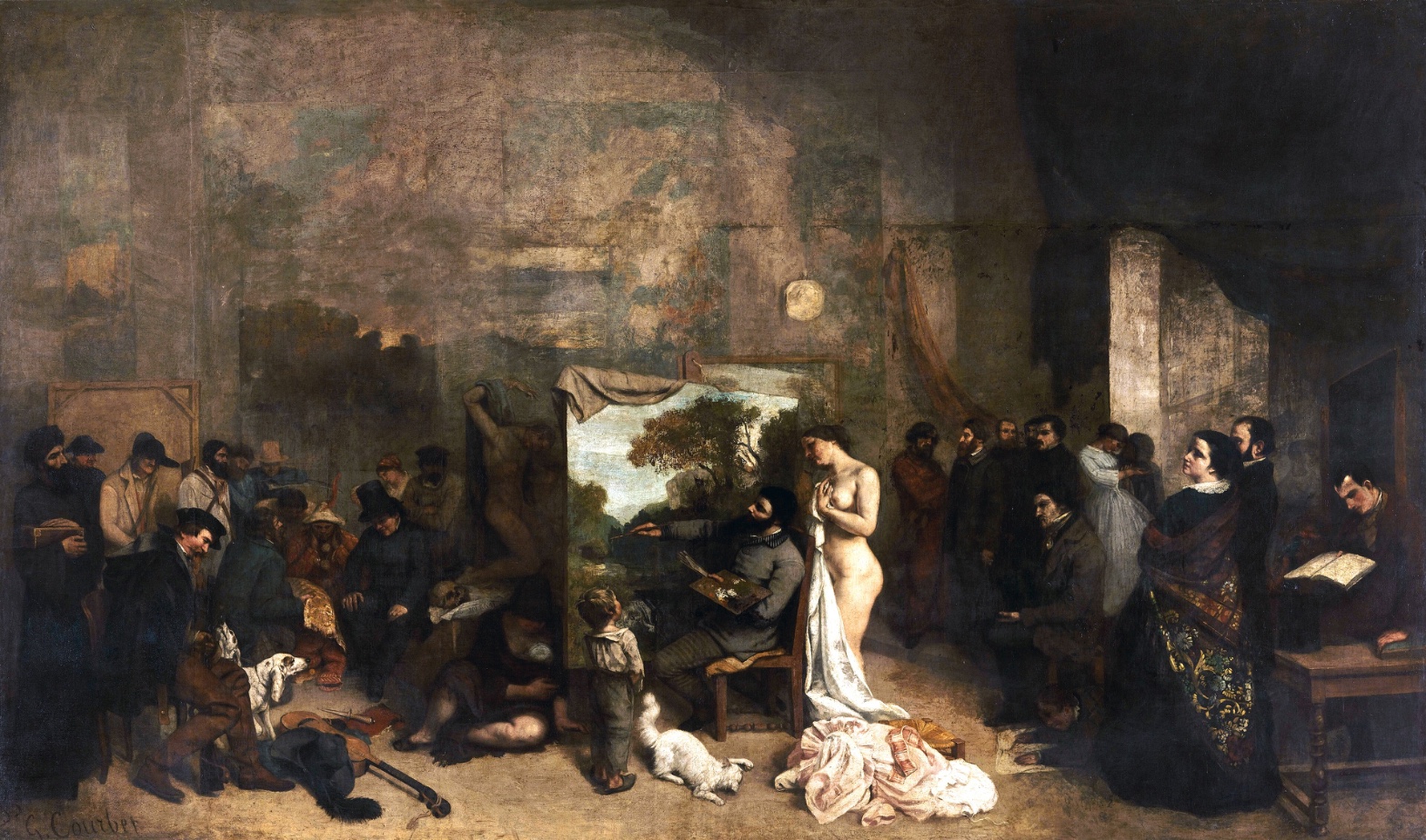
Gustave Courbet — The Painter's Studio
July 14, 2026 at 7:30 PM
Model: claude-sonnet-5
These 58 principles are perceptual mechanisms that influence what gets noticed, how forms organize, and how space is inferred - all before conscious interpretation. They do not determine meaning.
what the eye does
Nineteen and a half feet wide, almost twelve feet tall, and the first thing that actually stops you is how naked the woman in the middle is compared to everything around her. Not just literally — though yes, she's the only unclothed figure in a room full of coats and shawls — but visually naked, lit up white and central while everyone else gets absorbed into a kind of brown murk. Your eye goes to her first every time, then slides down to the painter working calmly at his easel like she isn't even standing there, then over to the small boy watching him work. That's the whole center of the painting, and it's the only part that's actually sharp. Go left and the crowd of onlookers turns into a smear of dark suggestion — faces half-finished, bodies melting into each other, some of them barely distinguishable as bodies at all. Go right and the picture goes quiet and dim, a man bent over a book, a shawl with a burst of gold and red in it that catches you almost against your will. The whole canvas is built so your eye does exactly what a person's eye does in a crowded room: settles on the brightest, clearest thing, then works outward into blur.
how it's made
Courbet worked this in oil on a canvas so big it had to be rolled to move it, and the paint handling shifts depending on what part of the room you're looking at. The nude, the drapery, the central figures — these are built up thick and opaque, brushed with real physical presence, paint sitting on paint. But the wall behind the crowd is scraped thin, almost dry, so you can see the weave of the canvas coming through like fabric under fabric. That's not an accident or an unfinished patch. It's Courbet using the actual materiality of paint to tell you what deserves your attention and what doesn't — density where he wants your eye to land, near-nothing where he doesn't. The space isn't built with converging lines toward a vanishing point; it's built by simply stacking figures in front of each other, layer over layer, the way a real crowded room reads before you've located a horizon at all.
where it lives
You notice, spending time with it, that this painting seems to be arguing with a Salon jury before you even know that's what happened. It was — the Exposition Universelle of 1855 rejected it, and Courbet, instead of accepting that, built his own pavilion nearby and charged admission to see it, alongside forty other works, under a sign reading "Realism, G. Courbet." That single act is one of the founding gestures of the artist showing outside the institution entirely, on his own terms. The painting itself carries the subtitle "a real allegory summing up seven years of my artistic life," which is either a joke or dead serious or both, and Courbet never fully explained who all these people are — critics have spent a century and a half guessing at which figures represent which political and cultural types clustered around him. The painting lives at the Musée d'Orsay now, hung at a scale that makes you understand immediately why no jury wall could have handled it comfortably.
what it's arguing
What the painting seems to want you to sit with is the idea that the artist's real subject isn't the model or the landscape on the easel — it's the entire social world that produces the act of painting at all. The crowd on the left, dissolving into shadow, and the cultured, recognizable friends on the right, more legible, more resolved — that's not a random division. It reads like Courbet sorting the world into the anonymous many and the specific few, with himself and his craft as the only stable, fully-resolved thing in the room. He's not painting a scene so much as staking a claim: this is what my work actually depends on, and here's everyone who orbits it, whether they're in focus or not.
what it holds open
Nobody has ever settled, with full certainty, who every figure in that crowd is supposed to be — the identifications shift depending on which historian you trust, and Courbet himself was cagey about it. That refusal to fully explain the allegory means the painting keeps working as a kind of riddle rather than a message delivered once and closed. Stand in front of it and you're still doing what its first viewers did: deciding for yourself who gets to be in focus, and why.
WAYS OF LOOKING
Notice how the analysis catches the wall behind the crowd being scraped thin enough to show canvas weave, while the nude and drapery are built up thick and opaque. That's not a passing detail — it's using paint handling itself as evidence, treating brushwork like a witness that testifies to what the artist wanted seen and what he was content to let dissolve. Any time you find yourself asking "where did the artist spend the labor," you're doing this: reading effort as a map of intention.
Notice, too, that three independent observers disagreed about which direction the light was coming from, and the analysis doesn't paper over that — it reports the disagreement as data. That's a habit worth stealing: when the evidence genuinely splits, say so, rather than picking the cleanest story and pretending it was unanimous. A claim earns more trust once you've shown where it wobbles.
Notice the move from "the crowd is blurry, the friends on the right are legible" to "Courbet is sorting the world into the anonymous many and the specific few." That's the hinge from formal observation to argument — you don't get to the political reading until you've first nailed down, precisely, where the paint is sharp and where it isn't. Composition becomes claim only after it's been described.
WHAT THIS WORK MAKES VISIBLE
Look at how your eye actually behaves in front of this canvas: it lands on the white nude first, then travels outward into murk, exactly the way real vision works in a crowded room — sharp center, blurred periphery. Most paintings ask you to infer this gradient. Here, Courbet built it so bluntly — thick paint at the center, scraped-thin paint at the edges — that you can watch the mechanism work in real time. Next time you're in front of any densely peopled scene, ask where the paint gets denser and where it thins out; that gradient is usually doing quiet editorial work.
Notice, too, how depth here comes entirely from stacking figures in front of each other rather than from converging lines toward a vanishing point. Most paintings blend several depth cues at once, which makes them hard to isolate. This one leans on a single strategy so hard you can name it cleanly — good practice for spotting, in subtler works, which trick is actually carrying the illusion of space.
And notice that nobody, a century and a half later, agrees on who half these figures are. That unresolved crowd is a rare, visible instance of a painting refusing closure on purpose — worth watching for in any work that invites you to decode it and then declines to hand you the key.
Writing guardrail
The house style rules this writing was asked to follow, and where it didn't. Flagged after the fact. Nothing was rewritten.
Pass 2
- Used a banned construction: em dash
Pass 3
- Used a banned construction: em dash
Alternative Interpretation
Pulled directly from this analysis's own language — nothing added.
The primary reading treats the painting as Courbet's deliberate social taxonomy — the anonymous crowd on the left and the legible friends on the right sorted intentionally to stage the artist's world around his own stable, resolved craft. The competing reading, which the analysis itself surfaces but doesn't resolve, is that the subtitle "a real allegory" may be "a joke or dead serious or both," meaning the entire sorting logic could be a sincere social statement or an ironic gesture Courbet never intended to be decoded literally.
Questions Raised
Who are the specific figures in the crowd meant to represent — the analysis admits critics have guessed for a century and a half without consensus, and Courbet himself never explained it.
Is the subtitle "a real allegory summing up seven years of my artistic life" a genuine key to the painting's meaning or a deflective joke — the analysis flags this ambiguity without settling it.
Was the sharp/blurred, right/left division a calculated statement about anonymity versus specificity, or simply how Courbet's eye and hand naturally worked across such a large canvas — the analysis asserts intent ("that's not a random division") but doesn't fully rule out the alternative that it reflects working process rather than symbolic design.
Pass 1 — blind observation used
The eye lands first on the central grouping: a seated painter at his easel, a nude woman standing directly behind his shoulder, and a small boy watching him work. This trio sits in the strongest light in the composition, functioning as an Anchoring and Reference Point around which everything else organizes.
From there, the picture splits into two large gatherings of clothed figures — one crowding the left portion of the canvas, one occupying the right — with the painter's group as the hinge between them. This creates a clear Symmetry/Asymmetry tension: the two crowds roughly balance each other in mass, but the poses, dress, and density within each differ enough that the balance feels weighted rather than mirrored.
Edges behave very differently depending on location. Around the painter, the nude, and the canvas-within-the-canvas, contours are tight and legible — I can trace the line of the woman's spine, the fall of the white drapery pooled at her feet, the painter's collar and sleeve. Moving outward into the crowd, edges loosen; figures on the left merge into shadow, coats and hats blur into one another, faces recede into a brownish murk. This is a clear Detail Density Gradient — resolution is highest at center, degrading as the eye moves to the framing edges of the canvas.
Value Structure/Massing dominates the overall read: the painting is built from large dark masses (the crowd on the left, the deep brown-black wall on the upper right) bracketing a central column of light that runs from the pale canvas-on-easel down through the nude's body to the white cloth on the floor. The darkest passages are undifferentiated black-brown in the upper right corner and lower-left shadow; the lightest is the nude's torso and the sunlit landscape depicted on the easel-canvas.
Color Temperature reinforces this split — the central figures and the painted landscape carry cooler, more silvery tones (grays, pale ochres, a blue-green in the landscape sketch), while the surrounding crowd is rendered in warm, muddied browns, rusts, and blacks. This creates Color Opponent Channels between the cool illuminated core and the warm enveloping dark.
Brushwork is visible as a dry, dragged application over much of the background wall — scumbled, thin, almost scraped in patches, showing the canvas weave beneath. In contrast, the nude figure and the drapery are built with smoother, more blended paint, denser and more opaque. This difference in Texture separates "finished" passages from passages left deliberately rough.
Occlusion/Overlap establishes depth throughout: figures overlap other figures in tight files on both sides, the easel overlaps the painter's legs, the standing nude overlaps the chair back. There is no deep perspectival recession — no strong Linear Perspective orthogonals — space is established almost entirely through this stacking and layering of forms parallel to the picture plane, plus atmospheric dimming toward the corners (a mild Atmospheric Perspective effect even though the setting is an interior).
Scale relationships stay fairly consistent — figures are close to life-size relative to each other, with the boy notably smaller, reinforcing him as a child amid adults through Scale Relationships rather than distortion.
Small pop-out elements interrupt the crowd: a white-and-brown dog at lower left, a discarded guitar and hat on the floor, a skull tucked among seated figures, a violin. These act as Visual Pop-out / Pre-attentive Features — pale or oddly shaped objects against the dark floor and legs, catching the eye briefly before it returns to the lit center.
The eye finally settles, after moving through both crowds, on the dim right-hand background — two seated readers, a curtain, and the deep charcoal-black upper corner — the area of lowest Detail Density and value contrast, where the image dissolves into near-featureless dark.