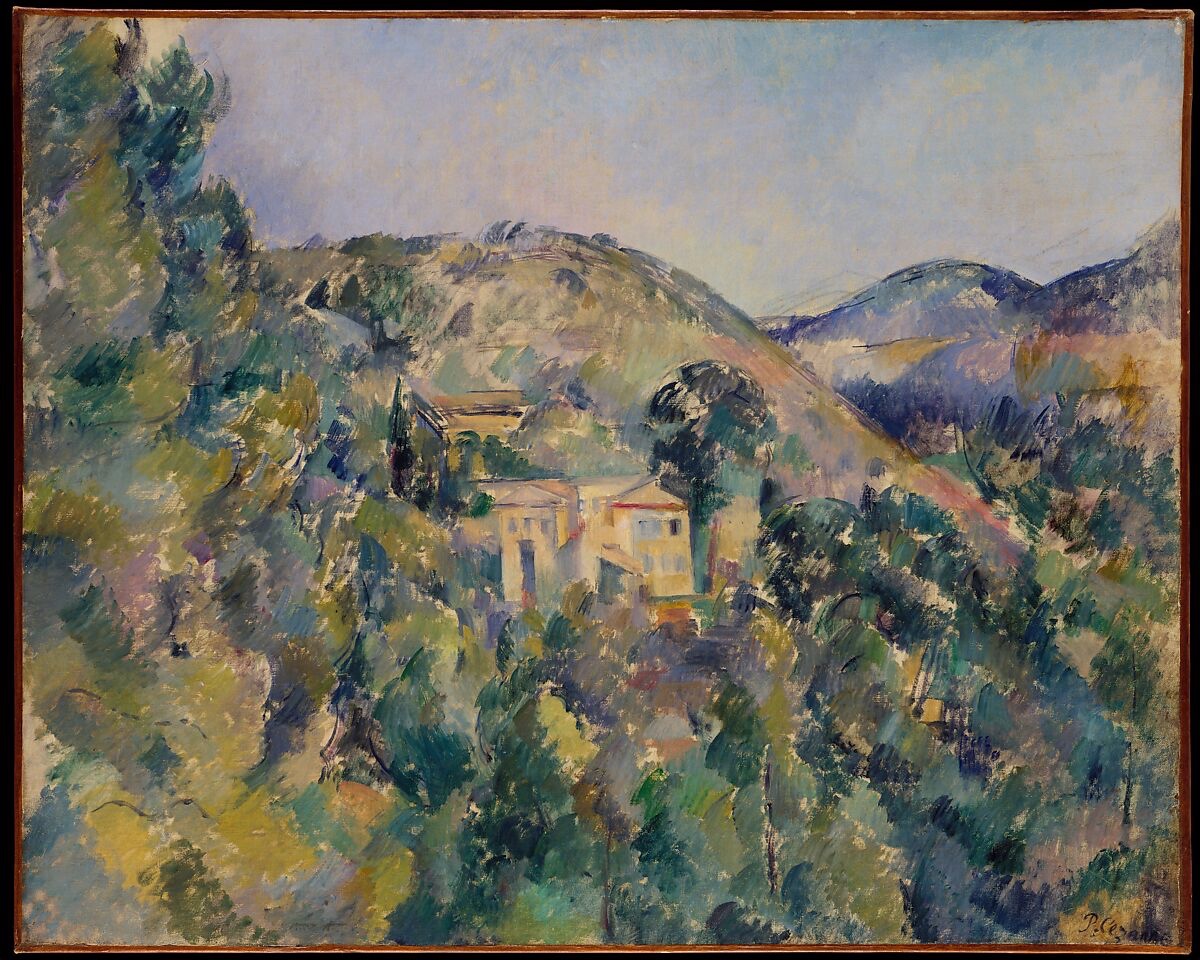
Paul Cézanne — View of the Domaine Saint-Joseph
July 17, 2026 at 7:42 AM
Model: claude-sonnet-5
These 58 principles are perceptual mechanisms that influence what gets noticed, how forms organize, and how space is inferred - all before conscious interpretation. They do not determine meaning.
LOOKING PROMPTS
Look at the cluster of pale buildings just left of center — notice how the edges of the rooftops and walls stay relatively firm and straight compared to everything around them.
Now look at the mass of trees and bushes on the left side and in the foreground — follow the individual brushstrokes and notice their direction, length, and how they sit next to each other without blending.
Follow the hillside as it moves toward the right edge of the canvas — watch how the color shifts from warm tones near the buildings to cooler, hazier blue-violet in the distance.
Start here: Notice that the straightest lines in the whole painting belong to the buildings — everything else, the trees, the hills, the sky, is made of broken, unresolved patches of color.
THE HOOK
Where does your eye land first, and how long does it take to find something in this painting that's actually finished? Look closely: almost nothing here has a continuous edge. The buildings look solid only because your eye fills in gaps between disconnected strokes of paint — Cézanne never actually draws a complete rooftop or wall. The illusion of a solid structure is built entirely out of your own visual habit of connecting dots that aren't fully connected.
THE STORY
Paul Cézanne painted this view in the late 1880s, working near his family home in Aix-en-Provence, in the countryside he returned to again and again through his life. By this point he had largely withdrawn from the Parisian art world and its exhibitions, painting the same hills, farmhouses, and quarries repeatedly, testing how color and brushstroke alone could build a sense of solid form without relying on traditional outline or smooth modeling. This was a quiet argument against the picture-making conventions of his time — Impressionism had already loosened form in service of light and atmosphere, but Cézanne pushed further, asking whether structure itself could be built out of color relationships rather than drawing. Younger painters, including Matisse and Picasso, would later point to exactly this kind of canvas as the hinge between nineteenth-century painting and the modern one that followed. Cézanne himself had little interest in defending the work publicly; he painted for his own investigation, not for an audience. Today this canvas is read less as a finished statement and more as a working proof — evidence of an idea still being tested, which is part of why it still feels unresolved on the wall.
THE LIVE QUESTION
Some viewers see this as an unfinished or hesitant painting — a study that never quite settled. Others see the roughness itself as the point, proof that solid form doesn't need a clean edge to feel solid. Stand with it a moment: does this look incomplete to you, or does it look exactly as finished as it needs to be?
WAYS OF LOOKING
Notice how the analysis doesn't just say "the buildings are the focal point" — it says the building edges are the firmest edges in the painting, "though still broken/discontinuous." That's a comparison, not a description. When you're building a stop, don't just point at what matters — measure it against everything around it. A rooftop is only sharp because the trees next to it are softer. Tell your group both halves.
Look at how the write-up handles disagreement: three different readings (Anthropic, Gemini, OpenAI) argued over where the eye lands first, and instead of picking a winner, the analysis kept the conflict visible — "no consistent convergence." That's useful. When you're not sure whether people's eyes go to the buildings first or wander the foliage first, say so out loud to your group. "Some of you probably went straight to the house. Others started in the trees." You're not failing to give an answer — you're giving them permission to look their own way, which keeps them looking longer.
Notice the move from formal observation to historical claim: "the straightest lines in the whole painting belong to the buildings" becomes, later, a whole biography of Cézanne quietly rejecting outline as a way of building form. That's the real skill of a tour stop — you start with something anyone can verify with their eyes in ten seconds, and only then do you attach the six-million-dollar historical idea to it. If you lead with the history, people nod without seeing anything. If you lead with the brushstroke, the history lands as a discovery they made themselves.
WHAT THIS WORK MAKES VISIBLE
Look at the building cluster again. Almost none of its edges are actually continuous — Cézanne never draws a complete rooftop. Your eye finishes the shape for him. This painting makes visible something called closure — the mind's habit of connecting broken information into a whole — more clearly than a tightly rendered painting ever could, because here the gaps are big enough to catch yourself doing it.
Look at the right-side hillside, where warm ochre near the buildings cools into blue-violet toward the ridge. That's atmospheric perspective — the old trick that distance reads as coolness and haze — but because Cézanne uses distinct, separated strokes instead of a smooth gradient, you can watch the temperature change stroke by stroke, almost like a chart. In a smoother painting this shift disappears into the illusion. Here the machinery is left exposed. Next time you're in front of a landscape, look for exactly this: where does warm turn to cool, and can you catch the seam?
Looking vs. Knowing
These are the analysis's own words, nothing added.
What the Work Shows Us
These are the claims that hold up when you look: each one is rooted in something the image actually puts in front of you, not from what we already knew—or thought we knew—about it.
Readings That Came From Outside
Not wrong, necessarily—but these readings didn't come from looking: they came from biography, cultural context, critical tradition, to complete what the image left open.
Writing guardrail
The house style rules this writing was asked to follow, and where it didn't. Flagged after the fact. Nothing was rewritten.
Pass 2
- Used a banned construction: em dash
Pass 3
- Used a banned construction: em dash
Alternative Interpretation
Pulled directly from this analysis's own language — nothing added.
The primary reading treats the painting's roughness as deliberate — evidence that Cézanne could build solid form purely through color relationships rather than outline, making the unresolved brushwork the whole point. The competing reading, which the analysis explicitly leaves open in "The Live Question," treats the same roughness as a sign of hesitancy or incompleteness — a study that never fully settled — and the text declines to resolve which of these is correct.
Questions Raised
Is the painting's unfinished quality intentional (a proof-of-concept about form and color) or genuinely a symptom of incompleteness — the analysis flags this as unresolved rather than settling it.
The claim that "your eye fills in gaps between disconnected strokes" is presented as the mechanism of the illusion, but the analysis doesn't establish whether Cézanne consciously engineered this perceptual effect or whether it's a byproduct of his working method.
The analysis asserts later painters (Matisse, Picasso) saw this kind of canvas as a "hinge" to modern painting, but doesn't show evidence from within the work itself for this claim — it's presented as historical reputation rather than something visible in the picture.
Pass 1 — blind observation used
My eye enters through the dense screen of foliage in the left foreground, where dark green and olive strokes mass together before opening onto the pale cluster of buildings at the center. That is where the looking settles first — a low white and cream house with a darker red-toned roof, sitting slightly below center, flanked by taller cypress-like green verticals.
Edge Detection varies considerably across the canvas: the architecture holds relatively firm geometric edges — the corners of the house, the line of the roof, a rectangular window opening — while everything surrounding it, the trees and hillsides, dissolves into broken patches of color with no continuous contour.
Value Structure/Massing organizes the composition into three bands: a dark, densely worked foreground of greens and blue-greens; a middle value zone holding the pale buildings and the ochre-green hillside behind them; and a light, thinly painted sky at top, closest in value to the pale hill on the right.
Atmospheric Perspective is at work in the hills — the nearer green slope is more saturated and textured, while the farther mountain on the right edge goes cooler and bluer, flattening into a hazier violet-grey mass.
Color Temperature shifts support the depth: warm ochre and ivory in the buildings and sunlit hill pull forward, while cool blues and violets recede toward the horizon and sky.
Directional Force/Implied Movement runs diagonally — a band of warm rose-tan color cuts across the hillside from lower right to upper middle, functioning almost like a path or seam, pulling the eye across the slope.
Brushwork is consistent throughout — short, choppy, directional strokes, none blended, laid in patches rather than continuous fields, visible as discrete marks of paint even in the sky.
Cropping/Framing places the true horizon high, with the top fifth given to open sky, while the bulk of the canvas is filled with layered, overlapping vegetation and hill forms.
The eye ultimately settles last on the far blue mountain at the right edge, the coolest, most desaturated element, where the terrain trails off the edge of the canvas.