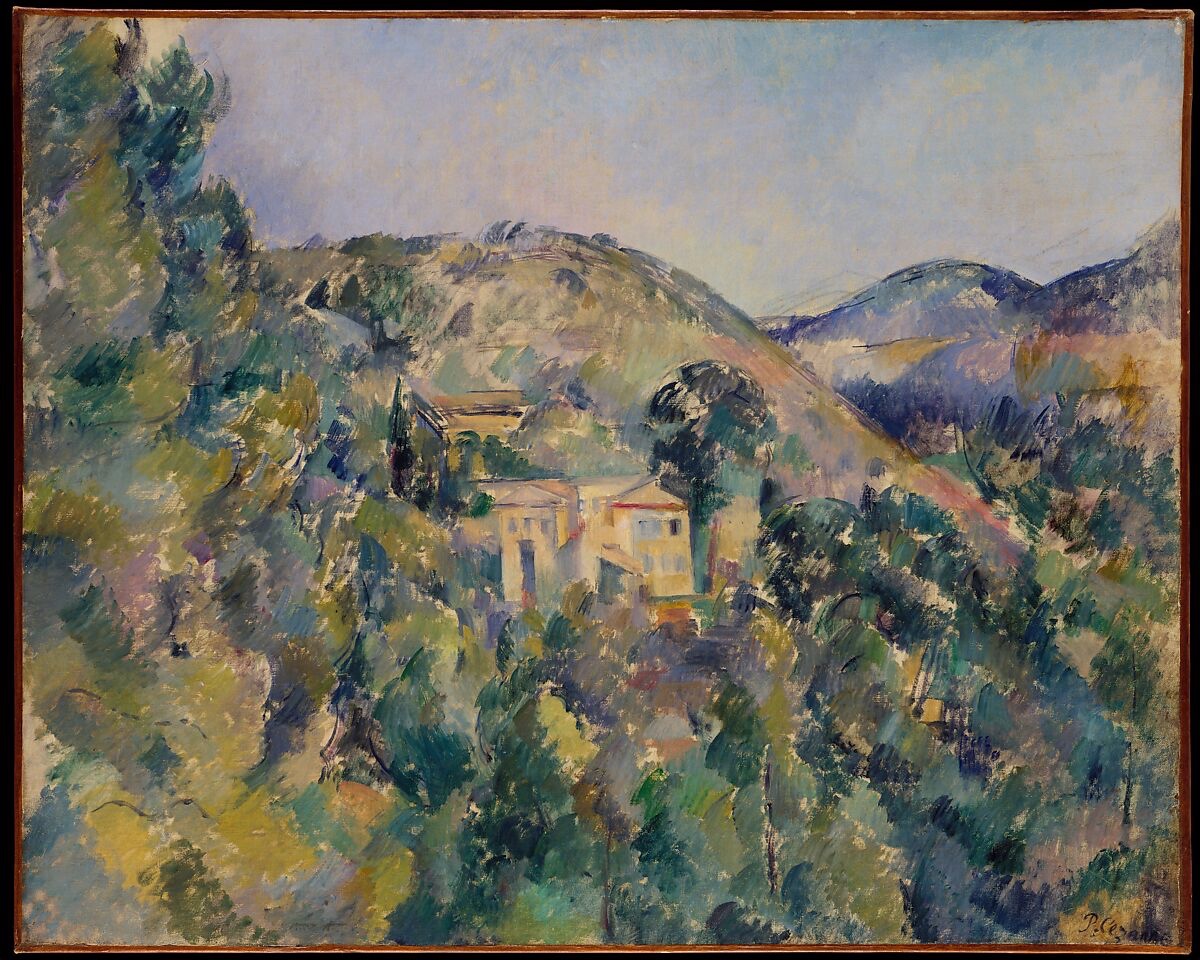
Paul Cézanne — View of the Domaine Saint-Joseph
July 17, 2026 at 7:40 AM
Model: claude-sonnet-5
These 58 principles are perceptual mechanisms that influence what gets noticed, how forms organize, and how space is inferred - all before conscious interpretation. They do not determine meaning.
what the eye does
The first thing that gets you isn't the houses, exactly, though your eye finds them fast — they're the only pale, right-angled shapes in a field of green that refuses to hold still. What actually stops you is how little those buildings are trusted to stay put. A roofline starts, breaks, picks up again a half-inch off from where it should. Cézanne gives you architecture — the most stable, human, geometric thing you could paint — and then won't let the edges finish the job edges are supposed to do. So your eye keeps going back to check. Did that corner really shift? It did. The foliage around it, meanwhile, never pretends to resolve at all — it's patches of short strokes that read as bushes and trees only because your brain is doing the closing-up work the paint refuses to do itself. So the eye moves in a loop: buildings, which almost hold together, out into the trees, which frankly don't, and back again, checking its own work. That's the whole engine of the picture. It's not letting you look once and be done.
how it's made
This is oil on canvas, and the brushwork is the argument. Cézanne isn't blending — there's no smooth transition anywhere, no attempt to erase the stroke and leave only the illusion behind. Each mark sits next to its neighbor, a little patch of ochre next to a patch of green-gray next to a patch of blue-violet, and it's your eye, not his brush, that fuses them into "hillside" or "tree." That's optical mixing, and it's why the surface has a kind of hum to it up close that a photograph of the same scene never would. The buildings get the straightest strokes he allows himself, laid down almost like small flat planes of color rather than modeled forms — which is why they read as solid against the foliage even though, if you isolate any single brushstroke in that cluster, it's just as rough and unfinished as the ones in the trees. The distance goes cooler and flatter — thinner paint, less texture, blue-violet instead of ochre — while the foreground is worked harder, thicker, warmer. That temperature shift is doing the depth work that a vanishing point would do in an older kind of painting. Cézanne's replaced the geometry of depth with the temperature of it.
where it lives
Stand in front of this and you're looking at Cézanne working out, painting by painting through the 1880s around Aix-en-Provence, a problem that had bothered him for years: how do you paint something solid — a house, a hill — without using the smooth illusionism the Renaissance had settled on, and without dissolving into the pure atmospheric flicker that Impressionism, which he'd trained inside of and then pulled away from, had settled on instead. The documented arc of his career at this stage shows him deliberately slowing brushwork down, squaring it off, making it more architectural — the so-called constructive stroke — while never letting go of the broken, patchy surface Impressionism had taught him. This painting sits right at that hinge. It's not trying to please a Salon jury with a tidy view of Provence. It's a private argument with paint, made in a region he returned to obsessively, and it anticipates — this part is well established in how the century that followed read him — the way Cubism would later take his flattened, faceted planes and run further with them. The painting lives at the Met now, but the argument it's having belongs entirely to Aix in the late 1880s.
what it's arguing
The case this painting is making, quietly and stroke by stroke, is that solidity and instability aren't opposites — that a form can be completely believable as a house and still refuse to give you a clean edge to hold onto. Cézanne doesn't think stability has to look stable. He thinks you can build weight and permanence out of small, visibly separate, slightly wrong marks, the way a wall is built out of bricks that don't individually look like a wall. That's a genuinely strange thing to argue with a brush, and it's why the painting still feels alive rather than settled — it hasn't resolved its own argument, and it isn't trying to.
what it holds open
The picture never tells you whether the buildings are the subject or just the excuse — a fixed point for a landscape that's really about how unfixed everything else is. It doesn't resolve whether that instability is a limitation Cézanne was working around or the actual discovery. Next time you stand in front of it, the buildings will hold, and then they won't, and that flicker is the whole point, still available, still unfinished.
WAYS OF LOOKING
Notice how the analysis didn't just say "the buildings are the focal point" and move on — it tracked what your eye does after it lands there, the loop out to the trees and back to check the roofline again. That's a habit worth stealing: describe vision as a sequence, not a destination. Ask not just what a viewer sees first, but where they're sent next, and why the painting won't let them stay put.
Look at how the piece handled the disagreement in its own sources — one reading said the eye enters through foliage first, another said it lands on the buildings immediately. Instead of picking a winner, the analysis used the contradiction itself as evidence: if trained lookers can't agree where the eye starts, that instability is probably built into the painting, not a flaw in the reading. Treat disagreement between viewers as data about the object, not noise to be resolved.
Watch the move from brushstroke to argument: "each mark sits next to its neighbor" becomes, two sentences later, "that's optical mixing." The analysis never stayed at the level of technique-naming — it kept asking what the technique was for. A specific paint-handling fact (unblended strokes) turns into a claim about what the painter believed (solidity doesn't require clean edges). That's the difference between describing a painting and making a case for one.
And notice the last section refuses to close the file. It says plainly that the picture doesn't resolve whether the buildings are the subject or just an anchor. Ending on an open question, instead of a tidy takeaway, is itself a way of respecting the object — some paintings are still arguing with themselves, and the honest reading lets them.
WHAT THIS WORK MAKES VISIBLE
Look at the roofline again — it breaks and resurfaces slightly off-register. In most paintings, that would just be a smudge or an error to look past. Here, because everything else is so clearly built from separate, visible strokes, that discontinuity reads as a decision. This is a good painting for training your eye to catch when "unfinished" is actually deliberate — look for it in any work where edges get less certain the closer you examine them.
Look at the temperature shift from the warm ochre foreground to the cool blue-violet ridge in back. There's no vanishing point doing the depth work — color heat is standing in for geometry. Once you've seen it named here, you'll start catching it everywhere warm-versus-cool substitutes for a horizon line: Impressionist landscapes, certain photographs, even a hazy view from a hillside.
Writing guardrail
The house style rules this writing was asked to follow, and where it didn't. Flagged after the fact. Nothing was rewritten.
Pass 2
- Used a banned construction: em dash
Pass 3
- Used a banned construction: not just X, but Y
- Used a banned construction: em dash
Alternative Interpretation
Pulled directly from this analysis's own language — nothing added.
The analysis primarily reads the picture's instability as a deliberate, generative discovery — proof that Cézanne could build solidity out of "visibly separate, slightly wrong marks." But it also explicitly entertains the competing possibility that this instability was simply "a limitation Cézanne was working around" rather than something he intended as a breakthrough, and it declines to choose between the two.
Questions Raised
Whether the buildings are the true subject of the painting or merely a stable anchor point that lets the surrounding instability register at all — the analysis says this is never resolved.
Whether the broken, unresolved edges represent an intentional argument about form or an unresolved by-product of Cézanne's transition away from Impressionism — flagged but not settled.
The analysis asserts Cubism's later debt to Cézanne's flattened planes as "well established," but doesn't independently verify or examine that claim within the image itself — it's imported as accepted art-historical framing rather than derived from the painting.
Pass 1 — blind observation used
My eye enters through the dense screen of foliage in the left foreground, where dark green and olive strokes mass together before opening onto the pale cluster of buildings at the center. That is where the looking settles first — a low white and cream house with a darker red-toned roof, sitting slightly below center, flanked by taller cypress-like green verticals.
Edge Detection varies considerably across the canvas: the architecture holds relatively firm geometric edges — the corners of the house, the line of the roof, a rectangular window opening — while everything surrounding it, the trees and hillsides, dissolves into broken patches of color with no continuous contour.
Value Structure/Massing organizes the composition into three bands: a dark, densely worked foreground of greens and blue-greens; a middle value zone holding the pale buildings and the ochre-green hillside behind them; and a light, thinly painted sky at top, closest in value to the pale hill on the right.
Atmospheric Perspective is at work in the hills — the nearer green slope is more saturated and textured, while the farther mountain on the right edge goes cooler and bluer, flattening into a hazier violet-grey mass.
Color Temperature shifts support the depth: warm ochre and ivory in the buildings and sunlit hill pull forward, while cool blues and violets recede toward the horizon and sky.
Directional Force/Implied Movement runs diagonally — a band of warm rose-tan color cuts across the hillside from lower right to upper middle, functioning almost like a path or seam, pulling the eye across the slope.
Brushwork is consistent throughout — short, choppy, directional strokes, none blended, laid in patches rather than continuous fields, visible as discrete marks of paint even in the sky.
Cropping/Framing places the true horizon high, with the top fifth given to open sky, while the bulk of the canvas is filled with layered, overlapping vegetation and hill forms.
The eye ultimately settles last on the far blue mountain at the right edge, the coolest, most desaturated element, where the terrain trails off the edge of the canvas.